the DON JONES
INDEX…
|
||
|
GAINS
POSTED in GREEN LOSSES POSTED in RED
4/17/76… 15,583.63 4/10/26… 15,638.08 6/27/13...
15,000.00 |
||
|
(THE
DOW JONES INDEX: 4/17/26... 48,578.92; 4/10/26...
48,185.80; 6/27/13… 15,000.00) |
||
LESSON for FRIDAY, APRIL 17, 2026 – “ONE for YOU, NINETEEN for ME!”
Wednesday,
was Tax Day (2026).
Back in 2025, our
explication of the history of taxation in the Index of a year ago (which we
fully reproduce as ATTACHMENT “A” – albeit with its attachments still up in the
cloud, see URL above, to be visited or not, as choice dictates) ranged from
ancient Egypt through Rome, the Sixteenth Amendment in 1913 and the World Wars
to the Venezuelan War (Iran still over the horizon); covering income,
consumption, property, estate, petroleum, food and corporate levies.
Tariffs, leaping
into the forefront at the Hand of Donald, were “the original pipeline of tax
revenue for the U.S. government,” including the “Tariff of Abominations”
in 1828, which increased tensions between the North and South leading up to the
Civil War, after which industrialization enabled the nativist dream of exports
becoming more common than imports.
Foreigners, predicably proposed... and have since exacted...
retaliation. Over the course of the year, tariffs have become more volatile and
more politicized as... until the demands of the Iranian War cut down on the
tariffing gameplaying... tariff policy tended to reflect the President’s likes
and dislikes across the globe.
And even tho’ tariff policies are supposed to be approved by
Congress, they remain under the sole authority (and whims) of Donald Trump
(howsoever influenced by market movements of the moment).
At least a few of the 2065’s losers have recouped their
plunder this year... Musk’s worth dropped by $130B to $302B a year ago, Bezos
was then worth $193B and the Zuck $179B... still more than enough to afford a
Saturday night splurge at the Olive Garden.
Stumbling further back into the past to the first year of
Goneaway Ol’ Joe’s first and only term, Biden gave a Rose (not
Olive) Garden speech outlining his infrastructure dreams – already compromised,
however, to the extent that the liberal Slate (April 8,
2021, ATTACHMENT “B”) would scoff that “Joe Biden Is Waging
Class Warfare Without the War” (and, as history proved, without the class).
Fresh off
his vanquishment of Trump 1.0 on the right and the Bern and Elizbeth Warren on
the left, and perhaps looking forward to a torrent of taxpayer money rolling
into his purview, the master of malarkey (if not mayhem or, even, mucous)
proposed his plan for
trying to fix everything—and
said he wanted it financed by “tax increases on wealthy individuals and
corporations”, just like the real progressives
hated by MAGA.
What differentiated Biden from
“the Democrats who were considered unelectable radicals for proposing the
things he’s doing”, the Slaterists said, was the way that he talked. “Twelve of the 14 times he’s said Wall
Street, it’s been to suggest that its analysts support his economic vision.
He has mentioned fighting for U.S. companies (“to ensure that
American businesses are positioned to compete and win on the global stage”) but
not against them. At his most hostile, Biden will lament the disproportionate
benefits accrued by “corporations” or the misguided ideas of “my Republican
friends,” (Djonald UnChained Himself excepted) and Slate sliced and diced his
contention that “we (the Bidenistas) don’t have anything against wealthy
people” so long as they pay their “fair share.”
Instead, he MAGAphrased Liz and
Bernie by praising the “backbone of this country”; the hardworking folks,
“middle-class folks, people who built the country” and their defenders among
the unions and Democratic Party.
Those
less-than-middle class folks... fluck em!
After the
woke drama of Barack Hussein Obama and the trauma of Trump, President Joe
“began the game” with a healthy helping of support from pollsters at the Morning Consult
(54-33) and Data for Progress. JPMorgan’s described Biden’s proposals as “manageable,” while Jeff
Bezos said his company was “supportive of a rise in the corporate tax rate,”
because, obviously, the billionaires and millionaires shop the Opulenzas, not
Amazon.
“The long and short of it,” Slate
concluded, was that corporate America did not view the Democratic president’s
transformative tax-and-spend proposals as an existential threat and, on that
long-ago Tax Day... before the wars in Ukraine, let alone Iran, before Covid
and before the vril leaked out of Joe and the Democrats... well, a rosy scenario
could still be imagined.
We presumed then, as now, world and national events might be
“dire” (the wars, inflation, the President, the Pope, the wolves, the
Shutdown... which Congress had pledged to end upon their return from Spring
Break on Tuesday) but, barring American revolutionary or nuclear war,
complications to the imposition and collection of Federal income taxes would
continue to bounce off the IRS like peanuts off an elephant’s backside hide.
Not that there haven’t been changes... and quite possibly
will be more this week... but in the typical yearly exchange of favors for
favors as favor the well-to-do... well... expect the tax collectors to enjoy
business as usual. (Even if, as may be
the case amidst the KakiStasis in Washington, there are fewer revenewers on the
job now, hence, persons of opportunistic mien may observe, and seize,
advantages.)
For example, the military.
Whether a war of choice... as his critics contend... or a war
of necessity to prevent America (and Israel and the uncaring world) from a
nuclear-armed Iran or its proxies in Hamas and Hezbollah, ISIS, al Qaida and
others yet unnamed or identified, President Trump’s Good Friday message to
America (NPR, ATTACHMENT ONE) proposed a crucifixion of domestic programs in
order to bolster the budgets of the military services now engaged in what is
increasingly appearing to be a Holy War against Iran.
Trump
proposed boosting defense spending to $1.5 trillion in his 2027 budget, “the
largest such request in decades, reflecting his emphasis on U.S. military
investments over domestic programs.”
The increase
for the Pentagon, some 44% of which had been “telegraphed” by the Republican
president even before the Iran war began, would also reduce spending on
non-defense programs by 10%.
"President
Trump promised to reinvest in America's national security infrastructure, to
make sure our nation is safe in a dangerous world," wrote Budget Director
Russell Vought.
In this first address to America in April (before the second
on Monday afternoon before the Tuesday deadline on Hormuz), the President, speaking privately to White House insiders on Wednesday, April
Fool’s Day, said: "We're
fighting wars. We can't take care of day care... (i)t’s not possible for us to
take care of day care, Medicaid, Medicare — all these individual things."
He said these
“individual things” (and their attendant costs) should be delegated to the
states. But there were also some
non-defense expenditures that were allowed to seep through the cracks in the
wall of war, including...
§ Department of Homeland Security
funds to continue opening detention facilities, including 100,000 beds for
adults and 30,000 for families.
§ A
13% increase in funding for the Department of Justice to focus on violent
criminals and the president's promise to stop what the White House calls
migrant crime.
§ A
$10 billion fund within the National Park Service for "construction and
beautification" projects in Washington, D.C. including the someday Golden
Ballroom in the ruins of the White House and a somehow Arch d’Trump-umpch
elsewhere in D.C....
§ A
$481 million increase in funding to enhance aviation safety and support an air
traffic controller hiring surge.
Up on the cross would go “green energy, housing and health
programs” like...
§ $15 billion from the Biden-era
bipartisan infrastructure law (above), including funds for renewable energy
projects and cuts to the National Oceanic and Atmospheric Administration, or
NOAA, grants (in the hope that the 2026 hurricane season will be as quiet as
that of 2025)
§ Food,
shelter and warmth would be taken from the poor through a 19% cut in the
Department of Agriculture, ending certain university grants, a 13% cut for the
Department of Housing and Urban Development, and about a 12% decrease to the
Health and Human Services department, including cuts to a low-income heating
assistance program.
§ Cuts
to what the White House called "woke programs" such as Community
Services Block Grants, $106 million in funding from the Agency for Healthcare
Research and Quality, and environmental issues.
THE DEFENDERS
The
Republican chairmen of the House and Senate Armed Services committees applauded
Trump's request for defense spending, saying the money “would ensure the
country's military remains the most advanced in the world while confronting
growing threats from China, Russia, Iran and others.”
"America
is facing the most dangerous global environment since World War II," said
Sen. Roger Wicker, R-Miss., and Rep. Mike Rogers, R-Ala.
NPR (itself
headed for the boneyard) added that the administration “is counting on its
allies in the Republican-led Congress to push part of president's beefed up
defense spending through its own budget process, as it was able to do last
year...” $1.1 trillion for defense coming through the regular appropriations
process, “which typically requires support from both parties” to avoid a
filibuster – plus another $350 billion through a budget reconciliation process
“that Republicans can accomplish on their own, through party-line majority
votes.”
THE
DETRACTORS
Sen. Patty
Murray, the top Democrat on the Senate Appropriations Committee, called Trump's
new budget "morally bankrupt" and noted costs associated with his
beautiful, golden ballroom.
The top
Democrat on the House Budget Committee, Rep. Brendan Boyle of Pennsylvania,
said the president was demanding a massive increase in defense while cutting
billions from health care, housing and more.
"This
budget represents 'America Last,'" Boyle said although POTUS announced he
would sign an executive order to pay all DHS workers who have gone without
paychecks during the record-long partial government shutdown that, as of April
3rd, had reached 49 days.
Nonetheless, Wednesday’s Tax Day brought accusations of a “rigged” system and
even outright fraud from the liberals at Common Dreams. (ATTACHMENT TWO)
Dreamer Stephen Prager charged the richest 0.1% of people on Earth
with “hiding more than $2.8 trillion in offshore accounts to avoid taxes,” here
in the U.S.A. but also in other countries.
“That money alone is more wealth
than is owned by the entire bottom half of humanity, more than 4.1 billion
people,” Prager charged, basing his contention on a report from Oxfam
International, released on the 10th anniversary of the 2016 Panama Papers,
which provided “an unprecedented look at how the world’s most powerful
capitalists, financiers, political leaders, celebrities, and criminals exploited
offshore tax havens to stash their money.”
Oxfam found that a “staggering”
$3.5 trillion, more than 3.2% of the global gross domestic product, still
remains in untaxed accounts. “That’s more than the entire GDP of France and is
more than twice the combined wealth of the world’s 44 poorest nations,” the
Oxscammers contended.
Prior to the recent military
surcharge, the MAGA megabudget had already
handed a trillion dollar tax cut to America’s wealthiest 1%, while slashing
more than $1 trillion in spending from Medicaid, food assistance, and other
safety net programs. “It has been
described by some economists as the largest upward transfer of wealth in US
history.”
According to the Tax Justice
Network’s Corporate Tax Haven Index, Caribbean islands under UK ownership,
including the British Virgin Islands, the Cayman Islands, and Bermuda, are
among the worst offenders. Other notable tax havens include Switzerland,
Singapore, Hong Kong, Ireland, and the Netherlands.
Individuals and corporations identified by NPR as tax cheats
(indictable or not) include Elon Musk’s Tesla and Big Pharma’s AbbVie,
Merck. Oxfam also called for taxes on
“extreme wealth” as have leftists like Sen. Bernie Sanders (D-Vt) in Attachment
Twenty, below.
Left of leftists... outright Communists, in fact (or, at the
least, the sort of quasi-democratic Socialists of Jacobin... ATTACHMENT THREE)
have seized upon one aspect of the income equality divide... a generational
divide diatribe by one Josh Mound.
The lengthy explanation of how “centrists and the Right, who have
long been desperate to cut and privatize Social Security” exploit the politics
of division – usually expressed in the promulgation of racial and cultural hate
to distract the bottom half... or 75 percent... or 99 percent from the prosecution
of a class war as might be expressed by means ranging from the wealth taxes
above and below and applicable to April 15th, to the guillotine,
applicable to the original Jacobins – are also being exploided to exploit the
generation gap.
Mr. Mound contends that “(a) specter is haunting the United
States — the specter of ‘total boomer luxury communism’. Or at least that’s what conservative pundits
want younger generations to think.”
The term Total
Boomer Luxury Communism (or, herafter TBLC) popped up in July, 2025 as a
cynical riff on the utopian left’s vision of a
post-scarcity “fully automated luxury communism” in an essay by Russ Greene in the American Mind,
one of the house organs of the Claremont Institute.
Jacobists like Mound decry the multiplicity of self-styled “Claremonsters” from Claremont (a “quixotic”... tho’
probably anti-windmill... fusion of “Barry Goldwater’s free-market fundamentalism and Leo
Strauss’s conservatism”), who have stocked Team
Trump’s armada, while
megaMAGA nabobs like investment banker Peter G. Peterson,
hedge fund manager Thomas Klingenstein and
similar non-producing, parasitic poobahs prosecute a “cold civil war”
pitting conservatism against “woke communism” and “social justice.”
“The essence of TBLC,” Greene
writes, “is that it redistributes wealth from younger families and workers to
seniors, who are on average much richer.” The result, he argues, is a cohort of
retirees living in a “Marxist paradise of hunting in the morning, fishing in
the afternoon, rearing cattle in the evening, and criticizing the American
President after dinner.”
This “generational injustice,”
Greene claims, is “driving every aspect of American decline — from skyrocketing
national debt and the erosion of the defense industrial base to the despair of
young people.” His remedy is to “radically overhaul America’s entitlement
regime” by cutting Social
Security and Medicare, even if it forces recipients
— whom he calls “welfare
queens” — back into the workforce or compels them
to sell their homes.
Tumbling
back through the history of Social Security to the New Deal, Mound recalls (if
probably through archives) the war on “government-provided old-age
pensions” as would lead to what human, corporate and
foundational entities of opposition called “dependency and indigency” as
would “pull the pillars of the temple down upon the heads of our descendants.”
He also revisits Barry Goldwater who, in
his disastrous 1964 campaign,
made a proto-TBLC case against Medicare, quipping:
“Having given our pensioners their medical care in kind, why not food baskets,
why not public housing accommodations, why not vacation resorts, why not a
ration of cigarettes for those who smoke and of beer for those who drink?”
And, also, Ronald Reagan – who predicted that
if Medicare became law, “you and I are going to spend our sunset years telling
our children, and our children’s children, what it once was like in America
when men were free.”
Less, even unfamous, bankers,
insurance men (women being rather scarce at the time), creepy crawlies out of think
tanks like Heritage, CRC, the neo-Nazi Liberty Lobby,
libertarians out of Reason and Cato and “a seemingly endless series of “deficit
hawk” organizations”
As Republican Senator David
Durenberger, chair of Americans for Generational Equity (AGE), put it, “The more America’s leaders
talk about and think in terms of generational equity, the more effective AGE
will be in its education program, and the better chance we will have of making
the difference on crucial legislative issues.”
And, as AGE’s Phillip Longman
wrote in the New York Times in agest past, “The Baby Boomers as a
whole are far from ‘upwardly mobile’. . . . A declining proportion of
younger Americans own their own homes, and those who do are typically
encumbered by unprecedented mortgage payments.” The problem, according to
Longman, was that “Baby Boomers are paying an unprecedented share of their
income to support the current older generation.”
But after a decade of triumphs
(not including the failure of its preferred Presidential candidates — former
Republican governor Pete du Pont and televangelist Pat Robertson — their
campaign for the privatization of Social Security faltered following
Durenberger’s use of the organization to boost his own reelection campaign.
Power passed into the pocket of
the Democrats’ Leadership Council (DLC) who, likewise, lobbied for both cuts to
and partial privatization of Social Security. The DLC argued that “millions of
retirees, without regard to their need, reap windfalls from Social Security
beyond the interest-adjusted value of their tax contributions into the system”
at the expense of “millions of baby boomers” who “have paid steep payroll taxes
for two decades and are struggling with their parents’ retirement needs even as
they worry about their own.”
As the “Greatest Generation” aged
and died and Boomers prospered... well, some of them... new right-wing
generational warriors like Lead… or Leave (LOL) popped up. By 1992 LOL, now billing itself as “the
largest grassroots college/twentysomething organization in the country” was
publicizing its manifesto “Revolution X” in print and broadcast media but,
again, after its ambitious agenda (including, Jacobin reported, a promised
“Rock the Debt” concert “and 1996 election protests at which Gen Xers would
burn their Social Security cards”) flatlined, more old fogies birthed and
butchered more false flag floozies: Third Millennium (TM); the Democratic false
front Progressive Policy Institute (PPI), and an anti-Social Security “Advisory
Council” fronted by Slick Willie Clinton that also squirmed,
squirted and crashed – courtesy of Monica Lewinsky.
With the war on Social Security
back under the thumb of the Bush family Republicans – whose new vehicles, like
the Committee for a Responsible Federal Budget (CRFB) and spurious Medicare
Advantage chugged and staggered on into Barack Obama’s Simpson-Bowles
commission, featuring tax cuts for the rich and healthcare cuts for the rest.
Jacobin’s Mister Mound’s take on
Obamacare (or the Affordable Care Act: ACA)
is that... at best... it has modestly reduced the growth
of health care costs while driving up the public debt and enriching those least
productive termites of the medical community with Americans bearing “far higher
administrative costs — roughly $925 per person versus $245 in peer nations,”
or, in other words, “well into Nordic territory” (albeit without Nordic-level
coverage).
Mound actually noted that Donald
Trump more or less backed off the war on Boomer relief in his first term (he
still being one). But now, Trump 2.0 –
flush with new cryptocash and supported by “conservative and centrist Democrat
claims of generational inequity to distract from the real issues of economic
inequality,” the Jacobins... rather reasonably, given their own ancestry...
simply state that it’s more important than ever “to ensure that Social Security
and Medicare aren’t cut before (the younger generation) can collect them.
Taxing the rich is the best path forward, but it’s the one that deep-pocketed
interests want most to avoid.”
So, they conclude, “stop focusing
on generational warfare, and start focusing on class warfare.”
There’s much, much more in the
Attachment and Jacobite charts and graphs that can be found here.
Cato, the
libertarian agglomeration of pot smoking, wife swapping real estate speculators
and Wall Street vipers already mentioned above, offered its own take on
equality via the economic and culturally
rightist Washington Examiner on
March 23, 2026 (ATTACHMENT FOUR); this
being, in the words of reporter Chelsea Follett, “a reality check
on the inequality panic.”
Unfortunately, say the Libs and
Xams, critics like Anthropic CEO Dario Amodei, singer Billie Eilish and NYC Mayor
Zorro persist in the perversion of perceived inequality even as the Examiner
and Catocrats insist that not only has global income inequality fallen
over the long run — contrary to the popular narrative — “but inequality has
also declined in education, health, and a host of other areas. The world is now
more equal across a range of factors, from lifespan and childhood survival to
internet access and schooling.”
Happy, happy days!
Over the past few years, “calls
for a worldwide wealth tax, a vast increase in foreign aid spending, and other
unprecedented measures are gaining steam across academia, non-profits, the press,
and international organizations like the United Nations.
In short, the damage to human
well-being was more limited than many feared.
“Alarmist narratives shape public opinion,” Ms. Follett contends, “and
encourage policymakers to pursue sweeping interventions that may do more harm
than good.”
Wealth taxes, she proceeds, have
their own problems, “from high administrative costs and enforcement challenges
to low revenue production and invasion of financial privacy. These problems
help explain why so many of the countries that have implemented wealth taxes in
the past — such as France, Germany, and Sweden— later abolished the tax.
Perhaps the worst of all, by discouraging risk-taking, wealth taxes suppress investment and growth,
effects that would be felt in both rich and poor countries and would likely prove
especially damaging to development in the world’s poorest economies.”
“Surprise!” a chorus growled and chortled as the federal income tax, as we know it,
“was officially born on Feb. 3, 1913, when Congress ratified the 16th Amendment to the U.S.
Constitution after an on-again-off-again effort that
lasted decades. (Investopedia, ATTACHMENT FIVE)
“Benjamin Franklin is credited
with saying that nothing is certain in this world but death and taxes. That was back in 1789 and it still holds true
in the U.S. today,” wrote fiscal historian Vikki Velasquez, describing the
permanent imposition of a federal income tax after former, brief ventures such
as that occasioned by the Civil War, or by the 1894 Wilson Tariff Act (which
the SCOTUS repealed a year later as unconstitutional).
The 1913 variant charged less than
one percent of Americans only one percent of net income. “Numerous tweaks and add-ons” occurred as a
result of World War Two with both the percentage of taxpayers and rates rising
as the war expenses mounted.
Investopedia tracked developments
such as the alternative minimum tax (AMT) created
in 1969 because “it was found that a few hundred high-income individuals were
able to use a combination of exclusions, deductions, and credits to pay little
or no income tax,” according to Annette Nellen, director of the MST Program at
San Jose State University. The Tax
Reform Act of 1986 (TRA) made numerous changes to the tax law, Nellen added,
“including taxing ordinary and capital gains income at the same rate and there
were only two brackets (15% and 28%).”
ATRA, the American Taxpayer Relief Act restored the
top income tax rate to 39.6% in 2012 after it was cut to 35% by President
George W. Bush’s tax cuts in 2001 and 2003, but Trump 1.0’s Tax Cuts and Jobs Act (TCJA)
dropped it back to 38% in 2017.
The Inflation Reduction Act (IRA) came
along in 2022. According to Nellen, “The IRA included numerous new and modified
energy credits for individuals and businesses. It's possible that some of these
credits may be repealed or downsized as part of any extension of expiring
provisions of the TCJA or new tax breaks such as not imposing income tax on
tips or overtime pay of employees.”
While income taxes provide the
largest proportion of the Federal Budget (despite the recent Trump tariff
inceases), Washington also collects interest rate taxes, based on itemized
deductions, gas taxes and the Sin and Excise Taxes on alcohol and tobacco (but
not firearms).
Brookings/Tax
Policy Center analyzed the “ugly history” of tax policy; reporter Howard
Gleckman warning that “(e)xtreme
partisanship makes tax policy more unstable than ever.” (9/26/25. ATTACHMENT SIX)
A SHRINKING TAX BASE
First, think about tax rates and
the tax base. “When I came on the scene,” Mr. Gleckman reported, “the top
marginal individual income tax rate was 70 percent. Today, it is roughly half
that, at 37 percent.”
As a result of these changes,
together with spending increasing as well, the Congressional Budget Office
projects that, over the next decade, the gap between federal revenue and
spending will reach 6 percent of Gross Domestic Product,
or more than $2 trillion annually.
“That simply is unsustainable. Yet
few in Congress appear to show any real interest in doing anything about
it.”
Investopedia noted
that much of the staff expertise that guided the TRA and other policy measures
has moved on... often to more
lucrative lobbying or legal jobs advising private sector clients.
“Thus, bills are increasingly
partisan and, as a result, policy shifts with the political winds, and
taxpayers are unable to plan more than a year or so ahead.”
On top of all this, “the IRS is
scaling back enforcement efforts, and Congress continues to slash the agency’s
budget and staff, making administration of the income tax increasingly
difficult.”
Currently, the White House and
Congressional (narrow) majority is committed to cutting taxes and/or replacing
them with volatile tariffs, but... looking ahead to the 2028 Presidential race
and November midterms, will Trump’s exorbitant, constantly changing,
counterproductive and “probably not sustainable” tariffs risk
damaging the US economy and.
What, then, will replace them?
That, Investopedia’s Velasquez believes, “will be the next big question for tax
policy.”
Perhaps new or higher “consumption taxes”
suggests USA Today’s Daniel De
Visé (April 11th,
ATTACHMENT SEVEN), specifying the proposed FairTax Act of 2025 which proposed a 23% federal sales
tax to replace most federal taxes, and noted the proposal’s history and
criticism that it would primarily benefit wealthy taxpayers.
Congress, so far, has agreed, so
the FTA ’25 has become FTA ’26 and still “has yet to reach a vote in the full
House or Senate.”
The United States does not
currently have a national consumption tax. Other countries, including Japan, which has a
7.8% standard and 6.24% do... with reduced tax rate for items like food, drink
and “some newspapers” (the “some” being perhaps intriguing to the press agents
of politicians who believe that some media are out to get them and, so, should
be warned against oppositioning). More than 175
countries, including all of Europe, impose a Value-Added Tax,
which taxes goods and services at each stage of production.
Consumption taxes as exist in the
United States are on a state-by-state basis with almost each and every state imposing
sales taxes, except for Alaska, Delaware, Montana, New Hampshire, and Oregon,
which instead allows cities to charge a local sales tax. California boasts the
country’s highest state sales tax rate at 7.25%.
“The FairTax Act would eliminate
most current federal taxes in favor of a 23% federal sales tax. Tax experts
have warned the act would mostly benefit the wealthy,
who would see major tax cuts,” concludes Mister de Visé... therefore, any
future of the FTA will depend upon the results of November’s midterm
elections.
In the heat of
tax season, Olivier Knox discussed the latest survey results from the Pew Research Center,
which show 60% of Americans are very bothered by the idea that wealthy
individuals and corporations don’t pay their fair share in taxes. (U.S. News, ATTACHMENT EIGHT)
With
the rising cost of living likely to play a big part in this year’s midterms,
anger over taxes could be a deciding factor.
Accordingly,
cultural
and economic conservatism were married, in the Washington Supreme Court, by
a Seattle millionaire petitioning to allow a referendum effort on the state's
new income tax law.
Let's Go Washington founder Brian
Heywood... long a fighter for parental rights and against transgender
participants in girls' sports... (Oregon Public Broadcasting, 4/5/26,
ATTACHMENT NINE) filed an emergency petition that asks justices to direct
Secretary of State Steve Hobbs to process the referendum paperwork submitted
Monday that would allow Heywood’s group must submit signatures of 154,455 voters by June 10 to qualify for the fall ballot.
“Time is already running out. Not
granting accelerated review of this matter would unfairly render the entire
process moot by significantly limiting the time available,” to collect
signatures, Heywood argued in court documents.
Opponents of the tax would need to
turn in 308,911 signatures by July 2 to
get an initiative on the ballot this year, or by Dec. 31 if they opt for an
initiative to the Legislature.
Meanwhile, the Citizen Action Defense Fund also
plans to sue over the tax, arguing that it’s unconstitutional. Rob McKenna, a
former state attorney general and 2012 Republican candidate for Washington
governor, will lead the litigation.
It had not been filed as of Friday.
Public
opposition to the new tax, a 9.9% levy on incomes over $1
million, gives Heywood hope. (New York
Post, ATTACHMENT TEN) After over 100,000
Washingtonians registered their displeasure during public testimony on the
bill, he said that, “unlike King Bob, we believe that the framers of our
state’s constitution meant it.”
Let’s Go
Washington must gather 200,000 signatures by June to qualify the referendum for
the upcoming election.
Heywood is
confident it can be done.
“Our state
constitution is the law of the land and not a suggestion that the legislature
and the governor can ignore on a whim,” he said.
“Washington’s
constitution is clear, and the courts have been equally clear for nearly a
century — income is property, and progressive income taxes are unconstitutional under
existing law,” countered McKenna.
Some of the Washington State peanuts speaking up in the New
York gallery expressed outrage against the tax.
“Stop punishing people for working
and making money,” exclaimed DD. “Stop the endless flow of freebies to those
who won’t work and feel entitled to the fruit of someone else’s labor.”
And, in view of the runaway
businesses which allegedly include Microsoft, Amazon, Meta and local and
regional firms such as Bulwark Capital Manager, another mature respondent,
answering to Granny513, posted that “...Seattle pro ball teams may have more
trouble recruiting high salaried players with this millionaire tax. They will
have to pay more to offset the almost 10 percent income tax.”
Whereas state taxing policies may be cited as cause for
runaway corporations (or at least their headquarters), liberals say that
Federal tax policies are already causing many businesses to relocate their tax
liabilities by employing overseas cutouts to cut or even wholly avoid American
taxes.
Michael Ettlinger of the Institute on Taxation And Economic
Policy (ITEP) justified state and local resistance to President Trump’s tax and
tariff policy which, he explained, (ATTACHMENT ELEVEN) has enacted “large tax
cuts that primarily benefit the well-off and corporations, dramatically
curtailed IRS enforcement, and issued legally problematic regulations.”
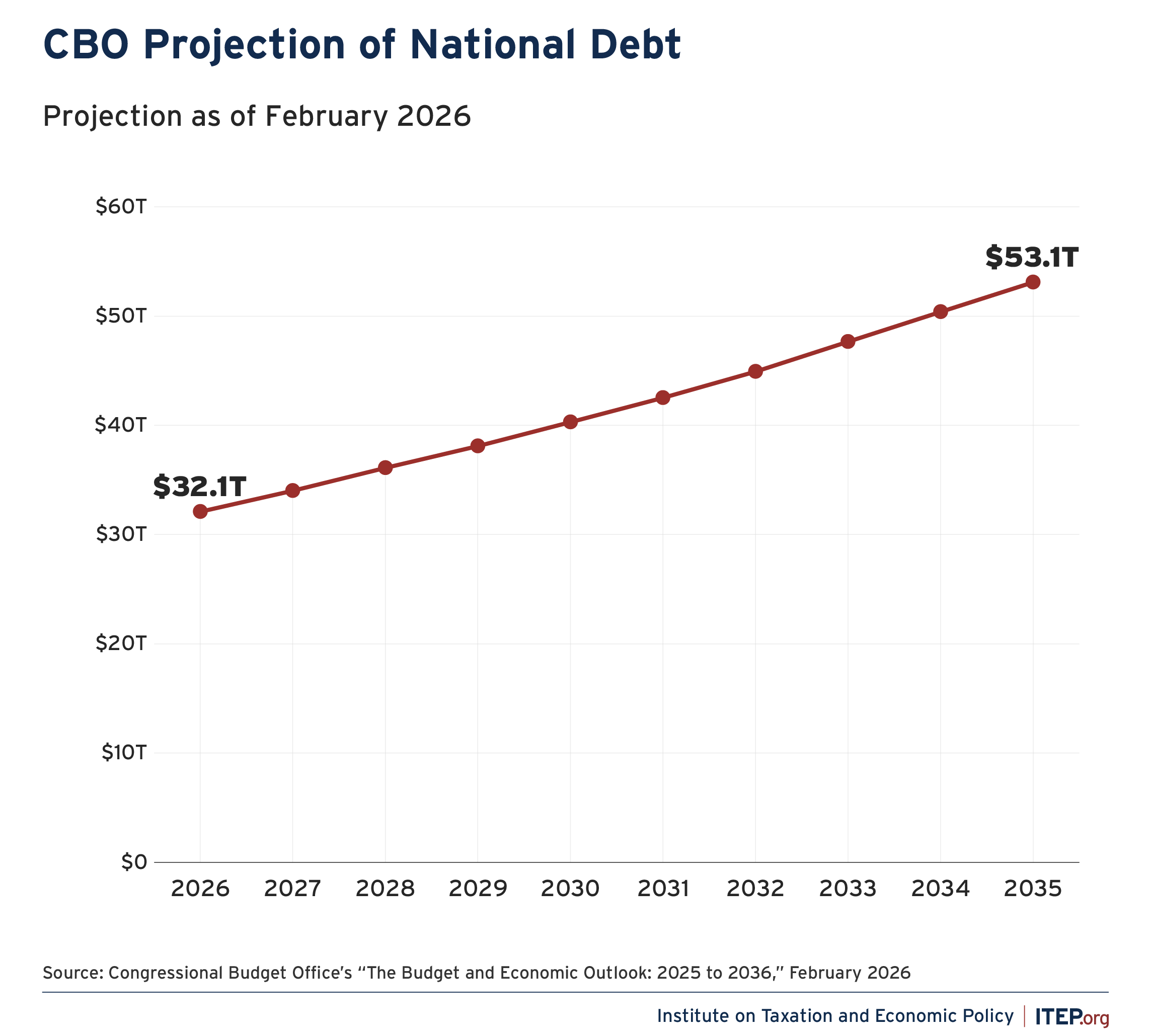
These tax cuts have come at a
substantial price, according to ITEP.
“The legislated tax reductions passed by Congress and signed by the
president in the One Big Beautiful Bill Act (OBBBA) are forecast to add $4.6 trillion to the
federal government’s debt over the coming decade. In the same bill, to whittle
down that price tag, net spending cuts amount to a $1.2 trillion reduction,
with the lion’s share coming from health care,” increasing income inequality in
2026 and causing taxes overall to go up for those in the lower income 95
percent of the population. For the top 5 percent, however, taxes will go
down on average.
“Although tariffs do affect
higher-income Americans,” Ettlinger acknowledged, “they claim a smaller share
of their income.” Through several graphs
and charts accompanying the article, ITEP detailed not only inequality, but debt
(and debt service payments), a growing Federal deficit and the concomitant
decrease in charitable contributions made by wealthy Americans shielding their
excess cash from the Taxman.
To put the $117 billion going to
the top 1 percent in 2026 in perspective, he added, thist is more than the federal
government will spend in 2026 on “the combined budgets of
the Department of Education, Department of Transportation, Department of
Justice, the State Department, the National Aeronautics and Space
Administration, the Environmental Protection Agency, the National Endowment for
the Humanities, and the National Endowment for the Arts.:
Or, perhaps in response to the
contention that state and local tax policies might cause some professional
athletes to relocate and federal levies might cause ballplayers to move back to
the Dominican Republic or other places, with that $117 billion sufficient to
buy “every Major League Baseball team (all of them together) or pay for the
combined cost of every wedding in the country for a year, as we described in July along with other
comparisons.”
See the abovenamed and
more ITEP charts and graphs here.
1440’s online explanation of “why
the IRS is necessary” (ATTACHMENT TWELVE) described the agency... a division of the US Treasury Department created in 1862 that enforces the Internal Revenue Code— whose roughly 75,000 employees
collected roughly $5T in tax revenue.
Given its role in diverting
household income streams, it also has a bad reputation. “In a ranking of 16
well-known federal agencies by popularity (in 2024), the IRS came in dead last,
behind both the Department of Justice and the Department of Education.”
1440 includes several
useful reference on assessment and enforcement of the Code... including the story of the
Beatles' "Taxman" (from whence our title is derived: Read more here)
Perhaps some of the hatred found in 1440 showed up in polls
by Pew Research (April 6, ATTACHMENT THIRTEEN)
“Roughly six-in-ten adults now say
the feeling that some wealthy people (61%) and corporations (60%) don’t pay
their fair share bothers them a lot.”
Pew broke down the causes of this disgruntlement to complexity (51%)
Polls within the polls divided
results by partisanship – thus, the feeling that some wealthy people don’t pay
their fair share (81% of Democrats vs. 41% of Republicans) or, conversely,
that poor people don’t pay their fair
share (16% Rep. vs. 8% Dem.) while complaints about complexity were almost
dead even.
Pew also broke down
its results by ethnicity, by wealth (or its lack), age (but not sex).
U.S. News (April 7, ATTACHMENT
FOURTEEN) also cited some of Pew’s findings, but added stats on who thinks who
pays how much (the figure of 60% - up from 56% in 2023, 49% in 2021, and 51% in 2019).
Knox ventured that
he “(wasn’t) sure what was going on in 2021,” (try,
oh, Covid?) but Pew’s numbers show that was a recent high-water mark – 44% –
for Americans saying they were paying the right amount. It’s currently 33%.
Tax Foundation.org. tracked the
influence of disease and tariffs, investment and savings, trade policy and, of
course, partisanship.
“The last time the United States
ran a trade surplus was in 1975; every year since, the United States has run a
trade deficit. That the United States has consistently run trade deficits for
decades is not an imminent economic problem. Net imports, another term for a
trade deficit, can reflect the strength of the US economy in attracting foreign
investment and in serving as a safe, reliable haven for foreign capital. When
net imports finance the capital stock, it allows the US to enjoy a higher level
of productivity and growth than otherwise would occur.” (March 13, ATTACHMENT FIFTEEN)
“In 2025, the trade deficit fell
by just $2.1 billion compared to 2024. The reduction in the trade deficit was
due to an increase in the trade surplus of services, as the goods deficit
actually increased by $25.5 billion year over year.”
Tax Foundation broke down tariff
rates by countries and goods... for example, Chinese Fentanyl... in predictions
for the next ten years. Not
surprisingly, the forecasts all predicted a continuation of inflation.
Abroad, the Telegraph U.K.
(ATTACHMENT SIXTEEN) offered up a pre-April Fool cacophony
of financial changes for British taxpayers to waddle through.
As in the colonies, the English pay
the Taxman – and even earlier, on April 6th and, as in America,
there’s nowhere to go but up. More
government controlled utilities means more taxes... also going up “are water
bills, car taxes, mobile phone and broadband prices and the cost of a TV licence.” A newfangled Making Tax Digital finally
arrives for sole traders and landlords with more than £50,000 of income. The conservative Telegraph calls it
“dreaded”.
A taxation survey by the World
Population Review (ATTACHMENT SEVENTEEN) found that the highest personal income
tax rates were in Finland (57.65%), followed by Japan, Denmark, Austria and
Sweden. The lowest rates were essentially
zero in a number of usually small, poor, Third World states – some of which
charge sales and corporate taxes and then a few wealthy Gulf states (Kuwait,
Bahrain, Qatar) swimming in oil revenues.
The United States fell somewhere
in the middle at an average 37%... better than Ireland and India, a little
worse than Algeria or Mexico. See
listings at attachment.
It’s not good enough for the AMERICANS for TAX FAIRNESS whose April 13th
study of the billionaires of Arizona found... to nobody’s surprise... that they
were “flying high while the state’s workers and families struggle to afford the
basics,” according to a new
report
by Opportunity Arizona and the ATF
Publishing
charts and graphs of the wealthiest, ATF identified the richest as members of
the Garcia family who defied popular perceptions of Latinos as poor – profiting
mightily off Trump’s One Big Beautiful Bill Act (OBBBA).
“With
nearly half of Arizona’s SNAP recipients losing access, the effects of OBBBA
are devastating,” said Ben Scheel of Opportunity Arizona. “Families everywhere
can’t afford food or healthcare while an Arizona-failed sports team owner and
predatory lending billionaire got $9 billion RICHER in just one year,” while
Americans “are forced to choose whether to pay rent or get their medications.”
“The
return of Donald Trump has been a boom for billionaires but a bust for average
workers and families,” said David Kass, ATF’s executive director.
ATF
also published a list of the richest members of Congress, many of whom have
been using special “pass-through” tax breaks and/or foreign accounts to hold
and increase their plunder. Sen. Jim
Justice (R-WV) enjoys the greatest net worth ($664
million) and the quiverquant website can
tell you how much your representative
makes.
ATF told some stories of the
victims of injustice and inequality – as individual or groups as, for example,
cuts to Medicaid that are closing the hospital in Forks, WA leading to more
disease and death.
In
addition to Federal tax changes, cities and states are going their own way with
leftists crying “inequality” and red state rednecks saying that oppressive laws
will drive wealthy business owners and their jobs out of town. (Fox Business, April 13, ATTACHMENT NINETEEN)
"They do have other places to
go. It's ultimately perhaps counterproductive if you want to fund certain
programs at certain levels," Tax Foundation senior fellow Jared Walczak
said.
The debate comes as some high-tax
states are already grappling with out-migration. IRS data shows residents
and businesses are moving from states like California, New York and Illinois to
states such as Florida and Texas in recent years — a trend policymakers are increasingly
factoring into tax decisions.
With Federal funding cut due to
the war, red state homeowners are squeezed by rising home values have driven
property tax bills higher in many regions, fueling calls for relief and adding
pressure on lawmakers to find alternative revenue sources before the claws of
debt sink in and haul them off to civilian life. Demonic Democratic and DEI media, foundations
and chitterbugs of the private and public persuasions are sharpening their
boxcutters for November, and the grim commanders are stirring.
One such
agglomeration of Blueys... the Institute On Taxation And
Economic Policy (ITEP), whom we have encountered before (above)... are getting
their belt buckles dislooped over what they now contend are eighty eight profitable U.S. corporations who paid zero...
that’s nothing, nada... ZERO federal income tax in 2025.
While
the biggest U.S. corporations have avoided taxes for decades (and under
bipartisan administrative somnolence), “it appears that corporate tax avoidance
has increased in the most recent year,” according to ITEP’s institutional
inmates Matthew Gardner and Spandan
Marasini. (April 14th,
ATTACHMENT TWENTY) This is, at least in part, due to two separate packages of
corporate tax cuts pushed through by the Trump administration: “last year’s
“One Big Beautiful Bill Act” and the 2017 Tax Cuts and Jobs Act (TCJA).”
Moving on
to mathematics, these tax-avoiding corporations
enjoyed more than $105 billion in U.S. pretax income in 2025. The statutory
federal income tax rate for corporate profits is 21 percent, which means these
rocket 88 corporations would have paid a collective total of $22.1 billion for
the year had they paid that rate on their 2025 income. Instead, they received
$4.7 billion in tax rebates.
Oozing
and cruising along, this means the total federal corporate income tax breaks
enjoyed by these companies “comes to $26.7 billion when measured against the 21
percent statutory rate. Measured against the 35 percent corporate income
tax rate that was in effect before the two corporate tax cuts pushed through by
Republicans and President Trump since 2017,” ITEP concludes that these
companies “collectively cut their income taxes by $41 billion in 2025 alone.”
That’s
two thirds of ten percent of a whole Musk!
ITEP’s
roster of tax ducklings include Tesla itself, Southwest Airlines, Yum (owners
of the President’s favorites KFC, Taco Bell and Pizza Hut) and a scouge of
techy, AI and cryptic cheatmates, See a
full listing in the Attachment.
The authors attribute much of
the corporate savings to “accelerated depreciation”, which
provision in the 2025 tax law allows companies to immediately write
off capital investments—the most extreme version of tax depreciation— and
“helped more than half of these companies reduce their federal income tax last
year.” Others exploited the federal research and experimentation
(R&E) credit to substantially reduce their
federal income taxes in 2025.
Some
lucky snakecharmers used both.
Tesla,
again, took advantage of the lax lacklaws as did Southwest and some others...
3M, HP, Disney and PayPal.
Other tax
dodging ploys include a new variant of the R&D expenses gifted by Congress
last year, the Foreign-Derived Deduction Eligible
Income (FDDEI) deduction, a writeoff for executive stock
options,
and other corporate tax cuts pushed through by Republican leaders and the Trump
administration in 2017 and 2025.
Thus, Tax Day, Wednesday, arrived with
the millions sweating payment or looking forward to refunds of maybe a few
dollars or even a few hundred to enjoy a treat from Yum – the billionaires
locking their wallets and, according to Politico’s polling and summary that
arrived before dawn (April 15, 4:45 AM, ATTACHMENT TWENTY ONE), Republicans
hoping that their tax cuts would offer giant
political benefits, with the rabble receiving super-sized refunds and then
rewarding them at the ballot box to vote for the candidates that their Masters’
money directed them to support.
But that “doesn’t look like it’s
going to happen,” opined Politico’s Bernie Becker, who believes that... even
with their refund checks in hand... Americans are experiencing less gratitude
and more attitude as their savings are eaten away at the grocery store, the gas
pumps, the rent collectors’ or bank mortgage bureaus and, of course, by the
war.
Even the most fervent of tax-cut
evangelists is concerned, stated Mr. Becker.
“Grover Norquist of Americans for
Tax Reform said Tuesday that a quick solution to the conflict with Iran could
reduce some of the pressure on prices that might currently be overshadowing tax
cuts.
“But that’s not guaranteed,”
Norquist said at a pre-Tax Day event hosted by his group. “I run a taxpayer
group. War’s kind of out of my control sometimes.”
There are some winners for the
President and his allies to encourage in November... some of the lowest paid service
workers
will enjoy better after-tax brass in pocket due to changes in tipped incomes,
overtime, and incentives to seniors, children and auto purchasers (although Mr,
Becker called that last “more of a dud”.
But even Fox
News couldn’t parse the problem that their pollsters warned, finding
that seven in 10 voters “believe their tax burden is too high, largely because
the wealthy aren’t paying enough.”
So as an already superheated
spring slides into an un-endless summer with the witches of Halloween and
Election day following, as the refunds are spent and the war and inflation seem
likely to persist, the vultures are gathering – and the baddest of all the
Democratic bad birds, The Bern, chose April Fools’ Day to propose changes in
tax law that claw back... not just billions... trillions from the nobilities, gentilities and tax cheat of
America.
“Never
before in American history have so few had so much wealth and power,” croaked
the Bern. (GUK, ATTACHMENT TWENTY TWO)
“Today,
the top one per cent owns more wealth than the bottom 93%. One man, Elon
Musk, worth $805bn (estimates on tax day, two weeks later, cut this to only
$636bn), owns more wealth than the bottom 53% of American households.” And last year, after receiving the largest
tax break in history from Donald Trump, the 938 billionaires in America (again,
the last report upped this to 1,135 – ranging from Musk on down to
bottom-hangers like Oprah and Taylor Swift) became $1.5tn richer. Since he was
elected, President Trump and his family have become $4bn richer.
Be they in the hundreds, or, now, in the thousands, the
billionaires... as “(n)ever before in American history”
control what we see, hear, and read in the media – never before in American
history “have we seen a ruling class, within a corrupt campaign finance system,
wield the kind of political power it has today.”
Bottom
line, says the Bern: “the richest people in America have never ever had it so
good!”
That
is one reality, he continues, as opposed to the other reality.
“The
American working class has been under savage attack for years. Over the last
many decades there has been an explosion in technology and a huge increase in
worker productivity. Despite that, the average American worker is making almost
$20 a week less today than he or she did 53 years ago, after adjusting for
inflation.
According
to the Rand Corporation, over the last 50 years, $79tn in wealth has been
redistributed from the bottom 90% to the top 1%. Almost all of the gains in
worker productivity have gone to the top 1%.
“In
America today, billionaires now pay a lower effective tax rate than the average
worker,” the Bern burned. “Elon Musk
paid an effective tax rate of less than 3.3%, while the average truck driver
paid 8.4%. Jeff Bezos, now worth $223bn, paid an effective tax rate of less
than 1%, while the average firefighter paid 8.7%.
“Michael
Bloomberg, worth $109bn, paid an effective tax rate of just 1.3%, while the
average registered nurse paid 13.3%.”
In
2006, Warren Buffett memorably said: “There’s class warfare, all right, but
it’s my class, the rich class, that’s making war, and we’re winning.”
And
Warren Buffett? His tax rate was just 0.1%, Saudners reported, “while the
average schoolteacher paid 9.8%.”
That
is why, Sen. Sanders says, “I recently introduced a bill that would establish a
5% wealth tax on the 938 billionaires in America who collectively are worth
more than $8.2tn. These 938 billionaires constitute 0.000003% of the
population.
“Over
a 10-year period, this bill would raise $4.4tn.”
The money would go to a barrel of bums... $3,000 handouts to
every American man, woman and child making under $150K/yr., subsidizing
universal childcare, adding dental, vision and hearing coverage to Medicare,
build affordable housing, pay schoolteachers a minimum of $60,000/yr., cover
home healthcare through Medicaid and repeal Trump’s BBB healthcare cuts.
“If this legislation had been
enacted last year, Elon Musk would have owed $42bn more in taxes, leaving him
with just $792bn to survive.
“Mark
Zuckerberg would have owed $11bn more, leaving him with a meager $209bn to feed
his family. Jeff Bezos would also have owed about $11bn more, leaving him with
just $207bn to put a roof over his head.
As
the Burn quoted Justice Louis Brandeis’ “profound” 1933 observation: “We must
make our choice. We may have democracy, or we may have wealth concentrated in
the hands of a few, but we cannot have both.”
“Let’s
choose democracy over oligarchy,” Sanders concluded.
“Let’s
create an economy that works for all of us, not just the 1%.”
|
IN the NEWS: APRIL 10th, 2026 to APRIL 16th, 2026 |
|
|
|
Friday, April 10, 2026 Dow:
47,918.57 |
Republicans block Democratic bill to end the Iranian
war as closure of the Hormuz Straits cuts world oil supply and raises prices
– at the pump, for now, but as it lingers, the supply chain will be rusted
and food (affected not only by transport but by the lack of fertilizer for
farmers to plant their 2026 crops), clothing, other imports, exports and
deports will be impacted. Politicians
promise that peace talks will begin tomorrow. The first
postwar inflation report is out and it’s not good (see below). The Fed says it’s the worst in four years,
with the war damage complicated by Trump’s tariffs... which are facing
challenges in court. And the hits keep
on coming, the troubled USPS announces it will raise prices on first class stamps
to 82¢. But there’s
good news too, this Friday, the Artemis Two “Integrity” capsule touches down
off San Diego at 8 PM. The heat
shields successfully battle 5,000° temperatures and then three parachutes
float the four astronauts back home.
They are taken aboard the U.S.S. John Murtha for medical examinations,
after which they go back to their families in Houston. |
|
|
Saturday, April 11, 2026 Dow: Closed |
The cherry blossoms are out in Washington due to an
early spring. They were a gift from
Japan in 1912 for an “enduring friendship” which would run into problems a
few decades later. NASA
headquarters welcomes the astronauts back with celebrations and celebrity
horn-ins plus speeches by spokespersons Alana Johnson and Harold Hu who say
the moonshot program is on track for Artemis Three next year and the actual
landing by Artemis Four in 2028. The
crew holds their first press conference; Reid Wiseman citing the view of
Earth from space, saying: “When you’re out there, you just want to get back
to your families.” Jere,y Hanson
says “We are a mirror reflecting
Earth; if you like what you see, look
a little deeper.” NASA’s Jared
Isaacman says forget the moon – we are now on target to go to Mars. President
Trump, announcing His naval blockade of Hormuz is “calling Iran’s bluff”
according to TV Colonel Steve Ganyard.
Nobody asks what will happen if America sinks a Russian or Chinese
tanker but there are some raised eyebrows at the fact of the USA and Iran both blockading the straits. Veep Vance touches down in Pakistan and
says he’ll extend “an open hand” if Iran surrenders. His boss calls the Iranians “dishonest” but
says the Israeli/Lebanese war is a different matter and the Lebanese PM
breaks off talks with Israel after 300 more civilians killed. DefSec/WarSec Hegseck says “we want a
victory with a capital V. guided by the Hand of God.” |
|
|
Sunday, April 12, 2026 Dow: Closed |
A weary Vance admits that 21 hours of negotiations
with Iran result in failure, but still says that there’s more bad news for
Iran than for America. Iran insists on
its right to nuclear weapons.
President Trump says the failure doesn’t matter to him, he’s on his
way to a UFC fight with Marco Rubio.
Russia chooses not to honor the Orthodox Easter, dropping more
explosives on Ukraine. It’s Talkshow
Sunday again – Sen. Tim Kaine (D-Va) says we need to extend the ceasefire
past April 21st... an impotent ceasefire being better than
resumption of the war. Citing Trump’s
tearing up our old Iranian nuke deal, Kaine says: “if you make diplomacy impossible,
you make war inevitable.” Former
CentComm director Joseph Votel warns that we have to be careful about bombing
civilians and infrastructure because it will provoke Iran to attack our allies... now in the Gulf, not Europe.
A round
table and a half begins with the New Yorker’s Susan Glasser says that,
instead of regime change, we just “swapped out” one Khameini for his even
crazier son and, from NPR, Mary Louise Kelly says we should all be “rooting
for peace” but “no trust is a very high hurdle.” Then come four more... liberal Donna
Brazile says it’s just round one with a lot of “sniffing”, Sarah Isgur says
Trump just followed the last seven Presidents on Iran... former House Speaker
Kevin McCarthy opines that POTUS went to the UFC to show Iran he doesn’t care
“which makes him stronger”. They also
discuss Melania and Swalwell. On Face the
Nation, Michael Leiter says we shouldn’t be surprised that Iranians lie, but
hopes we do not go back to “Kinetic activity”. Sen, Mark Warner (D-Va) warns that China is sending drones to
Iran. On “The Hill”, Rep. Dan Bacon
says that Congressional Dems and Pubs are working on a deal to evict sex
criminals Swalwell and Rep. Tony Gonzales (R-Tx) because neither can afford
to lose votes. |
|
|
Monday, April 13, 2026 Dow: 48,218.25 |
War with Iran not sufficing, Djonald UnChurched
picks a new fight with a new foe... Pope Leo – calling his opposition to the
war “weak” and he’s “a loser”, not like his MAGAbro Louis. Trump tips a Door Dash delivery woman $100,
releases a doctored photo of Bruce Springsteen and then a portrait of himself
as Jesus, curing a sicko whom cynics say “looks like Epstein.” Gov. Ron DeSantis kisses Donnie’s “clothed”
backside Still, the
war goes on. Enraged at Trump’s
ignoring him, Iranian Mohammad Bagher Ghalibaf tells Americans to be
“nostalgia for the $5 gallon of gas.”
Rubio, probably wishing he were back at the UFC arena, sits in at a
meeting between Israelis and Lebanese, but without Hezbollah, so he slinks
back home like Vance. Two of the
four disgraced Congressthings do the prudent thing and resign. Eric Swalwell also drops out of the
California governor’s race; Tony Gonzales capitulates to relatives of one of
his “dates” who killed herself after their meeting. Swallwell remains on the ballot, but does
this now mean a win for Gavin Newsome? |
|
|
Tuesday, April 14, 2026 Dow:
48,535.99 |
The Pope/Trump feud escalates with thre American
cardinals saying that Iran is not a “just war”. POTUS replies that the world cannot afford
a nuclear Iran as the cans and TACOs fly... the difference is now that the
U.S. downgrades his forever ban to a twenty year prohibition on Iranian nuke
while the mullahs in Tehran counter with a five year hold. Investors still believe Trump’s optimistic
gloating and the markets keep rising – as do gas prices.
Eeee-conmystics say that United
and American want to merge, effectively creating a supermonopoly in the
skies. On earth, 7/11 will close 600
outlets, average prices for new cars top $50K dooming the young and poor to
bicycles or shoe leather. Teenage
gamers learn coding to get into cyberhacks for big steals and big prison
time. A disgruntled AI troll shoots at
Open AI CEO Sam Altman’s house – two days after another throws a Molotov
cocktail at him! Doctors and police call for stronger
protections against teenage hacking. |
|
|
Wednesday, April 15, 2026 Dow:
48,483.22 |
It’s Tax Day in America (and for the Jews, Holocaust
Remembrance Day) The Wall Street Journal reports that staffing cuts
at the IRS encourage more cheating.
The layoffs have saved $46B but cost an estimated $643B. Cutbacks are leading to delays in refunds
for honest taxpayers but TV – con mystic Richard Rubin judges AI software OK
for small filers, but not for big business. In Veep
Vance’s struggle between loyalty to God and loyalty to Trump, the latter is
an easy victor. Vance puts on his Don
Corleaone mask and warns Leo to watch what he says, or else! America is God’s country because we won
World War Two, and Leo’s just a nobody from Chicago. Mixed
messages ooze out of the MidEast.
Because Iran is blockading the Straits of Hormuz from its side (and
thus causing oil prices, gas at the pump and, as key supply chain links like
truck transport and agricultural fertilizer falter, everywhere) Djonald
UnHinged orders the American Navy to blockade the other side of the straits – just to assure that nobody gets through. DefSec turned WarSec HegSeck orders the
Navy to fight and sink any tanker trying to get through – which may lead
to... let’s say, complications... if we blow up Russian or Chinese
ships. Time
unveils its 2026 list of the world’s most important people. Notably, Trump is snubbed. |
|
|
Thursday, April 16, 2026 Dow:
48,578.92 |
President Zelenskyy says that Ukraine is now winning
the war and winning back territory seized by Mad Vlad Putin due to his
deployment of robot soldiers who can kill Russians without being killed
themselves... and even if they are, they’re robots. Russia issues more nuke war warnings, but
the U.K. says it will send drones to help Ukraine, but not the U.S. while
Israel and Lebanon agree to a cease fire of their own – but not with
Hezbollah. Not to
worry... despite the war and its effect on gas prices, thus overall
inflation, the Dow is up a bit, the SP 500 a bit more and the tech-heavy
Nasdaq soaring to a record high.
Feddie Powell, slated to retire in May, says he won’t go until a
successor is appointed and confirmed, inciting Trump to try to fire him
again. Other
puppets in Team Trump are experiencing difficulties. Congress files five articles of impeachment
against HHS RFK Junior who responds by cutting of the penis of a roadkill
raccoon to “study” it, while former Trump attorney John Eastman is disbarred
in California. Bad, but not as bad as
former Virginia Lt. Gov., a Democrat, who murders his wife, then kills
himself. Kanye’s
French concert is cancelled following his cancellation at Glastonbury U.K. due
to his anti-Semitic rants. Ants, 2,200
of them, are smuggled out of Kenya, but smuggler is arrested. |
|
|
The first Inflation Report since the beginning of
the Iran War and closing of the Straits of Hormuz and the effect on gas
prices for Joneses was costly, as expected (but at least the 21% hike was not
as bad as fuel oil inflaton, which we do not count) and the total was only
slightly under one percent. And
conservative Catholics (like Veep Vance) are going to have to decide whether
to follow the President or the Pope into Heaven (which, at this point, looks
like a gas station with cheap prices). |
|
|
|
THE DON JONES INDEX CHART
of CATEGORIES w/VALUE ADDED to EQUAL BASELINE of 15,000 (REFLECTING…
approximately… DOW JONES INDEX of June 27, 2013) Gains in indices as improved are noted in GREEN. Negative/harmful
indices in RED as are their designation. (Note – some of the indices where the total
went up created a realm where their value went down... and vice versa.) See a
further explanation of categories HERE |
|
ECONOMIC INDICES
|
(60%) |
|
||||||
|
CATEGORY |
VALUE |
BASE |
RESULTS by PERCENTAGE |
SCORE |
OUR SOURCES and COMMENTS |
|||
|
INCOME |
(24%) |
6/17/13 revised 1/1/22 |
LAST |
CHANGE |
NEXT |
LAST WEEK |
THIS WEEK |
THE WEEK’S CLOSING STATS... |
|
Wages (hrly. Per cap) |
9% |
1350 points |
4/10/76 |
+0.161% |
4/26 |
1,893.61 |
1,896.65 |
|
|
Median Inc. (yearly) |
4% |
600 |
4/10/76 |
+0.056% |
4/24/76 |
1,128.11 |
1,128.74 |
http://www.usdebtclock.org/ 51,944 |
|
Unempl. (BLS – in mi) |
4% |
600 |
4/10/76 |
-2.33% |
4/26 |
542.60 |
542.60 |
|
|
Official (DC – in mi) |
2% |
300 |
4/10/76 |
+0.12% |
4/24/76 |
204.56 |
204.32 |
http://www.usdebtclock.org/ 7,670 |
|
Unofficl. (DC – in mi) |
2% |
300 |
4/10/76 |
+0.12% |
4/24/76 |
239.07 |
238.79 |
http://www.usdebtclock.org/ 14,331 |
|
Workforce Participation Number Percent |
2% |
300 |
4/10/76 |
-0.005% -0.012% |
4/24/76 |
295.79 |
295.76 |
http://www.usdebtclock.org/ In
162,716 Out 105,148 Total:
267,864 60.746 |
|
WP %
(ycharts)* |
1% |
150 |
4/10/76 |
+0.162% |
4/26 |
150.22 |
150.22 |
https://ycharts.com/indicators/labor_force_participation_rate 61.90 |
|
OUTGO |
(15%) |
|||||||
|
Total Inflation |
7% |
1050 |
4/10/76 |
+0.9% |
4/26 |
920.05 |
911.77 |
http://www.bls.gov/news.release/cpi.nr0.htm +0.9 |
|
Food |
2% |
300 |
4/10/76 |
+0.0% |
4/26 |
259.19 |
259.19 |
http://www.bls.gov/news.release/cpi.nr0.htm +0.0 |
|
Gasoline |
2% |
300 |
4/10/76 |
+21.2% |
4/26 |
262.47 |
206.83 |
http://www.bls.gov/news.release/cpi.nr0.htm +21.2 |
|
Medical Costs |
2% |
300 |
4/10/76 |
+0.3% |
4/26 |
270.91 |
270.10 |
http://www.bls.gov/news.release/cpi.nr0.htm
+0.3 |
|
Shelter |
2% |
300 |
4/10/76 |
+0.0% |
4/26 |
239.10 |
239.10 |
http://www.bls.gov/news.release/cpi.nr0.htm
+0.0 |
|
WEALTH |
||||||||
|
Dow Jones Index |
2% |
300 |
4/10/76 |
+0.80% |
4/24/76 |
371.32 |
374.30 |
https://www.wsj.com/market-data/quotes/index/ 48,578.92 |
|
Home (Sales) (Valuation) |
1% 1% |
150 150 |
4/10/76 |
-2.69% +2.71% |
4/24/76 |
133.12 260.67 |
129.54 267.74 |
https://www.nar.realtor/research-and-statistics Sales (M): 3.98
Valuations (K): 408.8 |
|
Millionaires
(New Category) |
1% |
150 |
4/10/76 |
+0.06% |
4/24/76 |
136.91 |
136.90 |
http://www.usdebtclock.org/ 24,164 |
|
Paupers (New Category) |
1% |
150 |
4/10/76 |
+0.034% |
4/24/76 |
135.18 |
135.14 |
http://www.usdebtclock.org/ 36,829 |
|
GOVERNMENT |
(10%) |
|||||||
|
Revenue (trilns.) |
2% |
300 |
4/10/76 |
+0.13% |
4/24/76 |
473.18 |
473.79 |
http://www.usdebtclock.org/ 5,432 |
|
Expenditures (tr.) |
2% |
300 |
4/10/76 |
+0.06% |
4/24/76 |
292.09 |
291.93 |
http://www.usdebtclock.org/
7,111 |
|
National Debt tr.) |
3% |
450 |
4/10/76 |
+0.074% |
4/24/76 |
346.96 |
346.70 |
http://www.usdebtclock.org/ 39,128 |
|
Aggregate Debt (tr.) |
3% |
450 |
4/10/76 |
+0.091% |
4/24/76 |
370.76 |
370.43 |
http://www.usdebtclock.org/ 107,477 |
|
TRADE |
(5%) |
|||||||
|
Foreign Debt (tr.) |
2% |
300 |
4/10/76 |
-0.13% |
4/24/76 |
254.35 |
254.03 |
http://www.usdebtclock.org/
9,462 |
|
Exports (in billions) |
1% |
150 |
4/10/76 |
+4.20% |
4/26 |
195.91 |
195.91 |
https://www.census.gov/foreign-trade/current/index.html 314.8 |
|
Imports (in billions)) |
1% |
150 |
4/10/76 |
-4.17% |
4/26 |
138.64 |
138.64 |
https://www.census.gov/foreign-trade/current/index.html 372.1 |
|
Trade Surplus/Deficit (blns.) |
1% |
150 |
4/10/76 |
+4.89% |
4/26 |
247.48 |
247.48 |
https://www.census.gov/foreign-trade/current/index.html 57.3 |
|
ACTS of MAN |
(12%) |
|
||||||
|
World Affairs |
3% |
450 |
4/10/76 |
-0.1% |
4/24/76 |
470.08 |
469.61 |
Hungarian voters oust Trump/Putin ally Orban. American influencer found dead in
Zanzibar. Second Turkish school
shooting kills nine. Spain legalizes
5,000 migrants. |
|
War and terrorism |
2% |
300 |
4/10/76 |
-0.1% |
4/24/76 |
284.02 |
283.74 |
American teen terrorists from “764” cult fling
bombs, behead dogs. Adult terrorist
vandalizes US C-130 planes... in Ireland! |
|
Politics |
3% |
450 |
4/10/76 |
-0.1% |
4/24/76 |
455.18 |
454.72 |
Swalwell (D-Ca) and Gonzales (R-Tx) resign from
Congress in sex crime scandals, both now face criminal charges. Criminal charges against One Six Proud Boys
and Oath Keepers vacated. Polls show
Trump support dropping but the good news for ‘Pubs is that, at the National
Action Network, Kamala Harris floats a 2028 campaign. |
|
Economics |
3% |
450 |
4/10/76 |
-0.1% |
4/24/76 |
428.77 |
428.34 |
Fed reports record inflation and World Economic
Outlook predicts new Great Depression but investors still trust Trump. United/American merger called
“monopolistic”. Corporations are
firing experienced workers and replacing them with younger, cheaper trainees
and AI robots. Nonprofit buys
non-profitable Pittsburgh Post-Gazette.
|
|
Crime |
1% |
150 |
4/10/76 |
-0.1% |
4/24/76 |
204.17 |
203.97 |
Machete man stabs 3 at GC Terminal, killed by police
after shouting: “I am Lucifer!” Jersey
masked maniac shoots Chik Fil-A diners, shooters target AI CEO Sam Altman’s
house... twice! School shootings in
Oklahoma and Turkey (first) averted by heroes but second Turkish trauma kills
eleven. |
|
ACTS of GOD |
(6%) |
|
||||||
|
Environment/Weather |
3% |
450 |
4/10/76 |
-0.1% |
4/24/76 |
279.42 |
279.14 |
West Coast finally eases up on heat, wildfires and,
here & there, floods. The Midwest
gets storms, hail and tornadoes, record heat E. in NY and DC while heat and
drought-caused wildfires strike Naples, Fl. down south. Way
down south climate change endangers Emperor Penguins. “Super typhoon” batters U.S. Northern
Mariana islands. |
|
Disasters |
3% |
450 |
4/10/76 |
-0.1% |
4/24/76 |
464.46 |
464.00 |
800 creepy girls enroll in Camp Mystic as deadly
flooding investigation continues. 100
killed in Nigerian air strike on wrong target. 30 more killed in Haitian stampede. Automated garbage truck picks up woman and
squeezes her to death. |
|
LIFESTYLE/JUSTICE INDEX |
(15%) |
|
||||||
|
Science, Tech, Education |
4% |
600 |
4/10/76 |
+0.1% |
4/24/76 |
621.07 |
621.69 |
AI fighters attack Sam Altman’s home and person twice – perhaps because TV-techsters
say AI chatbot advice is mostly wrong.
LA settles teachers’ strike. |
|
Equality (econ/social) |
4% |
600 |
4/10/76 |
+0.2% |
4/24/76 |
669.02 |
670.36 |
Diverse Artemis astronauts touch down and begin
their round of honors. Virginia Gov.
signs bill ending subsidies to neo-Confederates. |
|
Health |
4% |
600 |
4/10/76 |
+0.1% |
4/24/76 |
414.22 |
414.63 |
TV docs say high dose flu shots inhibit Alzheimers
and new pancreatic cancer drug doubles life expectancy. Teen births in U.S. hit record low. 300K Hyundais recalled for bad seatbelts,
FDA recalls bad Xanax. Lululemon
carcinogenic yoga pants sued for “forever chemicals”. Latest mental health trend “Scream Clubs”
based on Janov book go viral. Florida
doc arrested for murder after removing liver instead of spleen. Reality TV star “Dr. Pimple Popper” suffers
stroke. |
|
Freedom and Justice |
3% |
450 |
4/10/76 |
+0.1% |
4/24/76 |
479.20 |
479.68 |
Mister Hooker not charged in wife’s disappearance in
Bahamas. Prince Harry sues Lady Di’s
charity for libel. Driver who hit and
killed jogger sues his family for giving him
PTSD. Jury convicts Ticketmaster/Live
Nation of monopolistic gouging as more live shows become affordable, but some
refuse to accept cash for their tickets.
|
|
CULTURAL and MISCELLANEOUS
INCIDENTS |
(6%) |
|
|
|||||
|
Cultural incidents |
3% |
450 |
4/10/76 |
+0.2% |
4/24/76 |
588.99 |
590.17 |
Rory McIlroy wins 4th Masters. Deep red SC state senate honors deep blue
fired host Colbert. WNBA #1 pick:
UConn’s Azzi Fudd will chase wabbits for Dallas. RockRoll HoF inductees include Phil
Collins, Sade, Billy Idol; Mariah Carey snubbed. Partisans dispute whether Justin Bieber
flopped or rocked Coachella. Super
Mario wins B.O., summer of coming sequels includes 67 year old Madonna’s
“Confessions”, 99 year old Mel Brooks’ “Spaceballs” and Top Gun Three. Dead Val Kilmer revived through AI in new
movie. Bio of video gamer turned plane
hijacker SkyKing revives old Sky King series. RIP: rapper Afrikaa Bambaatta, Bollywood singer Asha
Bhosle, Mount Everest climber Jim Whittaker |
|
Miscellaneous incidents |
4% |
450 |
4/10/76 |
-0.1% |
4/24/76 |
551.75 |
551.20 |
New World screw worm found 90 mi. from U.S.A.; rabid
bats invade the South. Boston’s
“singing sewer worker” goes viral. TP
arsonist in California says he set the $500M blaze because he was underpaid. |
|
|
||||||||
NPR
TRUMP BUDGET SEEKS
$1.5 TRILLION IN DEFENSE SPENDING ALONGSIDE DOMESTIC PROGRAM CUTS
Updated April 3, 2026 6:31 PM
ET
President
Trump has proposed boosting defense spending to $1.5 trillion in his 2027
budget released Friday, the largest such request in decades, reflecting his
emphasis on U.S. military investments over domestic programs.
The sizable
increase for the Pentagon, some 44%, had been telegraphed by the Republican
president even before the the U.S.-led war against Iran. The president's plan
would also reduce spending on non-defense programs by 10%.
TAKEAWAYS FROM TRUMP'S TOUGH
WEEK, AS WAR AND GAS PRICES TAKE THEIR TOLL
"President
Trump promised to reinvest in America's national security infrastructure, to
make sure our nation is safe in a dangerous world," wrote Budget Director
Russell Vought.
The
president's annual budget is considered a reflection of the administration's
values and does not carry the force of law. The massive document typically
highlights an administration's priorities, but Congress, which handles federal
spending issues, is free to reject it and often does.
This year's
White House document is intended to provide a road map from the president to
Congress as lawmakers build their own budgets and annual appropriations bills
to keep the government funded. Vought spoke to House GOP lawmakers on a private
call Thursday.
Trump,
speaking ahead of an address to the nation this week about the Iran war,
signaled the military is his priority, setting up a clash ahead in Congress.
"We're
fighting wars. We can't take care of day care," Trump said at a private
White House event Wednesday.
"It's
not possible for us to take care of day care, Medicaid, Medicare — all these
individual things," he said. "They can do it on a state basis. You
can't do it on a federal."
MONEY FOR IMMIGRATION ENFORCEMENT, AIR TRAFFIC
CONTROLLERS AND NATIONAL PARKS
Among the
priorities the White House called for:
§ Supporting the Trump
administration's immigration enforcement and deportation operations by
eliminating aspects of a refugee resettlement aid program, maintaining
Immigration and Customs Enforcement funds at current year levels and drawing on
last's year's increases for the Department of Homeland Security funds to
continue opening detention facilities, including 100,000 beds for adults and
30,000 for families.
§ A
13% increase in funding for the Department of Justice to focus on violent
criminals and the president's promise to stop what the White House calls
migrant crime.
§ A
$10 billion fund within the National Park Service for "construction and
beautification" projects in Washington, D.C..
§ A
$481 million increase in funding to enhance aviation safety and support an air
traffic controller hiring surge.
CUTS TO GREEN ENERGY, HOUSING AND HEALTH
PROGRAMS
§ Cancels more than $15 billion from
the Biden-era bipartisan infrastructure law, including funds for renewable
energy projects and cuts to the National Oceanic and Atmospheric
Administration, or NOAA, grants.
§ 19%
cut in the Department of Agriculture, ending certain university grants, a 13%
cut for the Department of Housing and Urban Development, and about a 12%
decrease to the Health and Human Services department, including cuts to a
low-income heating assistance program.
The White
House is touting cuts of what it calls "woke programs" that often
direct federal investments toward low-income communities. The budget used the
word "woke" 34 times.
For example,
the administration is looking to cut Community Services Block Grants, which
funds activities such as financial and job counseling and helping people obtain
adequate housing. The administration says its cuts would target grants
"hijacked by radicals" to promote equity-building and green energy
initiatives.
The president
also seeks to cut $106 million in funding from the Agency for Healthcare
Research and Quality, which it says has "pushed radical gender ideology
onto children."
SUPPORTERS AND DETRACTORS
The
Republican chairmen of the House and Senate Armed Services committees applauded
Trump's request for defense spending, saying the money would ensure the
country's military remains the most advanced in the world while confronting
growing threats from China, Russia, Iran and others.
"America
is facing the most dangerous global environment since World War II," said
Sen. Roger Wicker, R-Miss., and Rep. Mike Rogers, R-Ala.
The top
Democrat on House Budget Committee, Rep. Brendan Boyle of Pennsylvania, said
the president was demanding a massive increase in defense while cutting billions
from health care, housing and more.
"This
budget represents 'America Last,'" Boyle said.
DEBT, DEFICITS AND TOUGH CHOICES AHEAD
With the
nation running nearly $2 trillion annual deficits and the debt swelling past
$39 trillion, the federal balance sheets have long been operating in the red.
About
two-thirds of the nation's estimated $7 trillion in annual spending covers the
Medicare and Medicaid health care programs, as well as Social Security income,
which are essentially growing — along with an aging population — on autopilot.
It's the rest
of the annual budget where much of the debate in Congress takes place, as
Democrats over the years have insisted that changes in the level of spending
for defense and non-defense need to be equitable.
The GOP's big
tax breaks bill that Trump signed into law last year boosted his priorities
beyond the budget process — with at least $150 billion for the Pentagon over
the next several years, and $170 billion for Trump's immigration and
deportation operations at the Department of Homeland Security.
The
administration is counting on its allies in the Republican-led Congress to push
part of president's beefed up defense spending through its own budget process,
as it was able to do last year.
REPUBLICANS IN CONGRESS SAY
THEY HAVE A DEAL
TO END THE RECORD-LONG SHUTDOWN AT DHS
It suggests
$1.1 trillion for defense would come through the regular appropriations
process, which typically requires support from both parties for approval, while
$350 billion would go in the budget reconciliation process that Republicans can
accomplish on their own, through party-line majority votes.
CONGRESS STILL FIGHTING OVER 2026 SPENDING
The
president's budget arrives as the House and Senate remain tangled over
current-year spending and stalemated over DHS funding, with Democrats demanding
changes to Trump's immigration enforcement regime that Republicans are
unwilling to accept.
Trump
announced Thursday he would sign an executive order to pay all DHS workers who
have gone without paychecks during the record-long partial government shutdown
that has reached 49 days.
Last year, in
the president's first budget since returning to the White House, Trump sought
to fulfill his promise to vastly reduce the size and scope of the federal
government, reflecting the efforts of billionaire Elon Musk's Department of
Government Efficiency.
However,
while Trump had sought a roughly one-fifth decrease in non-defense spending,
Congress kept such spending relatively flat.
Sen. Patty
Murray, the top Democrat on the Senate Appropriations Committee, called Trump's
new budget "morally bankrupt."
"Trump
wants to build a ballroom," Murray said, referring to the White House
renovation. "I want to build more affordable housing, and only one of us
sits on the Appropriations Committee."
COMMON DREAMS
‘A SYSTEM RIGGED’: UNTAXED WEALTH OF RICHEST 0.1% IS MORE THAN ASSETS
OF WORLD’S POOREST HALF
A decade
after the Panama Papers, the global rich are still hiding more than $2.8
trillion in tax havens. Just a fraction of that money could end extreme hunger
and provide clean water to everyone on Earth.
Stephen Prager Apr 02, 2026
The richest 0.1% of people on
Earth are hiding more than $2.8 trillion in offshore accounts to avoid taxes.
That money alone is more wealth than is owned by the entire bottom half of
humanity, more than 4.1 billion people.
These findings were published in a
report released Thursday by Oxfam International on the 10th anniversary of the
2016 Panama Papers, which provided an unprecedented look at how the world’s
most powerful capitalists, financiers, political leaders, celebrities, and
criminals exploited offshore tax havens to stash their money.
“Ten years on, the superrich are
still sequestering oceans of wealth in offshore vaults,” said Christian Hallum,
Oxfam International’s tax lead.
The percentage of untaxed wealth
in offshore accounts has dropped in the past 10 years, in large part due to
global reforms like the adoption of the Organization for Economic Cooperation
and Development’s Automatic Exchange of Information framework (AEOI), which
allows revenue authorities around the world to easily share information and
crack down on cheats.
However, many nations in the
Global South are excluded from this system, even though they need the tax
revenue the most.
Oxfam found that a staggering $3.5
trillion, more than 3.2% of the global gross domestic product, still remains in
untaxed accounts. That’s more than the entire GDP of France and is more than
twice the combined wealth of the world’s 44 poorest nations.
And while the percentage of
untaxed wealth is shrinking, that doesn’t mean inequality has shrunk.
On the contrary, the December 2025
“World Inequality Report” found that the richest 0.001% of humanity—fewer than
60,000 multimillionaires and billionaires—now have three times as much wealth
as the poorest half of the world’s population combined.
Inequality has surged around the
world in part due to taxation policies and pandemic recovery packages that
overwhelmingly favor the rich. The most glaring was adopted in the world’s
financial hub, the United States, last year.
The megabudget passed by
Republicans and signed into law by President Donald Trump handed a $1 trillion
tax cut to America’s wealthiest 1% while slashing more than $1 trillion in
spending from Medicaid, food assistance, and other safety net programs. It has
been described by some economists as the largest upward transfer of wealth in
US history.
While the global top 0.1% holds
about 80% of untaxed offshore wealth, an even smaller group of uber-wealthy
individuals does most of the cheating. The world’s richest 0.01%, who hold at
least $50 million apiece, control about half of all money in global tax
shelters—$1.7 trillion.
According to the Tax Justice
Network’s Corporate Tax Haven Index, Caribbean islands under UK ownership,
including the British Virgin Islands, the Cayman Islands, and Bermuda, are
among the worst offenders. Other notable tax havens include Switzerland,
Singapore, Hong Kong, Ireland, and the Netherlands.
A February Oxfam report on Elon
Musk, who is well on his way to becoming the world’s first trillionaire, found
that his company, Tesla—which managed to pay zero dollars on its $2.3 billion
income in 2024—has not published a country-by-country report on its taxes and
that it has subsidiaries in many countries considered to be tax havens.
Big Pharma companies, including
AbbVie and Merck, also used tax shelters to lower their total tax expense in
2025 by more than $1 billion, according to a report released earlier this month
by the Financial Accountability & Corporate Transparency Coalition.
“This isn’t just about clever
accounting—it’s about power and impunity,” Hallum said. “When millionaires and
billionaires stash trillions of dollars in offshore tax havens, they place
themselves above the obligations that bind the rest of society.”
“The consequences are as
predictable as they are devastating,” he continued. “We see our public
hospitals and schools starved of funds, our social fabric shredded by rising
inequality, and ordinary people forced to shoulder the costs of a system rigged
to enrich a tiny few.”
Even a fraction of the money
currently stashed away by the world’s wealthiest could alleviate untold amounts
of suffering.
In November, the United Nations’
World Food Program estimated that extreme hunger, which currently affects more
than 318 million people around the world, could be eradicated by 2030 with
investments of about $93 billion per year, but that global hunger programs
instead remain “slow, fragmented, and underfunded.”
According to a 2021 UN
Educational, Scientific, and Cultural Organization (UNESCO) report, investments
of around $114 billion per year would similarly be enough to ensure that
everyone on Earth has access to safe drinking water and sanitation.
Oxfam called on governments around
the world to increase coordination to prevent the wealthy from hiding their
riches from tax authorities. It also urged them to adopt more aggressive
policies to tax the 1%'s wealth at home, including taxes on income and on
extreme wealth.
JACOBIN
CHOOSE CLASS WAR, NOT BOOMER RESENTMENT
By Josh Mound
The generational warfare promoted
by centrists and the Right, who have long been desperate to cut and privatize
Social Security, is a fool’s solution to what ails the system. Taxing the rich
is the answer.
“Total boomer luxury communism” is
the Right’s latest attempt to convince younger Americans to slash their own
future benefits under the guise of sticking it to older generations
A specter is haunting the United
States — the specter of “total boomer luxury communism.” Or at least that’s
what conservative pundits want younger generations to think.
Conservative writer Russ
Greene coined the
term “Total Boomer Luxury Communism” (TBLC) in July 2025 as a cynical riff on
the utopian left’s vision of
a post-scarcity “fully automated luxury communism.” Greene elaborated on the
TBLC idea in a December essay in
the American Mind, one of the house organs of the Claremont
Institute.
Founded in 1979 as a quixotic
fusion of Barry Goldwater’s free-market fundamentalism and Leo Strauss’s
conservatism, Claremont has become one of the most influential institutional
champions of Trumpian “national
conservatism.” When parts of the Right questioned Donald Trump’s conservative
bona fides in 2016, the institute published Michael Anton’s viral essay,
“The
Flight 93 Election,” which urged conservatives to “charge the cockpit” —
that is, vote for Trump — or “die.”
In return, Trump stocked his administration with Claremont
alumni — the self-styled “Claremonsters” — across both terms. The
institute’s largest donor,
hedge fund manager Thomas Klingenstein, believes that
conservatism is locked in a “cold civil war” against “woke communism” and
“social justice.” As Vice President J. D. Vance recently quipped, Claremont is
“the only group maybe in California that makes me seem like a reasonable
moderate.”
Greene is CrossFit’s former
director of government relations and the current head of the Prime Mover
Institute, an energy-industry group that has called
for repealing the Environmental Protection Agency’s Carbon Pollution
Standards.
“The essence of TBLC,” Greene
writes, “is that it redistributes wealth from younger families and workers to
seniors, who are on average much richer.” The result, he argues, is a cohort of
retirees living in a “Marxist paradise of hunting in the morning, fishing in
the afternoon, rearing cattle in the evening, and criticizing after dinner.”
This “generational injustice,”
Greene claims, is “driving every aspect of American decline — from skyrocketing
national debt and the erosion of the defense industrial base to the despair of
young people.” His remedy is to “radically overhaul America’s entitlement
regime” by cutting Social
Security and Medicare, even if it forces recipients
— whom he calls “welfare
queens” — back into the workforce or compels them
to sell their homes.
Greene’s TBLC framework has been
endorsed and amplified by
figures affiliated with a range of billionaire-backed think tanks —
including the conservative Capital
Research Center, the neoliberal Institute for
Progress, and the right-libertarian Cato Institute and Reason Foundation —
as well as by centrist blogger Matt Yglesias,
white supremacist Jordan Lasker,
and conservative columnist George
Will.
Taken at face value, the timing of
the TBLC discourse might seem strange. After all, the oldest boomers are turning eighty
years old this year, and millennials are now the largest generation.
That’s because the real motivation behind the emergence of the TBLC argument is
the looming exhaustion
of the Social Security trust fund in 2032, which will provide
opponents of the old-age safety net with their best opportunity in decades to
cut it.
“Total boomer luxury communism” is
the Right’s latest attempt to convince younger Americans to slash their own
future benefits under the guise of sticking it to older generations.
It’s manufactured generational
warfare dressed up as legitimate class conflict, meant to distract from the
cross-generational economic inequality — and the policies that have fueled it —
at the root of younger Americans’ economic anxieties.
A LENINIST STRATEGY FOR PRIVATIZATION
From its inception as part of
Franklin D. Roosevelt’s New Deal, Social Security has faced conservative
opposition. Business groups such as the US Chamber of Commerce, the National
Association of Manufacturers (NAM), and the Du Pont–backed American Liberty
League lobbied aggressively against government-provided old-age pensions.
Testifying before Congress, NAM’s Noel Sargent argued that
Social Security would “increase dependency and indigency” while eroding the
“individual energy and efficiency” of the elderly to “take care of themselves.”
Republican James W. Wadsworth Jr
struck a more apocalyptic tone, warning that Social Security “opens the door
and invites the entrance into the political field of a power so vast, so
powerful as to threaten the integrity of our institutions and so pull the
pillars of the temple down upon the heads of our descendants.”
Medicare received a similar
reception from the Right when enacted under Lyndon Johnson. Barry Goldwater,
Johnson’s Republican challenger in 1964, made a proto-TBLC case against
Medicare, quipping,
“Having given our pensioners their medical care in kind, why not food baskets,
why not public housing accommodations, why not vacation resorts, why not a
ration of cigarettes for those who smoke and of beer for those who drink?”
Most famously, Ronald Reagan
committed his opposition to Medicare to vinyl.
He predicted that
if Medicare became law, “you and I are going to spend our sunset years telling
our children, and our children’s children, what it once was like in America
when men were free.”
Throughout the 1960s and ’70s,
Reagan talked
up Social Security privatization, only to distance himself from the
idea during his 1980 presidential campaign. Once in office, however, he
proposed a roughly 10 percent reduction in future Social Security outlays. The
Reagan era ultimately produced the Greenspan Commission and
the Social
Security Amendments of 1983, which raised the full-benefit retirement
age from sixty-five to sixty-seven, among other changes.
The Right’s failure to impose
deeper cuts on the old-age safety net during the Reagan era led the Heritage
Foundation’s Stuart Butler and Peter Germanis to call for what they bluntly
described as a “Leninist strategy” to privatize Social Security. The obstacle,
they conceded, was simple: the public liked the program. Conservatives,
therefore, needed to be “ready for the next crisis in Social Security,” which
“may be further away than many people believe.”
Preparing to exploit that crisis
moment, they wrote,
would require mobilizing “the banks, insurance companies, and other
institutions that will gain” from privatization while waging “guerrilla warfare
against both the current Social Security system and the coalition that supports
it.”
Foreshadowing TBLC and other
generation-based privatization appeals, Butler and Germanis argued that “the
young are the most obvious constituency for reform and a natural ally for the
private alternative,” provided they could be convinced through a “comprehensive
program of economic education” that “the prospects for a reasonable return on
one’s ‘contribution’ [will] continue to fade.”
BOOMERS AS VICTIMS (I)
In the decades that followed, a
seemingly endless series of “deficit hawk” organizations — including the
Committee for a Responsible Federal Budget, Americans for Generational Equity,
the Concord Coalition, Lead… or Leave, Third Millennium, The Can Kicks Back,
and Fix the Debt — worked to convince younger Americans of the need for radical
cuts to Social Security and Medicare. Each was backed by pro-privatization
investment banker Peter
G. Peterson, along with a predictable coalition drawn from business,
finance, and conservative think tanks.
Drawing on the dubious writings of
William Strauss and Neil Howe, these organizations understood that framing
economic issues generationally — rather than in terms of class or other
categories — was crucial to their success. As Republican Senator David
Durenberger, chair of Americans for Generational Equity (AGE), put it, “The more
America’s leaders talk about and think in terms of generational equity, the
more effective AGE will be in its education program, and the better chance we
will have of making the difference on crucial legislative issues.”
While the generations in question
changed, the message these organizations delivered to the youth of the day
remained the same: retirees are greedy, Social Security and Medicare won’t be
there for you, and it’s time to cut and privatize.
Strauss and Howe’s early work cast
baby boomers as the victims of the Silent Generation’s profligacy, and early
pro-privatization groups claimed to speak on their behalf. As AGE’s Phillip
Longman wrote in the New York Times, “The Baby Boomers as a whole
are far from ‘upwardly mobile’. . . . A declining proportion of younger
Americans own their own homes, and those who do are typically encumbered by
unprecedented mortgage payments.” The problem, according to Longman, was that “Baby
Boomers are paying an unprecedented share of their income to support the
current older generation.”
With the backing of Peterson,
Exxon, and General Motors, among other corporate heavy-hitters, AGE garnered
widespread media coverage throughout the 1980s. In the 1988 presidential
primaries, AGE endorsed the
two candidates — former Republican governor Pete du Pont and televangelist Pat
Robertson — willing to call for the privatization of Social Security. But only
a few years later, AGE collapsed after investigations into Durenberger’s use of
the organization to boost his own reelection campaign.
AGE wasn’t alone in marshaling
empathy for the boomers for conservative ends.
The Democratic Leadership Council
(DLC), a corporate-funded “New Democrat” organization, invoked “the
question of equity among generations” as it lobbied for both cuts to and
partial privatization of Social Security. The DLC argued that “millions of
retirees, without regard to their need, reap windfalls from Social Security
beyond the interest-adjusted value of their tax contributions into the system”
at the expense of “millions of baby boomers” who “have paid steep payroll taxes
for two decades and are struggling with their parents’ retirement needs even as
they worry about their own.”
But despite being saddled with
Reagan’s cuts to Social Security, boomers resisted entreaties to turn against
the program. So opponents of Social Security and Medicare shifted course,
pinning their hopes on Generation X.
BOOMERS AS VILLAINS (II)
As the 1990s began, Strauss and
Howe updated their generational theory for a younger audience. In 13th
Gen, they now argued that boomers and previous generations had “push[ed]
every policy lever conceivable — tax codes, entitlements, public debt, unfunded
liabilities, labor laws, hiring practices — to tilt the economic playing field
away from the young and towards the old.”
13th Gen reinforced this narrative
with a series of heavy-handed political cartoons: a tidal wave of national debt
looming over twentysomethings (“HONEY, I SOAKED THE KIDS”); lunching boomers
debating the purchase of a “second Beemer” while complaining about the Gen X
waitstaff; and an elderly couple tossing the keys to a Cadillac — license plate
“I-URND-IT” — to a teenage country-club valet without dropping a dime into his
“COLLEGE FUND” tip jar.
A new target generation meant new
organizations, too. With backing from Peterson and Ross Perot, recent college
grads Rob Nelson and Jon Cowan founded Lead… or Leave (LOL!) in 1992. LOL billed
itself as “the largest grassroots college/twentysomething organization in the
country.” In their manifesto, Revolution X, Nelson and Cowan called
for cutting Social Security benefits for current retirees and
transitioning future generations to mandatory private accounts.
Though Nelson and Cowan appeared
on ABC’s Nightline, CBS This Morning, and CNN, and were
profiled by dozens of print outlets, LOL proved to be a house of
cards. Its vaunted membership numbers counted every student at any college
where it had a single member. Though it managed to wrangle five hundred people
for a “Dis the Deficit” protest on
capitol hill, LOL’s other high-profile plans — including a promised “Rock the
Debt” concert and 1996 election protests at which Gen Xers would burn their
Social Security cards — never materialized. LOL soon folded.
LOL was succeeded by Third
Millennium (TM). With funding from Peterson, the Prudential Foundation, Merrill
Lynch, and several business groups, Third Millennium marketed itself as a
“post-partisan” Gen X version of Students for a Democratic Society, complete
with a self-important “Third Millennium Declaration” that labeled Social
Security “a generational scam — fiscally unsound and generationally
inequitable.”
Like AGE and LOL, the media and
sympathetic politicians lavished attention on TM. Its leaders — including
Meredith Bagby, Richard Thau, and Maya MacGuineas — appeared on NBC’s The
Today Show and CBS This Morning and testified before
Congress. Warning of “generational warfare,” TM called for the
privatization of Social Security. It organized a “Call
Your Grandma” campaign urging young people to persuade their grandparents
to oppose the addition of prescription drug coverage to Medicare and instead
support “comprehensive Medicare reform that relies on a public-private
partnership of competition and choice.”
TM also bought ads on MTV as part
of the “Coalition for Change.” One commercial featured a young woman lamenting,
“At this rate, I’ll be spending my whole life paying off the bills run up by
our parents and grandparents. Without change, programs like Medicare won’t have
any money left by the time I retire.”
TM’s most successful stunt was
hiring Republican pollster Frank Luntz to gauge young people’s attitudes toward
Social Security. Rather than field a traditional survey, TM’s board pushed for
the inclusion of an unrelated question about UFOs — a setup that allowed them
to disingenuously pit young people’s confidence in Social Security against
their belief in life from outer space.
In an era when major publications dubbed Social
Security a “Ponzi scheme,” referred to
seniors as “greedy geezers,” and gave Peterson
cover space to argue for replacing Social Security with “mandatory” private
savings, the press eagerly amplified the resulting talking point. It appeared
in some five hundred news stories and reached the White House. In a 1998 speech
at the University of Illinois, President Bill Clinton quipped “that
young people in their twenties think it’s more likely that they will see UFOs
than that they will ever collect Social Security.”
Despite the efforts of Wall Street
and groups like LOL and TM, the Clinton-era push to cut or privatize Social
Security ran headlong into political reality.
“If we had done nothing else, that
was our signal achievement,” TM’s Thau recalled to journalist Eric Laursen,
“perhaps more important to the culture and the Social Security discussion than
anything else we did.” In fact, the talking point hinged on a misleading juxtaposition
of two unrelated questions. When asked directly whether UFOs were more likely
than collecting Social Security, young Americans chose Social Security by a
two-to-one margin.
Despite the efforts of Wall
Street and groups like LOL and TM, the Clinton-era push to cut or
privatize Social Security ran headlong into political reality.
In 1995, Democratic Senator Bob
Kerrey and Republican Senator Alan Simpson proposed raising the retirement age
to seventy and partially privatizing Social Security. The plan made waves in
the press — Kerrey even cited TM’s
UFO poll in defending it — but it went nowhere in Congress.
Following Clinton’s reelection in
1996, the DLC pushed him
to pursue a “fundamental restructuring” of Social Security and Medicare by
bringing both “into marketplace.” Will Marshall, the president of the
DLC-affiliated Progressive Policy Institute (PPI), called
for a “grand bargain” based around “personal accounts [that] would
refashion Social Security from a system of wealth transfer into one that also
promotes individual wealth creation and broader ownership.”
In late 1997, Clinton met secretly
with House GOP leader Newt Gingrich and Ways and Means chair Bill Archer to
hammer out a plan to partially privatize Social Security and Medicare. “I’m
prepared to take the political heat to provide political cover for the
Republicans,” Clinton assured Archer.
For Social Security, the outlines of the deal included a hike in the retirement
age and the diversion of a portion of payroll tax dollars into private
accounts. Fortunately, the revelation of Clinton’s affair with White House
intern Monica Lewinsky derailed the talks.
As the scandal exploded, Clinton
picked up a proposal made by former Social Security Administration (SSA)
commissioner Robert Ball and other members of the mid-’90s Advisory
Council on Social Security for the government, rather than
individuals, to invest payroll taxes in higher-yield equity index funds. The
Advisory Council argued it would be “possible to maintain Social Security
benefits for all income groups of workers, greatly improving the money’s worth
for younger workers, without incurring the risks that could accompany
individual investment.”
An independent federal fund could offer low
administrative costs and socialized risk — in sharp contrast to individual
private accounts, whose fees would
vastly outstrip Social
Security’s minuscule administrative
costs and whose holders would face the danger of
seeing their savings wiped out by a market downturn just as they were about to
retire.
Clinton proposed investing
approximately 15 percent of Social Security’s surplus into index funds. Experts
like Robert
Reischauer, Alan
Blinder, Robert
Greenstein, and Henry Aaron endorsed
the plan. As Aaron told the Senate Budget Committee in 1999, “Because
administrative costs would be smaller, investment of part of the trust funds in
equities would yield higher returns than individual accounts, while protecting
beneficiaries from the risks they would bear under a system of individual
accounts.”
Clinton also proposed Universal
Savings Accounts, a supplementary program outside of Social Security that would
automatically deposit $300 per year into retirement accounts for lower- and
middle-income workers, with the government matching additional contributions.
Some progressive Democrats
were understandably skeptical of
the plan, and the public’s reaction was lukewarm,
at best. But Federal Reserve Chairman Alan
Greenspan, congressional Republicans,
and other conservatives ultimately
sank it. They saw the federal fund as socialistic and the external individual
accounts as insufficient. For the Right, individual private accounts within
Social Security were the only acceptable solution.
The Right’s best shot at
privatization came during President George W. Bush’s administration. Bush spent
the “political capital” he claimed to have earned from his narrow reelection in
2004 on a plan to partially
privatize Social Security, which he claimed would
be “a better deal for younger workers” who’d been “stuck with
an enormous tab” by baby boomers like him.
Bush’s plan was boosted not merely
by conservative think tanks like Cato — whose Michael Tanner told Congress
that “more privatization is better than less” because “you don’t cut out half a
cancer” — but also
by the Peterson-backed Committee for a Responsible Federal Budget
(CRFB) led by former TM board member MacGuineas.
The problem was that, as one
account noted,
“the more the President talked about Social Security, the more support for his
plan declined,” and Bush ultimately dropped the plan.
Pro-privatization forces were more
successful with Medicare. The 1997 budget bill passed by Republicans in
Congress and signed by President Clinton included Medicare+Choice, which opened
Medicare to private plans. Medicare+Choice was expanded and renamed Medicare
Advantage as part of the Bush-era legislation that
created Medicare’s prescription drug coverage.
MANUFACTURING MILLENNIAL OUTRAGE
Though the cost of the Bush tax
cuts far
exceeded the long-run Social Security shortfall, and Vice President
Dick Cheney famously declared that “deficits don’t matter,” Republicans
predictably rediscovered their fiscal hawkery once Democrat Barack Obama
entered the White House.
Taking that concern at face value,
Obama foolishly pivoted
to deficit reduction in 2010, even as the economy was still reeling from the
Great Recession, and appointed the National Commission on Fiscal Responsibility
and Reform — better known as the Simpson-Bowles commission, after its two
chairs, the aforementioned Alan Simpson and President Clinton’s former chief of
staff, Erskine Bowles.
From the outset, the
Simpson-Bowles commission tilted toward a conservative vision of deficit
reduction. It proposed cutting top corporate and individual income tax rates
even as it called for cuts to Social Security, including raising the retirement
age to sixty-nine and shifting to a slower cost-of-living adjustment that understates the inflation faced
by retirees. The result was a roughly 2:1 ratio of spending cuts to new
revenue.
At the same time, Rep. Paul Ryan
rolled out a series of
Republican budget blueprints that
would have sharply
reduced taxes on corporations and high earners by cutting individual
rates, scrapping the corporate income tax in favor of a border-adjusted consumption
tax, and eliminating taxes on investment income and estates. Ryan paired those
tax cuts with proposals to privatize Medicare
and shift Social Security toward individual accounts.
This Obama-era push for cuts to
Medicare and Social Security brought with it a new wave of Peterson-backed
groups, along with yet another downward shift in the target generation.
This Obama-era push for cuts to
Medicare and Social Security brought with it a new wave of Peterson-backed
groups, along with yet another downward shift in the target generation.
The most prominent of the new
Peterson-backed groups, Fix the Debt (FTD), enlisted Simpson and Bowles as its
cochairs. CRFB functioned as its de facto parent organization, and its
president, MacGuineas, also headed FTD.
While Bowles — by then a Morgan Stanley board member — lent the effort a
bipartisan veneer, the eighty-six CEOs on its Fiscal
Leadership Council were overwhelmingly Republican
donors.
FTD’s public relations blitz
stumbled early when one of its CEO backers, Goldman Sachs chief Lloyd
Blankfein, told CBS in November 2012, “You’re going to have to undoubtedly do
something to lower people’s expectations [about] entitlements and what people
think that they’re going to get, because it’s not going to happen. They’re not
going to get it.” The remark triggered a wave of reporting on
the outsize compensation and retirement packages enjoyed by Blankfein and other
executives backing FTD, as well as their behind-the-scenes lobbying to
shield their own tax preferences from any deficit deal.
Shifting onto firmer ground, FTD
began airing commercials in December that leaned heavily on the idea that the
national debt represented an albatross around the necks of younger generations.
In one, a teacher laments,
“I would love for everything to start getting resolved now so that I can tell
my children and the children that I teach and not be lying to them when I say
to them that there is a bright future and you can do anything that you want to
do.”
FTD also launched a youth
affiliate, The Can Kicks Back (TCKB), to gin up generational outrage. Billed as
a “millennial-driven campaign to solve America’s fiscal crisis,” TCKB’s stated
goal was to “organize over 100,000 young people” to demand “fiscal
sustainability and generational equity.” Although TCKB’s staff consisted
largely of people in their twenties and thirties, its advisory board included
both Simpson and Bowles as well as LOL’s Cowan, who was now serving as the
president of Third Way, a centrist Democrat think tank with deep Wall
Street ties.
Sandwiched between Occupy Wall
Street and Bernie Sanders’s youth–powered 2016
campaign, TCKB pressed generational conflict as a substitute for class politics
more forcefully than any of its predecessors. Through its “Swindled” project,
TCKB warned of an “economic crisis” caused by “inequality beyond anything we’ve
ever seen before.” This was “not the gap between the rich and the poor,”
according to TCKB. Instead, it was “the one between the young and the old,”
which was “threatening for the first time in our history to leave one
generation worse off than their parents and grandparents.”
TCKB’s policy prescriptions were
predictable. It called for a “grand generational bargain” built around
“reforming the tax code” and “slowing the growth of entitlement spending.”
Unsurprisingly, given its advisory board, it endorsed the Simpson-Bowles plan.
TCKB heaped praise on Paul Ryan’s budget, ranking it
first in its March Madness–style “Budget Madness” bracket and applauding Ryan’s
“courage and leadership on budget issues.” It also proposed the
Intergenerational Financial Obligations Reform (INFORM) Act, which sought to
codify inherently inaccurate
and misleading “generational accounting” as an alternative to the
federal government’s traditional income-based distributional analyses.
In addition to TCKB,
Peterson poured nearly
half a billion dollars between 2007 and 2011 into a range of initiatives aimed
at convincing Americans — especially younger ones — of the need to cut or
privatize Social Security and Medicare.
Partnering with MTV’s campus
network, mtvU, he launched the Indebted campaign,
whose website featured a “Debt Ski” video game and deficit-themed pop-up videos
for songs by artists like Kanye West, Lily Allen, and Fall Out Boy. Like TCKB,
Indebted warned that government deficits were dooming young people “to be the
first generation that won’t enjoy the same growth in standard of living as
their parents.”
Reaching for an even younger
audience, Peterson also funded an “Understanding Fiscal Responsibility” curriculum through
Columbia University’s Teachers College. Six of its fifteen lessons focused
on Social Security and Medicare, while just one zeroed in on taxation. It was
distributed for free to high schools nationwide.
Few of
Peterson’s efforts had the desired effect.
Raising taxes on the rich is the
‘easy way’ to fix Social Security. These organizations and their wealthy donors
just don’t want it to happen.
Like LOL and TM, TCKB sought to
project the image of a mass movement. It brought its “AmeriCAN” mascot —
literally “a giant can character” meant to “represent the young Americans who
are kicking back to reclaim their future” — on a “Generational
Equity Tour” of college campuses, where organizers hoped to launch
local chapters and dramatize millennial concern about the “growing economic inequality
between younger and older Americans as a result of current fiscal policy” by
collecting aluminum cans from students.
The tour did not go as planned.
TCKB was exposed for
planting identical, ghostwritten op-eds in college newspapers nationwide.
Critical editorials in the Georgetown and University of Virginia student papers
accusing TCKB of being an “astroturfed” campaign “misrepresenting” itself to
students. A leaked internal email revealed TCKB staffers lamenting,
“We generated 800 cans through our national tour at a cost of about $3,000 per
can.”
TCKB’s only genuinely viral moment
came when it persuaded the
eighty-one-year-old Simpson to dance “Gangnam Style” in a video alongside
“AmeriCAN.” But the video gained attention more for
its absurdity — with Simpson telling the press that he “made a perfect ass” out
of himself — than for its message, perhaps because it consisted of Simpson
scolding youth to “stop Instagramming your breakfast and tweeting your first
world problems” and instead “start using those precious social media skills to
go out and sign people up on this baby,” otherwise “these old coots will clean
out the Treasury before you get there.”
By early 2014, TCKB’s funding had
dried up, and one member of its dwindling staff privately conceded that
“Fix the Debt is increasingly seen (I think in a lot of ways justifiably) as a
mouthpiece for corporate America, and particularly Wall Street.”
The Obama-era push for a deficit
deal collapsed as
well. Despite proposals calling for anywhere from a 2:1 to
a 6:1 ratio
of spending cuts to revenue increases, Republicans balked at any tax hikes,
while pressure from
progressives such as Sanders and Elizabeth Warren pushed Obama to retreat from
cutting Social Security.
PHONY GENERATIONAL WAR
With the TBLC discourse, Greene
and like-minded conservatives appear to view the Social Security trust fund’s
projected depletion as the “next crisis” foretold by Butler and Germanis — a
moment to force through cuts or privatization that had previously proved
politically toxic, despite the efforts of AGE, LOL, TM, TCKB, and the veritable
alphabet soup of other groups.
Indeed, Greene’s playbook reads
like a modernized version of Butler and Germanis’s “Leninist strategy.” As
Greene has written:
To terminate TBLC we need to:
1.
Raise
awareness of mass generational injustice.
2.
Align Wall
Street, the defense industrial complex, corporate America, and the media
against TBLC (the alternative is tax hikes, cuts to discretionary spending and
a debt crisis).
3.
Form a
counter-AARP.
Greene sees the growing number of
articles “aligned“
with his TBLC framework as proof that the strategy is working. While its
ultimate success remains to be seen, there’s no doubt that an effort to paint
boomers as the new “greedy geezers” is gaining traction.
The key to the TBLC narrative is
the idea that, as Greene has put it, baby boomers are “the wealthiest, most
privileged generation in America,” consisting of
“retired millionaires [with] country club lifestyles.” Yet this impression
rests on misleading data that simultaneously exaggerates the wealth and
understates the needs of the average boomer, while ignoring the deeper
inequalities within and across generations that point toward income-based
redistribution rather than generational demagoguery.
Most articles that emphasize baby
boomers’ wealth rely on measures of mean wealth by generation or each
generation’s share of
total wealth. Because these measures ignore inequality within generations, they
can be misleading. If Jeff Bezos, a baby boomer, were to transfer his wealth to
Mark Zuckerberg, a millennial, both metrics would suddenly make boomers appear
poorer and millennials richer — even though nothing about the actual economic
circumstances of either generation would have changed.
Looking at wealth by percentile
using the Federal Reserve’s Survey of Consumer Finances (SCF) provides a much
more realistic picture of each age group’s net worth.
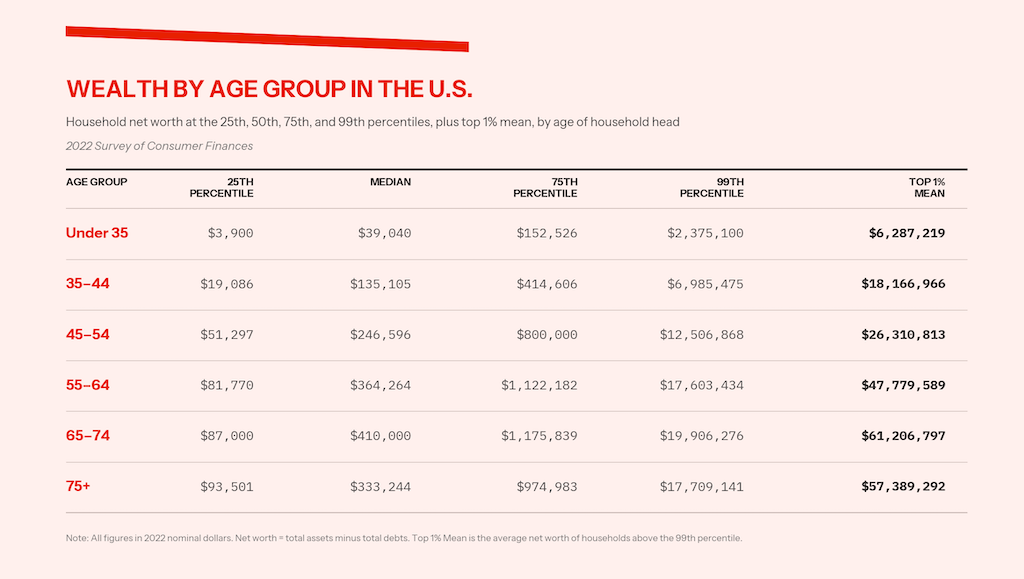
Older households are wealthier.
That’s no surprise, given that they’ve had longer to save.
But wealth inequality within age
groups swamps wealth inequality between them. The median household aged
sixty-five to seventy-four has three times the wealth of the median household
aged thirty-five to forty-four. But the 99th percentile of households aged thirty-five
to forty-four has fifty times the wealth of that group’s median, and the top 1
percent of households aged thirty-five to forty-four average 134 times the
median.
The 99th percentile of households
aged sixty-five to seventy-four holds forty-seven times their age group’s
median, while the top 1 percent averages 147 times the median. The lack of
wealth at the bottom is just as consistent. The 25th percentile never exceeds
half the overall median in any age group.
Making matters more complicated:
even though older households are wealthier, on average, for most households
over sixty-five, that wealth isn’t liquid. Instead, it’s equity in their
primary residence.
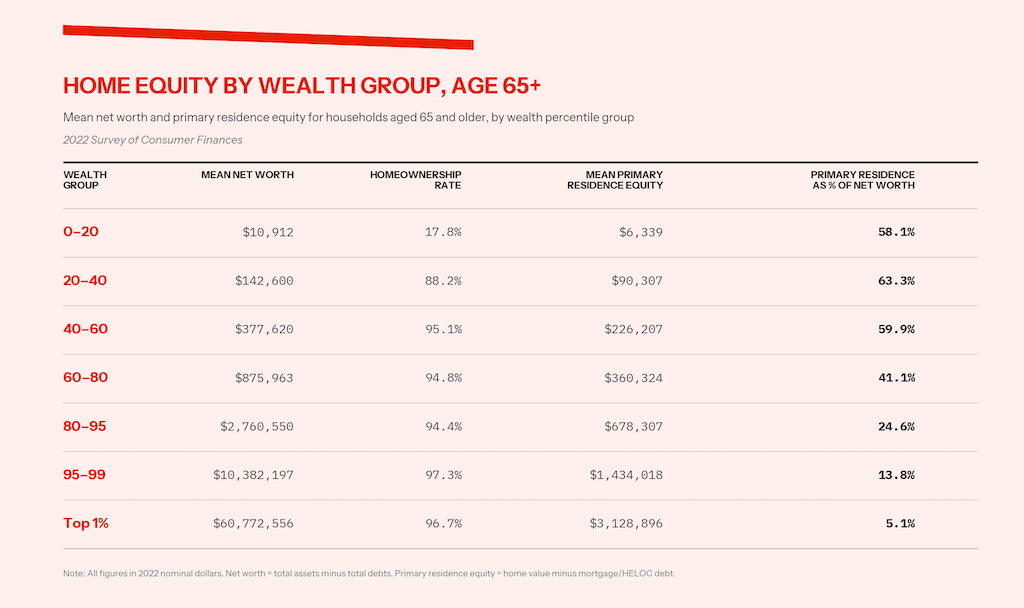
Nearly 60 percent of the roughly
$375,000 in wealth held by the middle wealth quintile of over-sixty-five
households is composed of home equity. For the bottom 60 percent of elderly
households, the primary residence accounts for most of their net worth. It’s
only within the top fifth of households over sixty-five that a significant
portion of wealth comes from something other than their primary residence.
Non-white older households
are especially
likely to have their wealth tied up in their home they occupy.
Moreover, the percentage of homeowners over sixty-five with a mortgage has
nearly doubled, from 21 percent to 39 percent, since 1989.
Things look even worse for older
households when it comes to income. SCF data is pre-tax, but includes wage
income, pensions, Social Security, and other cash transfers.
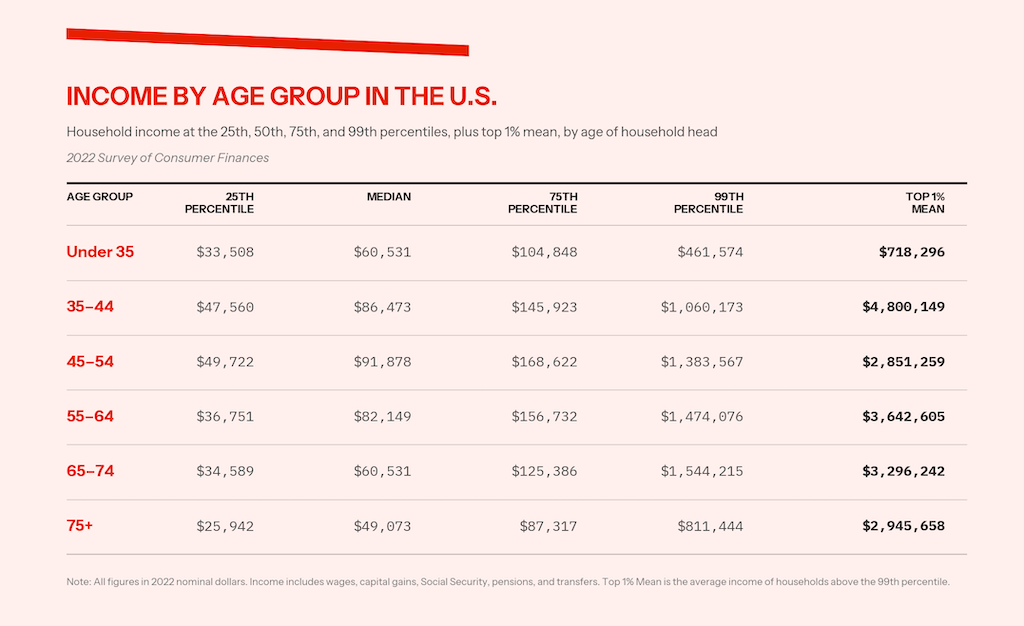
Households over seventy-five have
the lowest household income of approximately $50,000. The sixty-five to
seventy-four and under thirty-five age groups are next, both making about
$60,000 per year. Individual,
rather than household, income data from the census shows the same pattern.
Americans sixty-five and older
have the lowest income — approximately $35,000, including Social
Security — of any age group besides those between fifteen and twenty-five. This
isn’t surprising, given that both age groups largely consist of people who are
too young or too old to work. Transferring money from working-age adults to
kids and the elderly is one of the main
functions of all welfare states.
It’s also worth considering that
the elderly — like lower-income people more broadly —
face higher inflation rates.
The “Elder Index,” published by the Gerontology Institute at the University of Massachusetts
Boston, is a county-level estimate of the income older adults need to meet
basic living expenses without relying on family support or means-tested public
assistance.
Nationally, for a couple in good
health, the index estimates annual costs of roughly $38,000 for homeowners
without a mortgage, $47,000 for renters, and $52,000 for homeowners with a
mortgage. Depending on the data source, between 25 and 45 percent of older
households fall below those
thresholds. As a result, about a third of midlife adults provide financial
support to their parents, underscoring the reality that younger generations’
financial security is imperiled by older generations’ lack thereof.
Even if most elderly households aren’t
rich now, that doesn’t settle the question of whether Gen X, millennials, and
Gen Z are worse off than boomers were at similar ages. But historical SCF data
allows for those comparisons.
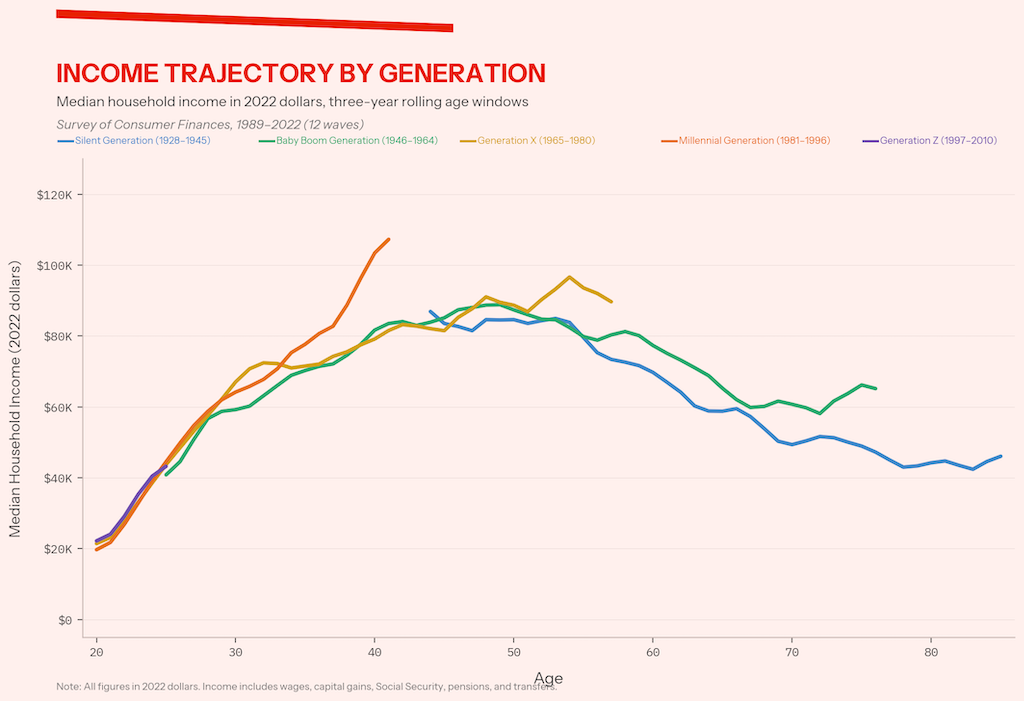
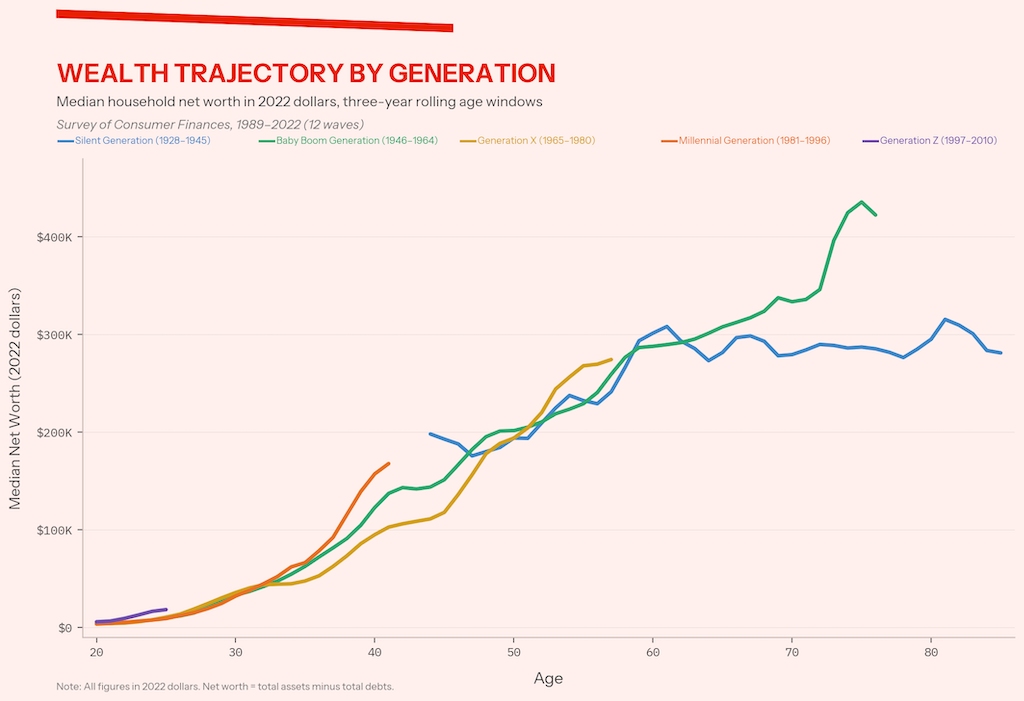
While baby boomers fared better
than the Silent Generation, younger generations have all done just as well as —
or even better than — boomers. Younger households fare even
better relative to boomers when including taxes and adjusting for
falling household sizes.
There’s good reason not to be
Pollyannaish about the economic fortunes of younger generations, however. While
the SCF suggests that the median millennial household is wealthier than its
boomer counterpart at the same age, studies using other surveys find that
poor and middle-class millennials are worse off, while wealthy millennials are
much better off, than comparable boomers.
Because these surveys are older
than the SCF — and millennials have experienced the strongest wealth
growth in recent years — they may paint an overly pessimistic picture of the
median millennial today. Nonetheless, they underscore the importance of the
within-generation inequality ignored by the TBLC discourse’s cross-generational
focus. Indeed, by some measures, millennials are the most
unequal generation in US history.
There’s also evidence that
millennials are less
likely to experience absolute upward mobility — that is, earn more
than their parents in real terms — than any generation in modern US history.
Moreover, home ownership rates for both millennials and Zoomers lag behind previous
generations’ rates at similar ages, regardless of
education level or income,
thanks to the twin albatrosses of
rising housing prices and student loan debt.
Ultimately, there’s little
evidence to support the TBLC claim that boomer retirees are living in a
“Marxist paradise.” More importantly, the worse off one believes Gen X,
millennials, and Gen Z are compared to boomers, the more intergenerationally
unjust the cuts to Social Security proposed by conservatives are.
CONSERVATIVES’ GENERATIONAL MYTHS
As with earlier attempts to
persuade younger generations to support cuts to old-age benefits, proponents of
the TBLC narrative hope to create the impression that cutting Social Security
would allow younger Americans to stick it to supposedly “greedy geezers.”
Last month, conservative Washington
Post columnist Ramesh Ponnuru declared,
“Don’t Save Social Security.” Echoing the TBLC discourse, Ponnuru argued that
the program simply funnels money to already-well-off retirees — citing the common conservative talking point that
a rich retired couple could receive $100,000 in benefits each year.
He also contended that Social
Security is too generous to middle-income retirees, since “a middle-class worker
who retires in the next decade will, on average, receive 47 percent more than
the sum of what the person paid in taxes and the interest on that money,” while
simultaneously being too stingy to poor ones, given that “even though Social
Security paid out $1.6 trillion last year, around 6 percent of seniors still
live in poverty.” His solution? Raise the retirement age and replace the
current benefit formula with a flat payment of roughly $1,350 per month.
In mid-March, MacGuineas appeared before
Republican Ron Johnson’s Senate Finance Subcommittee on Fiscal Responsibility
and Economic Growth. In her testimony, she claimed that “seniors are the
richest” Americans, decried the “generational imbalance” of current spending,
and warned of “generational resentment.”
Having previously coauthored
a plan to
cut and partially privatize Social Security, she called for “reforms” to
old-age programs and proposed creating another Simpson-Bowles-style fiscal
commission to enact them. Following her testimony, Johnson — who has called Social
Security a “Ponzi scheme” and proposed privatizing
it — posted a
video of her remarks on social media, writing, “It is immoral what we are doing
to our children and grandchildren.”
Critics portray Social Security as
too generous to well-off retirees and too stingy to poor ones, while also being
a great deal for boomers and a terrible deal for younger generations; neither
claim holds up to scrutiny.
Critics thus portray Social
Security as a system that is too generous to well-off retirees and too stingy
to poor ones, while also being a great deal for boomers and a terrible deal for
younger generations. Neither claim holds up to scrutiny.
Social Security is a progressive
system designed to provide proportionally higher benefits to workers with lower
earnings. Benefits are calculated using a formula that replaces 90 percent of
the first $1,024 of a worker’s average monthly earnings, 32 percent of earnings
between $1,024 and $6,172, and 15 percent above that level. As a result,
lower-income workers receive benefits that replace a larger share of their
preretirement income than higher earners.
Despite conservatives’ frequent
invocation of couples collecting $100,000 per year in Social Security benefits,
most retirees receive far more modest payments. The mean monthly
retirement benefit is
about $1,975, while the median is roughly $1,195. Just 13 percent of retirees receive
more than $3,000 per month, and fewer than 3 percent receive over $4,000.
Among households over sixty-five,
the middle quintile receives about $2,400 per month in Social Security
benefits. For the bottom 80 percent of households, moreover, Social Security
provides a substantial
share of total income — a crucial consideration when evaluating any
changes to benefits.
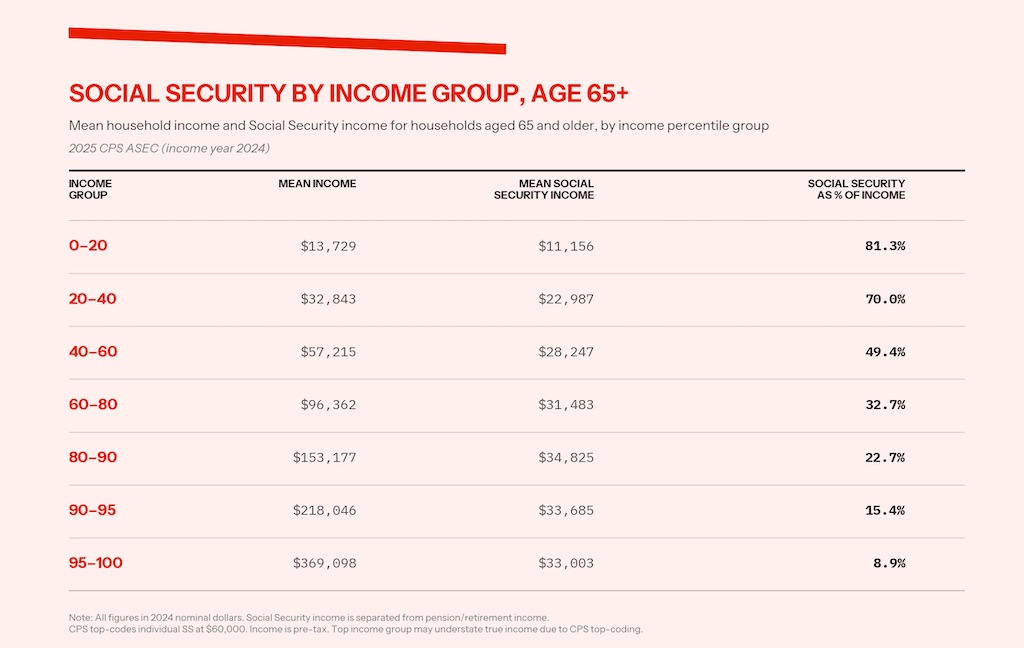
How many households actually
receive $100,000 or more per year in Social Security benefits? Just two-tenths
of 1 percent, according to Current Population Survey data. In fact, only about
5 percent of households receive $60,000 or more. That’s why proposals to establish an
inflation-adjusted $100,000 benefit cap don’t save much in the short run but
generate growing long-term savings by eroding the share of preretirement wages
replaced by Social Security for both the rich and upper-middle class workers,
since wages grow faster than inflation.
Contrary to the idea that Social
Security is short-changing younger generations, the system is structured to be
more generous to Americans born in the 1970s, 1980s, and 1990s — roughly Gen X
and millennials — provided that benefits aren’t cut before they reach
retirement age.
The nonpartisan Congressional
Budget Office (CBO) publishes projections for Social
Security that include lifetime benefits and lifetime taxes for each decade’s
birth cohort and earnings quintiles. The projections include two scenarios:
benefits scheduled under current law and benefits payable if Congress takes no
action and lets across-the-board cuts take effect upon trust fund depletion.
The benefit-to-tax ratio shows
whether each cohort and income group will receive more in lifetime benefits
than it contributes in lifetime taxes, with both valued in 2025 dollars
discounted to age sixty-five at the average interest rate on federal debt.
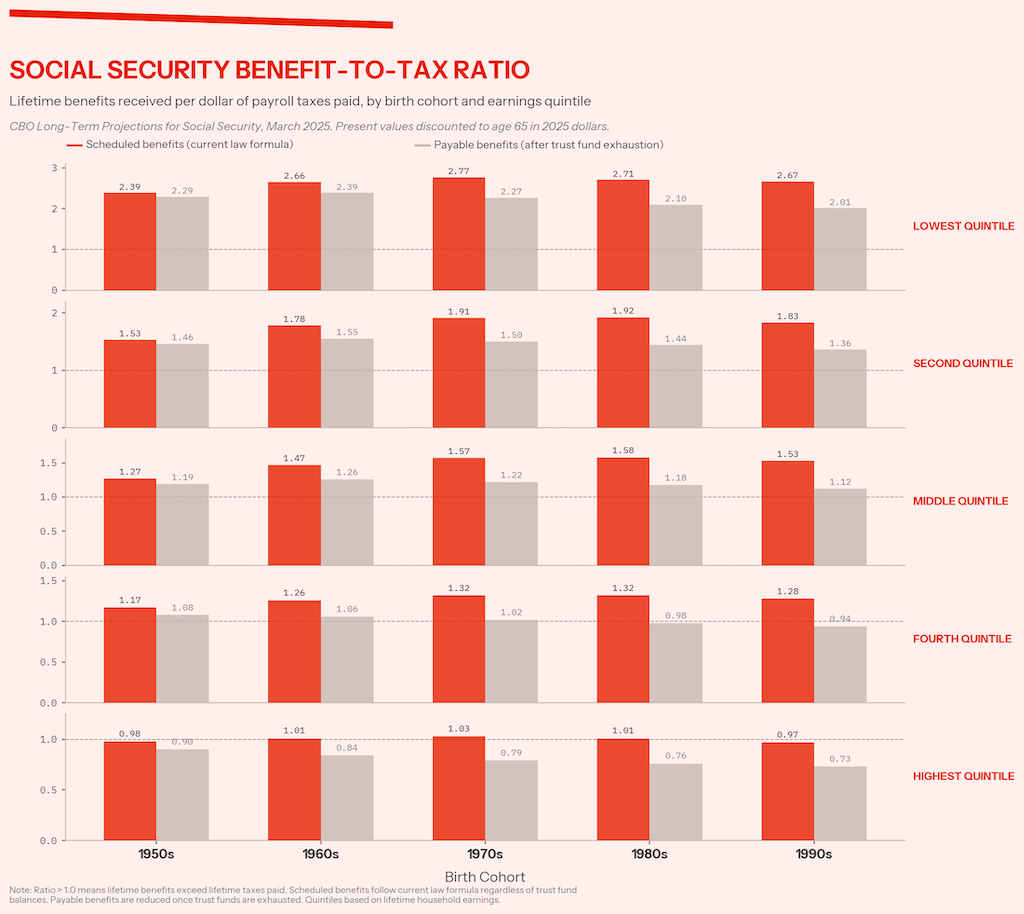
With the partial exception of the
highest quintile, the three younger cohorts’ benefit-to-tax ratio exceeds the
ratios for those born in the 1950s and 1960s, unless benefits are cut.
In other words, cuts to Social
Security — not Social Security’s benefit structure itself — would make
conservatives’ generational criticism of Social Security true. Other estimates of
Social Security’s benefit-to-tax ratio by birth cohort reach the same
conclusion.
The CBO’s benefit-to-tax ratio is
also the source for claims like Ponnuru’s that workers receive “more than the
sum of what the person paid in taxes and the interest on that money.”
Cuts to Social Security would make
conservatives’ generational criticism of Social Security true.
Yet this raises an obvious
question: If Social Security returns more than workers contribute, how can
conservatives simultaneously claim that the
program is a “very bad deal” and that, as President George W. Bush put
it during his privatization push, workers’ “money will grow, over
time, [in private accounts] at a greater rate than anything the current system
can deliver”?
The CBO figures assume a real rate of
return below 1 percent — specifically, the average interest rate on outstanding
federal debt. This is the rate at which the federal government itself borrows
money. It is not the rate that the Social Security trust fund earns on its
reserves, which is roughly 2.6
percent.
It’s also not the effective rate
of return that retirees of various income levels get on their payroll taxes.
The Social Security Administration (SSA) does publish those internal real rates
of return for workers of various income levels and birth years, though.
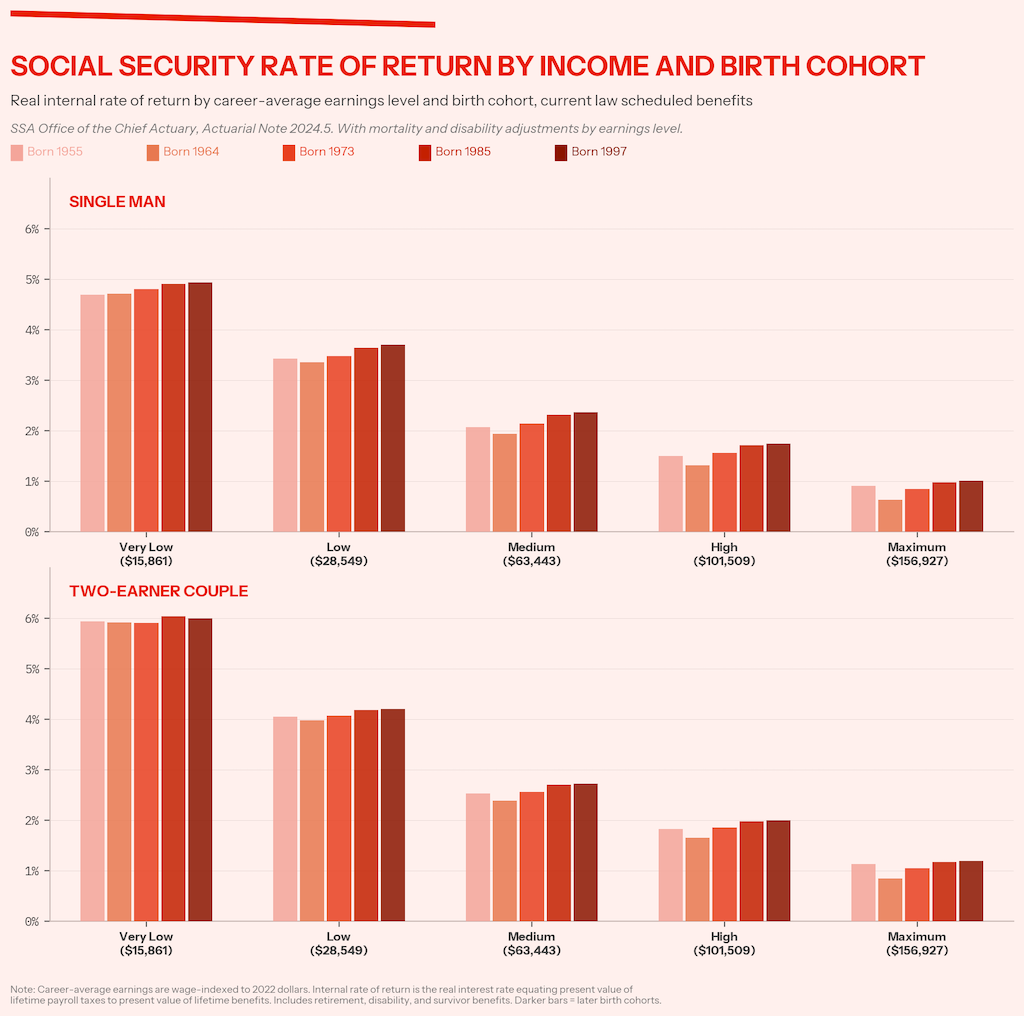
The SSA’s data shows that — even
before considering market volatility and other downsides — it would be hard for
private accounts to exceed Social Security’s returns for lower- and
middle-income workers. That’s why studies that account for risk, fees, and
transition costs find that privatization wouldn’t deliver better returns for most workers —
particularly lower- and middle-income earners.
So the ultimate question is: How
do we prevent the across-the-board cuts to Social Security that would, in fact,
make it a worse deal for younger generations than older ones?
The answer reveals the central
bait and switch of both the TBLC narrative and the entire “generational equity”
framework. The only scenarios in which Social Security becomes a worse deal for
younger generations are the ones TBLC proponents support, while the proposals
that would ensure Gen Xers, millennials, and Zoomers are treated as well as
— or better than — boomers are the ones they oppose.
CUTTING SOCIAL SECURITY (FOR YOUNGER GENERATIONS)
Beyond outright privatization,
conservatives’ preferred solution to Social Security’s seventy-five-year
shortfall is to cut benefits. Specifically, conservatives have put forward
numerous proposals to transform Social Security into a flat benefit, ranging
from Andrew Biggs’s $1,025 per
month to Ponnuru’s $1,350 to Greene’s $1,250. Biggs,
a staffer at the conservative American Enterprise Institute (AEI), has
also endorsed proposals
that would set monthly benefits at either 125 percent (about $1,660 per month)
or 150 percent (about $2,000 per month) of the federal poverty level.
Alternatively, he’s proposed retaining earnings-based benefits while imposing a
roughly $3,500 per month cap.
With the exception of the $3,500
cap, all of these proposals would impose drastic benefit cuts on future
retirees. Right now, nearly 90 percent of retired workers receive more
than $1,025 per month, 80 percent more than $1,250, 75 percent more than
$1,350, 60 percent more than $1,660, and half receive more than $2,000.
Most of Social Security’s critics
would prefer that the program didn’t exist. That their reform proposals result
in a system that’s a terrible deal for younger generations is a feature, not a
bug.
While flat benefits would boost
benefits for those at the bottom, their value would erode over time. Currently,
initial Social Security benefits are indexed to wage growth — something
that conservatives have often criticized.
Only the $1,025 per month proposal maintains that. The others that specify
adjustments tie initial benefits to inflation. That means that flat benefit
proposals level up fewer
and fewer low-income retirees as each generation passes, since
inflation tends to grow more slowly than wages. The $2,000 per month flat
benefit would boost payments for approximately the bottom 40 percent of the
1970s cohort but only the bottom 20 percent of the 1990s cohort.
In fact, the vast majority of
workers in the post-1960s cohorts would actually be better off with the
automatic across-the-board cuts than with the lower flat benefit proposals.
Even with the most generous flat benefit of $2,000 per month, 60
percent of the 1990s cohort would be better off with the across-the-board cut.
Previous Republican plans don’t
fare better in terms of progressivity or “generational equity.” Paul Ryan’s
aforementioned “Roadmap for America’s Future” proposed a variety of changes to
Social Security. Ryan’s plan would’ve partially indexed initial benefits to
inflation rather than wage growth, raised the retirement age for younger
workers, and indexed yearly benefit growth to a version of the Consumer Price
Index (CPI) that grows more slowly — despite the fact, as noted above, that
elderly people tend to face higher rates of inflation. This would all come on
top of partially privatizing the program.
The combined effects of the three
benefit changes would’ve cut benefits by
age seventy-five for retirees born in 1985 by 11 percent for a low earner
(approximately $19,000 in 2010 dollars), 26 percent for a medium earner
($43,000), and 33 percent for a high earner (high earner ($69,000). Ryan’s cuts
would be deeper for younger cohorts, growing by roughly 4 to 8 percentage
points per decade depending on earnings level.
Nor did the private accounts
rescue the plan. The CBO modeled the
private accounts against the payable, rather than scheduled benefits, baseline;
that is, it assumed that benefit cuts would take place upon the trust fund’s
depletion. Even then, it projected that most younger generations would be no
better off under Ryan’s plan than under the automatic cuts themselves — and
worse off compared to what they’d been promised under scheduled benefits.
The Simpson-Bowles proposals
changed Social Security’s benefit formula, raised the retirement age,
introduced a new minimum benefit, and switched to the same slower-growing CPI
used in Ryan’s plan, along with slightly increasing the payroll tax cap.
The commission’s plan
went through several revisions,
but the final
version analyzed by the SSA would have raised benefits at age seventy-five for
approximately 30 percent of low-income retirees born in 1985, while cutting
benefits for everyone else. A medium earner would’ve seen a cut of 15 percent,
a high earner 30 percent.
The cuts deepened both with income
and each succeeding generation. Benefits for all workers would converge to a
narrow range between $850 and $1,250 per month. As the Center on Budget and
Policy Priorities put
it, “In the long run, most workers would end up getting very similar
benefits, despite having paid very different amounts in payroll taxes.”
In 2016, Republican Sam Johnson,
the chair of the House Ways and Means Subcommittee on Social Security, put out
a proposal with many of the same changes as Simpson-Bowles, except that it
eliminated cost-of-living adjustments for higher-income retirees and eschewed
any tax increases. For those born in 1985, a new minimum benefit would have
slightly boosted benefits for roughly 25 percent of low-wage workers but
imposed cuts on most — between 17 and 28 percent for a medium earner
(approximately $50,000 in 2016 dollars) and 33 percent for a high earner
($80,000). It also proposed raising the full retirement age to sixty-nine by
2030.
Raising the retirement age is, in
fact, central to
virtually every conservative or centrist Social Security proposal, even though
increases in longevity have been concentrated among upper-income Americans.
As one study summarized,
today “the richest American men live fifteen years longer than the poorest men,
while the richest American women live ten years longer than the poorest women.”
In other words, raising the
retirement age would concentrate its costs on poor and working-class members of
younger generations — the very group that proponents of “generational equity”
claim to care about most. It is, in effect, a benefit cut engineered to fall
hardest on the millennials stocking shelves and driving trucks, and lightest on
those managing hedge funds.
All the same, these proposals were
touted by conservative think tanks and Peterson-backed groups focused on
deficit reduction and generational accounting. The CRFB, for example, praised Ryan’s
“Roadmap,” arguing that
he “deserves a blue ribbon for fiscal courage.” The CRFB’s senior policy
director, Marc Goldwein, served on the Simpson-Bowles commission’s staff, and
the CRFB wrote that
Johnson “should be commended for putting forward a serious plan to make Social
Security financially sustainable.”
The CRFB’s own 2019 Social
Security proposal —
drafted by MacGuineas, Goldwein, and Chris Towner — incorporated elements
of the Ryan, Simpson-Bowles, and Johnson plans, including an altered benefit
formula, a slower-growing measure of inflation, an increased retirement age,
and add-on private accounts. The proposal is billed as “maximiz[ing]
generational fairness.”
For all their talk of
“generational equity,” the originators of TBLC-style narratives have
consistently championed plans that
impose nearly all of their cuts on younger generations. Few of the proposals
they praise would apply changes to current retirees, the demonized boomers.
MacGuineas made this explicit in
her recent Senate testimony, assuring Americans that “current seniors do not
need to worry about [cuts].” Even cuts that do apply to current retirees, such
as the Simpson-Bowles CPI change, would hit younger generations harder, since
the boomers have already collected a substantial share of their benefits.
Tellingly, the CRFB praised Johnson’s proposal even though it would’ve boosted
the incomes of rich boomers by eliminating income taxes on Social Security benefits
— a provision that currently only affects upper-income retirees.
What gives?
The truth is that most of Social
Security’s critics would prefer that the program didn’t exist. That their
reform proposals result in a system that’s a terrible deal for younger
generations is a feature, not a bug. The worse Social Security becomes, the
more likely it is that future generations will eventually turn against it and
embrace privatization.
Raising the retirement age would
concentrate its costs on poor and working-class members of younger generations
— the very group that proponents of ‘generational equity’ claim to care about
most.
They’re also anxious to avoid tax
increases — at least on the rich. As Greene noted, proponents of the TBLC
framework want to “align Wall Street, the defense industrial complex, corporate
America, and the media against TBLC,” because “the alternative is tax hikes.”
In a November essay,
“Start Demagoguing Against the Old,” which has been cited by
Greene, erstwhile far-right provocateur Richard Hanania put the stakes in stark
terms. He argued that the popularity of Social Security and Medicare proved
that “you should have contempt for the political views of most people.”
According to Hanania, “there’s
nobody less deserving of being the beneficiaries of the welfare state than the
old,” because “poverty becomes more blameworthy with age.” Hanania warned that
unless the public could be persuaded that “the energies of the young and
productive are [being] sucked dry to continually make life more and more
comfortable for those on death’s door,” the result would be “anti-rich
demagoguery” and tax hikes on the well-off.
Indeed, both the CRFB and Third
Way have framed raising
taxes on the rich as a mythical solution
to Social Security’s shortfall, and AEI’s Biggs has written,
“If there were an easy way to fix Social Security, it would have been done by
now.”
But raising taxes on the rich is
the “easy way.” It’s just that these organizations — and, especially, their
wealthy donors — don’t want it to happen.
SAVING SOCIAL SECURITY BY TAXING THE RICH
The overarching public policy goal
of the American political right and the Republican Party for the past five decades
has been cutting taxes for the rich. From Reagan’s 1981 tax cuts through Bush’s
2001 cuts to Trump’s 2017 and 2025 cuts, the first thing almost every
Republican president does upon taking office is pass a top-heavy tax
cut.
As a result, each time Republicans
have left the White House, taxes on the rich have been lower than
when they entered. Amid shifting positions on issues like trade and immigration,
it’s the one thing that Republicans can agree on.
Besides soaring incomes for the
rich, the upshot has been worsening deficits over the
course of each Republican president’s team since Reagan. Far from accidental,
this has been part of a concerted conservative strategy to “intentionally
increase the national debt through tax cuts in order to bind the hands of a
subsequent liberal government,” as Bruce Bartlett has summarized.
This strategy has largely succeeded in turning Democratic presidents into
deficit-conscious “Eisenhower
Republicans” by the end of their terms, with the encouragement of the
aforementioned corporate-backed “deficit hawk” groups.
But in recent years, Republicans’
strategy of passing bills that pair a huge tax cut for the very rich with small
ones for lower- and middle-income Americans has hit a snag. After decades of
cuts, federal income taxes — as opposed to regressive payroll, state, and
local taxes — are
too low on most Americans for there to be much to cut. In response, Republicans
at the national level have borrowed a strategy from their counterparts at the
state level: pairing tax cuts for the rich with tax hikes on the poor.
Just as Ryan’s “Roadmap” would
have dramatically boosted incomes
at the top while cutting them for the middle class, both 2017’s Tax Cuts and
Jobs Act (TCJA) and 2025’s combination of the One Big Beautiful Bill Act
(OBBBA) and tariff increases have followed the same pattern: lowering federal
taxes for the rich while raising them on nearly everyone else.
The TCJA even borrowed a tool from
conservative Social Security proposals, switching the inflation measure used to
index tax brackets to a slower-growing one, producing “bracket
creep” that will gradually push lower- and middle-income taxpayers into higher
brackets over time, a stealth tax increase that
even the Cato Institute has criticized in
the past. The OBBBA and tariffs are starker still.
According to the Budget Lab at Yale, the combined effect is a reduction in
income for the bottom 90 percent of households and an increase for the top 10
percent.
Republican Senator Ted Cruz is
even pushing Trump’s Treasury
to unilaterally cut capital gains taxes by allowing taxpayers to subtract
inflation from their gains. This proposal has been rejected by
several Republican administrations in the past as an unconstitutional
usurpation of Congress’s power of the purse, but there’s no telling what might
happen today. Slashing capital gains taxes has been one of the Right’s primary
goals since the 1970s, and the benefits of Cruz’s proposal would accrue
almost wholly to
the top 1 percent.
Democrats must break the cycle of
top-heavy tax cuts, and the Social Security payroll tax cap is the perfect
place to start.
Social Security’s projected
seventy-five-year shortfall is roughly 1.3 to 1.5 percent of GDP. To
put that into perspective, the United States spends 7.3
percent of its GDP on old-age pensions and survivors’ benefits. Contrary to
TBLC proponents’ claim that Social Security is too generous, that’s below the
thirty-eight-country OECD average, as is the share of recipients’ pre-retirement income replaced by
Social Security.
Where is the US below average?
Revenue. The average country of the Organisation for Economic Co-operation and
Development (OECD) collects 34.1 percent of its GDP in taxes, while the United
States collects just 25.6 percent, and the gap between the United States and
the OECD average has grown in the past twenty-five years.
Republicans at the national level
have borrowed a strategy from their counterparts at the state level: pairing
tax cuts for the rich with tax hikes on the poor.
The SSA publishes a comprehensive
list of proposed changes to Social Security, and the CRFB incorporates
some of them into its interactive Social Security “Reformer” tool. Looking at
either, the inescapable conclusion is that the single easiest way to improve
Social Security’s long-term solvency is to eliminate the payroll tax cap
without proportionally boosting benefits for the rich. This single change would eliminate two-thirds
of Social Security seventy-five-year shortfall. Amusingly, President Bush floated the idea of
raising the cap, provided the revenue went toward his private accounts.
Why does removing Social
Security’s payroll tax cap have such a large effect? Because income inequality
has soared in the past fifty years. As a larger and larger share of
total income flows to the rich, more of it escapes Social Security taxation. In
1983, 10 percent of income was above the
cap. Today, more than 16 percent is. Compared to other OECD countries, our
payroll tax cap is
low.
While eliminating the Social
Security payroll tax cap isn’t a popular change with conservatives, it is with
the public. Many Americans don’t even know that
Social Security’s payroll tax is capped. Currently, Americans don’t pay Social
Security payroll taxes on income above $184,500. Only
about 6 percent of
workers a year make more than that. In other words, a tax increase that only
affects the richest 6 percent of Americans each year would fix 67 percent of
Social Security’s seventy-five-year shortfall.
This is also the most popular
reform according to polls. Throughout the Bush- and Obama-era reform debates,
between two-thirds and 80
percent of Americans supported eliminating the cap. Recent surveys have
found similar proportions.
The most notable is a recent
National Academy of Social Insurance (NASI) survey that
used trade-off analysis “to learn which of various packages of Social Security
policy changes Americans want and are willing to pay for, via their impact on
the financing gap.” Unlike single-issue polling, this “forces respondents to
weigh the costs of options holistically versus considering individual options
in isolation.”
The NASI found that eliminating
the Social Security payroll tax cap was the most popular reform idea, favored
by 68 percent of respondents, including majorities of all income, age,
education, and political groups. As NASI summarized, “By far respondents’
greatest aversion is to any reform package that does not change the payroll tax
cap.”
The NASI tested both a total
elimination of the cap and lifting the cap above $400,000. The latter proposal
would leave an untaxed “donut hole” between $184,500 and $400,000 but would
comply with President Joe Biden’s foolish pledge not to raise taxes on the
middle class, which he preposterously implied extended
to $400,000. The NASI’s study, though, found that a total elimination was more
popular than the $400,000 threshold.
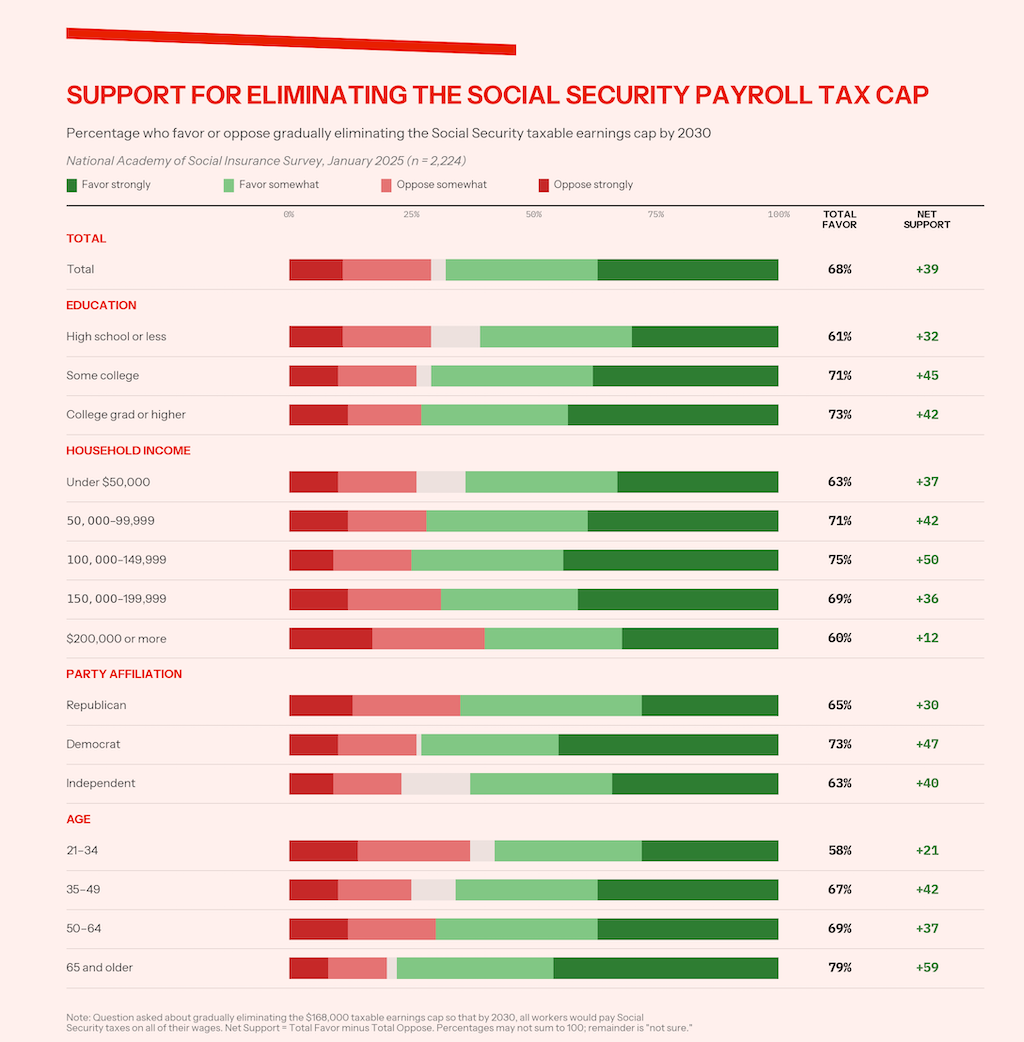
Even a recent Cato Institute survey question
that primed a negative reaction by saying that eliminating the Social Security
payroll tax cap “would cover only part of the shortfall and could discourage
work” found 2:1 support for its elimination, which is perhaps why Cato left the
question out of its report.
The public’s views on eliminating
the Social Security payroll tax cap are part of a broader pattern
of public support for
raising taxes on the rich and opposition
to cutting Social
Security or Medicare. According to the NASI study, “Respondents also
have a strong aversion to any reform package that increases the retirement age
to 69 or reduces the cost-of-living adjustment — two policies that would reduce
benefits.” Indeed, 64 percent said they wanted Social Security to adjust
benefits according to the faster-rising inflation measure that better reflects
seniors’ cost of living.
Most Americans would even prefer raising their
own payroll taxes to cutting Social Security. The NASI study, for
example, found that “only 15 percent of respondents say we shouldn’t raise
taxes on any American even if it means reducing benefits.” Fifty-seven percent
specifically supported gradually raising the payroll tax rates by 2 percentage
points.
This change would eliminate 39
percent of Social Security’s seventy-five-year shortfall. It would also be
better for Americans born in the 1970s, 1980s, and 1990s than automatic cuts or
any of conservatives’ flat benefit proposals. An immediate increase of 1.25
points would eliminate roughly a third of the shortfall, while also ensuring
that the vast majority of those cohorts would also enjoy higher benefit-to-tax
ratios than those born in the 1950s.
The single easiest way to improve
Social Security’s long-term solvency is to eliminate the payroll tax cap
without proportionally boosting benefits for the rich.
The Cato survey ironically ended
up reaching similar conclusions, despite seemingly intending to generate a
Luntz-like UFO viral talking point. The few news stories on Cato’s survey
writeup foregrounded a
“generational divide” on Social Security based on a question framed to suggest
that younger generations preferred cutting benefits to raising taxes. However,
Cato’s report noted that “Americans under age 30 are about as likely as older
Americans to support increasing taxes to maintain Social Security benefits.”
Only when another question posited
a scenario where they “would eventually get back less than they paid in” did
younger respondents turn against tax hikes.
Moreover, even if younger
Americans were to express a relative willingness to cut Social Security, that
doesn’t mean it’s a durable viewpoint. Decades of propaganda have told them the
program won’t be there for them, and younger people tend not to worry much
about a retirement that’s still decades away. During Bush’s Social Security
privatization push, some polls found
that most Gen Xers were open to private accounts. But those are now the same
fiftysomethings strongly opposed to cuts, according to both the NASI and Cato
surveys.
Even if Americans of all ages are
willing to raise their own payroll taxes, that option should take a back seat
to taxing the well-off, which is essential to
addressing the real inequality in the United States — the gap between rich and
poor, not young and old.
DISTRIBUTIONAL FAIRNESS TRUMPS “GENERATIONAL FAIRNESS”
Both marginal and effective tax rates on
the ultrarich have fallen sharply
since the “Great
Compression” of the mid-twentieth century, when income inequality in the
United States was low and average workers enjoyed strong real wage growth.
Today the richest Americans often pay lower effective
tax rates than the middle class, whether measured against their income or
their wealth.
Soaring inequality has
reshaped the income distribution. Since 1979, real incomes of the middle class
have grown 65 percent after taxes and transfers, while those of the very
richest have grown by more than 600 percent, according to the CBO.
This may even understate the gap, considering that the well-off tend to face
lower inflation rates than
those further down the income distribution.
One recent study found
that while the income gap between the richest and poorest households grew 16 percent
between 2002 and 2019 according to typical cost-of-living measures, it rose to
23 percent when accounting for the unequal inflation rates faced by different
households.
Conservatives have dubiously attempted to
downplay these trends. They also insist that raising taxes on the rich
will harm economic
growth, even if it reduces inequality. But there’s little reason to take these
arguments seriously.
Falling taxes on the rich have
fueled rising inequality not only by directly boosting their after-tax incomes
but also by indirectly incentivizing their rent-seeking behavior —
extracting wealth rather than creating it. Research shows that “a lower top tax
rate increases the rate of return to efforts demanding greater compensation
from boards of directors,” as economist Andrew Fieldhouse has summarized.
These boards are often composed of
fellow executives,
creating a mutual back-scratching dynamic that professor Edward Lawler has
captured well. “You don’t have to be a compensation expert to realize that if
you vote for one of your peers to have a higher salary, you are in effect
voting for your own salary to go up, because it is based on what will be a
higher market,” he notes.
CEO pay has skyrocketed 1,322
percent since 1978, pushing the CEO-to-worker compensation ratio from
31:1 in 1978 to 281:1 today.
As a larger and larger share of
total income flows to the rich, more of it escapes Social Security taxation.
Making matters worse, numerous
studies have found that the ultrarich then use their inflated incomes to lobby
for tax cuts and other policies that further enrich them. Since the Supreme
Court gutted campaign
finance laws in the 2010 Citizens United v. FEC decision, the
influence of the rich in US politics has exploded.
Prior to Citizens United, the share of spending on federal elections
by three hundred billionaires and their families was just 0.3 percent. By 2024,
it had jumped to 14 percent.
This has exacerbated
politicians’ preexisting tendency
to cater to the preferences of the rich. As one team of researchers found that “politicians
who receive a larger share of their campaign funding from the top one percent
donors are more likely to shift their voting toward the preferences of the
wealthy,” especially on economic issues “such as taxation, regulation, and
social welfare programs,” where “top earners have more convergent — and mostly
conservative — views.”
The result is a vicious cycle
whereby each inequality-driven increase in
political donations leads to the enactment of policies that boost the incomes
of the well-off, which begets a further increase in their donations and another
round of inequality-increasing policies.
As political scientists Adam
Bonica and Howard Rosenthal have explained,
“If Republicans promote policies — such as tax changes — that make their
current donors immediately wealthier, they can expect a proportional increase
in total donations.” Ultimately, as another study concluded,
“The erosion of tax progressivity has contributed to raise the political clout
of wealthy individuals, via campaign donations,” creating a “spiral between
economic inequality and uneven political influence.”
Nor is it clear that raising taxes
at the top will harm economic growth, despite the claims of conservative “supply–side“
logic. The most persuasive evidence finds no support for
the idea that low taxes on the rich increased economic growth.
A recent widely
cited study by David Hope and Julian Limberg of the London School of
Economics looked at the economic effects of major tax cuts for the rich in
eighteen wealthy countries over a fifty-year period. They found that cuts
reliably boosted the incomes of the rich but influenced GDP and employment at a
level that was “statistically indistinguishable from zero.” Indeed, a
growing body of research suggests that,
contrary to conservatives’ claims, income redistribution and lower inequality
actually improve growth.
Even if raising taxes on the rich
were to pose a trade-off between growth and equality, it’s not clear why most
Americans should prioritize the former over the latter. Over the past five
decades, the benefits of rising GDP and productivity have flowed to the
top. In a 2017 study of
the distribution of economic growth in the United States since World War II,
economist Pavlina Tcherneva found that “with every postwar expansion, as the
economy grew, the bottom 90 percent of households received a smaller and smaller
share of that growth.”
The tight labor market and
redistributive policies of the COVID-19 pandemic temporarily reversed this
trend, but the gains for
lower- and middle-income workers have already begun to erode —
a trend that President Trump’s regressive tariffs and top-heavy tax cuts have
exacerbated.
That trend is directly related to
the incentives created by low taxes on the very rich. As Fieldhouse explained,
executives’ “successful efforts [to boost their compensation] will come out of
workers’ paychecks, not shareholders’ portfolios.” By one estimate,
rising inequality since 1979 has cost middle-income households roughly $40,000
per year.
This inequality, rather than too-slow
growth, is also the primary cause of younger generations’ declining odds of
earning more than their parents in real terms. As the New York
Times explained,
the research team studying intergenerational mobility
ran a clever simulation recreating the last several decades with the
same GDP growth but without the post-1970 rise in inequality. When they did,
the share of 1980 babies who grew up to out-earn their parents jumped to 80
percent, from 50 percent. The rise was considerably smaller (to 62 percent) in
the simulation that kept inequality constant but imagined that growth returned
to its old, faster path [of the early post-WWII decades].
Beyond their economic and
political effects, taxes on the rich need to be raised to restore faith in the
tax system. For decades,
large majorities of the public have told pollsters that large corporations and
rich individuals don’t pay their fair share of
taxes. With leak after leak exposing
the elaborate tax avoidance schemes
of the ultrarich and President Trump declaring that escaping federal
income taxes “makes me smart,” it’s easy to see why the public is cynical about
the fairness of the tax system.
From President Clinton’s “Reinventing
Government” initiative to Trump’s Department of Government Efficiency
(DOGE) fiasco,
both Democratic and Republican presidents have been obsessed with rooting out
supposed waste, fraud, and abuse in the federal budget to restore faith in
government spending. But what about faith in the tax system? A recent Internal
Revenue Service (IRS) survey found
that more than 70 percent of Americans said that focusing on wealthy
individuals and corporations who exploit tax loopholes would help ensure that
other taxpayers “pay their taxes honestly.”
A cynical public might be willing
to pay higher taxes for overwhelmingly popular programs like Social Security
but not for other worthy policies. Republicans understand this.
When President Biden attempted to reduce tax avoidance by the rich by increasing IRS
funding, conservative groups organized against
it, despite its popularity.
Republicans then worked to rescind it piece by piece at
the same time that they were inserting new loopholes to benefit the rich.
Congress hasn’t attempted major
loophole-closing tax reform since
1986, and even that reform largely undid its
loophole-closing effects by dramatically cutting rates on upper-income earners.
But unless Democrats restore faith in the tax system, they’ll remain trapped in
the anti-tax
logic and donor-legislation feedback loop that reliably benefits the Right.
Beyond eliminating the Social
Security payroll tax cap, Democrats have plenty of options to
address the program’s remaining shortfall and fund other priorities by raising
taxes on the well-off.
Viewed yearly, Social Security’s
shortfall currently totals approximately $450 billion, with annual deficits
closer to $250 billion today and
larger ones in later years. The yearly “tax gap” — taxes owed that go uncollected — is
somewhere between $650 billion and $1 trillion per year. This gap is
driven primarily by
tax avoidance among the wealthy, and tougher IRS enforcement could close a
substantial portion of it.
Beyond their economic and
political effects, taxes on the rich need to be raised to restore faith in the
tax system.
Democrats should also focus
on eliminating “tax
expenditures” that benefit the well-off. The exclusion for employer-sponsored
retirement plans and IRAs costs between 0.9 and 1.3 percent of GDP each year.
Research shows these
tax incentives do little to boost retirement savings, and the benefits flow
disproportionately to the well-off. As the CBO has reported, “Households in the
highest quintile received more than 60 percent of the benefits of the
income tax expenditure. The two lowest quintiles together received less than
5 percent of the benefits.”
A bipartisan trio of scholars
has proposed wholly
or partially eliminating this tax expenditure and redirecting the savings to
shore up Social Security. They note that “rollbacks of the ineffective
retirement saving tax preference could fill a substantial portion of Social
Security’s long-term funding gap.”
The preferential rate on capital
gains is nearly as
large as the retirement tax expenditure and tilted even
more toward the
top, flowing almost wholly to the richest 1 percent.
Given how skewed capital gains are, many Americans are likely unaware that
investment income is taxed at a lower rate than labor income, and surveys show that
most Americans support eliminating the preference.
Effectively eliminating the
capital gains preference is challenging, given that the rich can change their
realization patterns to avoid higher rates. However, a wealth
tax, financial
transactions tax, or mark-to-market taxation
of investment income are viable responses. In terms of Social Security, the
SSA has modeled five different options for
taxing investment income to fund Social Security, using rates of either 6.2 or 12.4
percent. Depending on the specifics, these changes could close between 18 and
48 percent of Social Security’s long-term shortfall.
To create real intergenerational
equity, Democrats should also fix the estate tax. Currently, only the
wealthiest 0.14
percent of estates owe any tax, a share that’s fallen in the past
twenty-five years due to a series of Republican-led cuts.
But the estate tax is the most progressive tax
in the US tax system.
Given TBLC proponents’ professed
concern about the unfairness of boomers’ wealth, they should support using the
estate tax to capture the upcoming “great
wealth transfer” set to occur when boomers pass away. Failure to
adequately tax inherited wealth “increases wealth inequality within generations
and amplifies the inequality due to intergenerational wealth transfers.” If the
United States reverted to its 2001-era tax laws, the inheritance tax would
have raised $145
billion, rather than $18 billion, in 2021.
In addition to higher rates,
the current system could be improved by converting the estate tax to an inheritance
tax, which would “raise revenue, increase progressivity, broaden the income tax
base, improve equity, and boost economic mobility,” as a recent Brookings
Institution study summarized.
A key piece of effective reform is
eliminating the “stepped-up
basis” loophole,
which allows the wealthy to pass investments to their heirs without ever paying
capital gains taxes on the gains accrued during their lifetime. The best way to
eliminate that loophole would be to tax unrealized gains at death, which
would raise roughly
$536 billion per decade, according to the CBO.
Democrats should also undo many of
the recent cuts introduced by Trump and congressional Republicans. Beyond
reversing cuts to top brackets, Democrats should repeal the corporate tax cut
known as 100 percent bonus depreciation, which is expected to cost $362
billion per decade, as well as the hollowing
out of Biden’s corporate minimum tax, which was projected to raise
$222 billion per decade.
Particularly if the payroll tax
cap is removed, only a fraction of the above reforms would be needed to fix
Social Security’s long-term shortfall. But policymakers should consider
directing some of the revenue raised from progressive tax reform toward
rebuilding Social Security’s “Missing Trust Fund.”
The yearly ‘tax gap’ — taxes owed
that go uncollected — is somewhere between $650 billion and $1 trillion per
year.
The great irony of demonizing
boomers as the source of Social Security’s shortfall is that scholars have
long known that the real beneficiaries of intergenerational inequity in the
program were the Lost Generation and Greatest Generation. Americans who retired
in Social Security’s first few decades received far more in benefits than they
had contributed, a windfall that consumed not only the reserves that would have
accumulated but also decades of compound interest on those reserves. The Silent
Generation, boomers, and every cohort that followed have been paying for that
gift.
The 1939 restructuring of Social
Security that benefitted those early generations shifted the program from a
funded system toward pay-as-you-go financing. The cost of those missing
reserves has been baked into payroll tax rates ever since.
According to research by
Alicia Munnell and colleagues at the Boston College Center for Retirement
Research, this “Missing Trust Fund” now stands at roughly $27 trillion. Its
absence is why Social Security’s payroll tax rate is approximately 3.7
percentage points higher than it would otherwise need to be. Had Congress
eliminated the payroll tax cap in 1939, payroll tax rates might be lower today,
and we might not be talking about a shortfall at all.
One ambitious solution would be to
rebuild the “Missing Trust Fund” and invest it in assets with higher returns
than the low-yield Treasury securities the trust fund currently holds, thereby
creating what amounts to a sovereign wealth fund (SWF) for Social Security.
Munnell suggests that a 2.3
percent income tax increase would be the fairest mechanism for funding it.
There are other options for
creating a SWF. Democratic Senator Tim Kaine and Republican Senator Bill
Cassidy have recently proposed allowing the government to borrow and invest in
stocks and bonds — a less-than-ideal version of
the same concept, since it relies on borrowed rather than dedicated revenue.
Whether any of these plans would
be worth the risk would depend on the fund’s political independence, among
other factors. But it’s hard to imagine today’s Republicans supporting an idea
they deemed too socialistic when it was proposed by President Clinton, or
progressive Democrats risking Social Security’s guaranteed character without an
ironclad guarantee that the Treasury would backfill any investment losses with
general revenue.
These revenue options aren’t
merely theoretical. Independent Bernie Sanders and
Democrats John
Larson, Chris Van
Hollen, and Sheldon
Whitehouse have put forward plans that combine several of the above
elements. All secure Social Security’s seventy-five-year solvency, according to
the SSA’s chief actuary.
Larson’s and Sanders’s plans also
expand Social Security by boosting the minimum benefit and switching to a
cost-of-living index that better reflects the higher inflation faced by elderly
Americans, among other changes. Three of the four eliminate the payroll tax cap
— while, unfortunately, creating a “donut hole” — and three raise taxes on
either investment or inherited wealth.
The CRFB has put forward a
centrist alternative to fully eliminating the Social Security payroll tax cap
or creating a “donut hole.” It calls
for replacing the 7.65 percent employer-side payroll tax with an employer
compensation tax, which would apply to all compensation, not just wages. This
would raise lifetime taxes by less than 1 percent of income on the bottom 80
percent of the population, increasing to over 3 percent for the richest 5
percent. It would close two-thirds of Social Security’s seventy-five-year
shortfall and half of Medicare’s. While less progressive than a full
elimination of the cap, it’s more progressive than raising existing payroll tax
rates.
Whatever combination of tax
increases on the rich Democrats use to shore up or even expand Social Security,
it’s crucial that they reject any cuts to Social Security. It won’t be easy,
given that both Third
Way and the PPI are
still churning out proposals to slash the program and maintain the payroll tax
cap.
But a recent study touted by Democratic moderates like Yglesias who’s supported Social
Security cuts in the past — demonstrates that this is political suicide for
Democrats.
Political scientists David
Broockman and Joshua Kalla presented 6,000 registered voters with pairs of
hypothetical 2028 presidential candidates. Each candidate had three of their
twenty-nine policy positions randomized to reflect either their party’s
standard position or what Broockman and Kalla dubbed an “elite middle”
alternative.
For Social Security, the standard
Democratic position was “cash benefits should remain at their current level
forever, paid for by raising taxes on incomes above $400,000 by 12.4 percent.”
The “elite middle” position was the same, except that the tax rate above
$400,000 was lowered to 5 percent, and it called for “raising the age when
people become eligible for Social Security from 65 to 68 years old.”
Switching from the Democratic to
the “elite middle” position on Social Security produced the single largest
negative effect on Democratic electability of any issue tested, reducing the
likelihood that respondents would pick the Democratic candidate by 1.7
percentage points. Moreover, the Republican position on Social Security —
“Social Security cash benefits should decrease slightly over time and the age
when people become eligible for Social Security should increase from 65 to 68
years old, in order to avoid raising taxes” — was the least popular option
among both Democratic and Republican voters.
WHAT’S LEFT OF TBLC?
Proponents of TBLC-style generational
warfare have less to say about the other pillar of the United States’ old-age
benefits system: Medicare. This is partly because conservatives like Greene are
vehemently opposed to Medicare for All, which is the best way to control
overall health care costs in the United States and improve both distributional
and generational fairness. It’s also because many of Medicare’s current flaws
can be traced directly to previous Republican reforms.
Since the creation of President
Obama’s Affordable Care Act in 2010, Republicans have struggled to
move beyond Presidents Trump’s “concepts
of a plan.” That’s largely because “Obamacare” was built on
the basic structure of
Republican alternatives to single-payer, such as Senate Republicans’ 1993
alternative to “Hillarycare”
and Mitt Romney’s 2006 Massachusetts reform.
Republicans’ most prominent
proposal in the years since Obamacare was Ryan’s “Roadmap” and its descendants,
which called for the voucherization of
Medicare under a “premium support” model. The problem was that seniors’ costs
would have more than doubled:
from $6,150 under traditional Medicare to $12,500 under premium support in
2022, and from $9,159 to $20,700 by 2030 — a crushing burden for
those with modest incomes. The trajectory pointed toward something even starker
down the road. “By 2050,” as one analysis found,
“a Medicare-equivalent policy will be unaffordable for most 65-year-olds.”
Unsurprisingly, Ryan’s plan was
deeply unpopular with most Americans.
As the Kaiser Family Foundation (KFF) explained,
“There is remarkable agreement on this issue by age, with at least two thirds
in each age group supporting keeping Medicare as is. Even among Republicans, a
narrow majority (53 percent) say they would prefer to keep Medicare as
currently structured.”
Absent popular reform options,
proponents of the TBLC narrative have attempted to portray Medicare as
overgenerous. According to
Greene, “Medicare programs are paying for golf balls, greens fees, social club
memberships, horseback riding lessons, and pet food.” The perversity of
Greene’s complaint is that he’s referring to
Medicare Advantage, which was championed by President Bush and expanded by President Trump.
The Bush administration predicted
that Medicare Advantage would harness the magic of the marketplace to provide
better care at lower costs, demonstrating the superiority of private insurance
over traditional government-run Medicare. As the White House put
it at the time, “Private health plans will compete for seniors’
business by providing better coverage at affordable prices — helping to control
the costs of Medicare by using marketplace competition, not government
price-setting.”
Pointing toward “younger
generations of Americans” in 2007, Bush argued that Medicare Advantage pointed
the way toward Medicare privatization. “The lesson [of Medicare Advantage] is,
is that when you trust people to make decisions in their life, when you have
competition it is likely you’ll get lower price and better quality,” he said.
“It is the spirit of this reform that needs to be now extended to Medicare
overall.”
By any measure, Medicare
Advantage failed to
deliver on these promises. Study after study shows that Medicare Advantage
costs taxpayers at least 20
percent more per
enrollee than traditional Medicare without delivering better health outcomes.
The perks lambasted by Greene are put in place by private insurers to lure
retirees into choosing their inferior plans.
Unsurprisingly, Medicare Advantage
hasn’t done anything to curb Medicare’s total costs. Instead, its private
insurers collect $75 billion in overpayments from
taxpayers each year, and the CRFB estimates that
the total could be as high as $1.2 trillion over the next ten years. Those
companies then use those taxpayer dollars to bankroll “dark money” groups
that lobby to
prevent reining in those overpayments. (Amusingly, one of the few remaining
conservative health reform proposals is dubbed “Medicare
Advantage for All.”)
But it’s also time for Democrats
to stop pretending that the Affordable Care Act (ACA) is the solution to
America’s health care problems. The ACA has at best modestly reduced the
growth of health care costs. The United States still spends dramatically more
per capita and as a percentage of GDP than peer countries. According to the
Peterson-KFF Health
System Tracker, the $14,775 per person we spend is almost $5,000 more than
the next highest peer country and almost twice the peer-country average.
This extra spending isn’t driven
by Americans using more health care but by higher prices.
Everything from doctor’s visits to pharmaceuticals to
individual procedures costs more in the United
States. As the lead author of one of the seminal studies of American health
care costs put
it, “It’s not that we’re getting more. It’s that we’re paying much more.”
Because the US system is so heavily privatized, Americans also bear far higher
administrative costs — roughly $925 per person versus $245 in peer nations.
The Supreme Court upheld the ACA,
in part, by casting the individual mandate as a tax — an apt framing. When
health care premiums are added to the federal, state, and local taxes faced by
Americans, the US tax system no
longer looks progressive nor does the overall burden appear lower than
in countries with public systems. As Matt Bruenig has calculated,
adding health premiums to formal taxes puts the effective tax burden on average
American workers well into Nordic territory. Indeed, even counting only public
health expenditures, the United States spends more than any
other country as a percentage of GDP, despite lacking universal coverage.
With the Republican-led expiration
of the ACA’s enhanced subsidies, one in ten enrollees is losing coverage. The
solution is Medicare for All, which even the CRFB has found would
lower health care costs for the vast majority of Americans under any defensible funding mechanism.
Medicare for all is also the
definition of generational equity. Today low-income Americans under sixty-five
who earn just enough to fall off Medicaid face a brutal jump in costs on the
ACA marketplace — a coverage cliff that penalizes any
small gain in income — while older Americans approaching retirement age count
the days until they qualify for Medicare
and escape the private market altogether.
Medicare for All fixes both at
once, while meaningfully reducing economic inequality and putting the United
States on a path toward a health care system that works for everyone.
Needless to say, conservatives
— including Greene —
vehemently oppose Medicare for All. Centrist groups like the CRFB, Third Way, and
the PPI are
critical of Medicare for All too. That might have something to do with the fact
that both Third Way and PPI are supported by Pharmaceutical Research
and Manufacturers of America (PhRMA), Big Pharma’s trade association.
The one area where TBLC advocates
have a point is housing — but it’s also a case that highlights the fundamental
flaws of generational thinking.
By any measure, housing
is less affordable today than
at perhaps any time in modern US history. According to
Harvard’s Joint Center for Housing Studies, “The US home price index is now a
whopping 47 percent higher than since early 2020, while “rents remain up 26
percent nationwide since early 2020.” At least one-third of
US households are now considered “cost-burdened,” meaning that they spend more
than 30 percent of their income on housing each month.
There’s no doubt that unaffordable
housing has generational effects, particularly when it comes to the dream of
home ownership. In 2024, the “new homeowner penalty” — the gap in housing costs
between those who bought years ago and those entering the market today —
hit a thirty-four-year high, with predictable results. As the National
Association of Realtors reported in
November, “The share of first-time home buyers dropped to a record low of 21
percent, while the typical age of first-time buyers climbed to an all-time high
of 40 years.”
Building more housing, both by
dismantling exclusionary zoning and investing in public housing is
the most important first step toward addressing the housing crisis. Interest
rates need to be addressed too.
As the Consumer Financial Production Bureau reported in
late 2024, “Higher rates are significantly decreasing housing affordability,
with the mortgage payment on a $400,000 loan rising over $1,200 from trough to
peak.” The gap between previous low interest rates and today’s high interest
rates, known as “rate lock,” also discourages housing turnover and raises prices.
It’s true that older Americans
tend to be more skeptical of
zoning reforms and new construction. In part, that’s because they’re more
likely to own homes. But driving down housing prices will decrease the net
worth of all existing homeowners, including plenty of younger Americans.
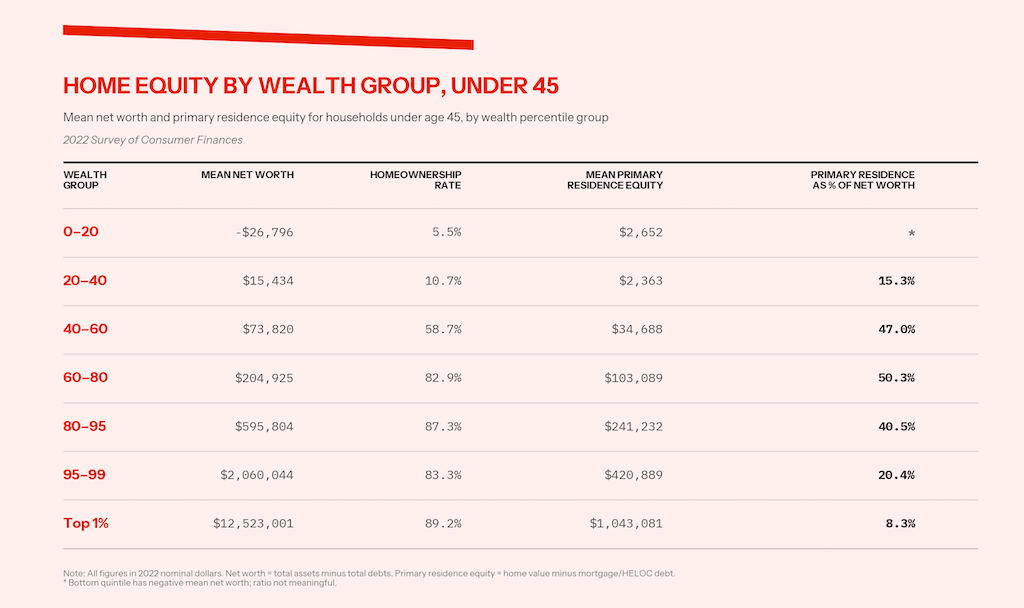
That’s okay. There’s no reason to
preserve housing values simply to benefit those lucky enough to hold an
affordable mortgage, regardless of their age. Indeed, the paper value created
by high housing prices should be thought of as a form of collective poverty,
not wealth. Everyone would be better off in the long run if housing were more
affordable.
For all the TBLC rhetoric,
conservatives seem torn on this issue. The Heritage Foundation and Republicans
like Senator Mike Lee opposed an
Obama-era rule requiring localities that received federal housing funds to
reform exclusionary zoning practices that contributed to residential
segregation, which Lee warned would allow the federal government to “seize
control of local zoning decisions.” But the 21st Century ROAD to Housing Act,
which seeks to
boost supply by tying federal dollars to local zoning reform and streamlined
permitting, passed with large bipartisan support — albeit with more opposition from Republicans
than Democrats.
Just what other assistance
conservatives support for young renters and would-be homebuyers squeezed out of
the housing market is unclear. In his TBLC essay, Greene criticized “focusing
exclusively on supply restrictions.” He has also gone further than most conservatives in
openly welcoming high interest rates as a cudgel against “wokeness.” His fellow
“Claremonster” Ryan Neuhaus, meanwhile, has gestured vaguely
at “assistance options that can reopen the path to ownership without inflating
scarcity.”
For his part, President Trump
seems to like high housing prices. “People that own their homes, we’re going to
keep them wealthy,” Trump said in
a January cabinet meeting. “We’re going to keep those prices up. We’re not
going to destroy the value of their homes so that somebody that didn’t work
very hard can buy a home.”
Beyond a lackluster pair of
executive orders and pressuring the Federal Reserve to lower interest rates
despite his inflation-boosting tariffs,
Trump has proposed cannibalizing
retirement security to paper over the housing crisis by letting prospective
homebuyers withdraw money from their 401(k) accounts for a down payment on a
house.”
Student loan debt has been a key
barrier to young people’s ability to purchase a home. According to a 2024
Federal Reserve study,
“Millennials and Generation Xers earn as much as Boomers did, but the larger
amount of student loan debt the two younger generations carry can reduce their
ability to own a home and, thus, accumulate wealth.” More than 7.7 million
borrowers — a record number
— were in delinquency and default on $181 billion in federal student loans by
the end of 2025, and even some conservatives
recognize that student debt is depressing homeownership among younger
Americans.
The vast majority of Republicans,
though, oppose student debt relief. In 2023, the Republican majority on the
Supreme Court struck
down President Biden’s popular student
debt cancellation plan in response to a lawsuit brought by state Republican
attorneys general. More recently, Republicans successfully sued to eliminate
Biden’s income-driven repayment plan. Reflecting prevailing opinion among
conservatives, Claremont’s Inez Feltscher Stepman has called student
loan forgiveness “the regressive grift of the woke revolution.”
But student-debt relief is a
proven method of boosting younger generations’ homeownership. A 2020 study by a
team of Federal Reserve economists concluded that “a $1,000 increase in student
loan debt lowers the homeownership rate by about 1.8 percentage points for
public four-year college-goers during their mid-20s.” More recently, an
analysis of the effects of Biden’s loan cancellation found that
homeownership rates increased by nearly 8 percentage points three-years after
cancellation.
Given the effectiveness and
popularity, at least when tied to
economic need, of student loan forgiveness, Democrats should revive the policy
when back in power.
Rather than focus on increasing
supply, lowering interest rates, or providing debt relief, Greene’s prime
exhibit of housing TBLC in action is “special tax breaks for senior
homeowners.” He’s right that age-based property tax breaks are an unfair, kludgey fix
for increasing property taxes. But those flaws illustrate a deeper problem.
TBLC-style thinking elevates generational concerns over distributional ones — and
that inversion distorts every policy question it touches.
The share of cost-burdened older
Americans has risen significantly in
recent years. But income is
the most important determinant of who can afford housing. Both the
Congressional Research Service and Harvard’s Joint Center for Housing
Studies have found that
cost burdens decrease linearly with income. More than two-thirds of households
making under $30,000 per year are cost burdened, while less than a quarter of
those making more than $75,000 are. The regressivity of property
taxes only exacerbates the issue.
Historically, the Right’s solution
to excessive property taxes was property tax limitation initiatives like
California’s Proposition 13, which was proposed by
businessman and conservative gadfly Howard Jarvis and touted by
Reagan. But since its passage in 1978, Prop 13’s benefits have been concentrated among businesses
and well-off homeowners, particularly older ones.
Republicans in states like Florida, Texas, Wyoming,
and Indiana have
now gone further, championing total property tax abolition. Since Republicans
won’t touch progressive taxation, most abolition plans propose replacing lost
revenue with budget cuts and sales tax increases — a tax that is even more regressive
than the property tax. The result would be Prop 13 on steroids, with the biggest benefits concentrated
among well-off homeowners and businesses.
As with all questions of taxation,
the best solution is to tie property taxes to ability to pay. “Circuit
breakers,” which have long been championed by
the grassroots left, do just that by capping property taxes as a percentage of
income. Unfortunately, while most states offer some type of circuit breaker, only seven
states plus the District of Columbia include homeowners and renters of all ages
— and even many of those states’ circuit breakers aren’t generous enough to
offer meaningful relief to low- and middle-income residents.
More states should follow
Minnesota, which the conservative Tax Foundation considers one of the
worst state tax systems, and use progressive revenue sources to fund
substantial circuit breakers.
Despite all the talk of
‘generational equity,’ the Right seems to prefer that younger Americans face
higher housing costs and a more precarious retirement rather than live
alongside more immigrants.
At the federal level, policymakers
could help by replacing the mortgage interest deduction — which overwhelmingly
benefits wealthy itemizers — with a flat refundable tax credit available to all
households regardless of income. This switch would benefit lower-
and middle-income households while raising taxes on the rich.
Meanwhile, higher immigration is
strenuously opposed not just by elected Republicans but also conservative think
tanks like Heritage and Claremont.
But the SSA’s actuaries have found that
each 400,000-person increase in immigration would cut Social Security’s
long-term shortfall by roughly 10 percent. More immigration would also improve Medicare’s solvency and
boost housing construction.
But despite all the talk of “generational equity,” the Right seems to prefer
that younger Americans face higher housing costs and a more precarious
retirement rather than live alongside more immigrants.
SAME AS IT EVER WAS
When Trump ran for president in
2016, he was eager to distance himself from the Social Security and Medicare
plans championed by decades of Republicans and the losing Mitt Romney–Paul Ryan
ticket. To win the White House, he foreswore any
attempts to cut old-age programs and even praised single-payer health care.
That was a sharp break from his past comments, when he called for the
privatization of both Social Security and Medicare.
FALLING IN BEHIND TRUMP
Republicans temporarily scuttled
talk of cuts to Social Security and Medicare, but the TBLC-style talk signals
that’s changing. During Trump’s first term, Republican Senator Joni Ernst said that
lawmakers should discuss fixing Social Security “behind closed doors.” In 2023,
the Republican Study Committee put forward a proposal to
cut Social Security modeled on Sam Johnson’s 2016 plan. Later that year,
Republican House Speaker Mike Johnson proposed another
Simpson-Bowles-esque fiscal commission.
Despite the aforementioned political disaster that cuts to Social Security
would pose for Democrats, several Democrats have recently joined the call —
garnering predictable praise from
the CRFB.
President Trump, meanwhile, is
returning to his old ways. His Treasury secretary, Scott Bessent, has referred to
the administration’s new “baby bond” accounts as “a backdoor for privatizing
Social Security,” and Trump has said that
he’s “looking
at“ Australia’s system of individual accounts “very seriously.”
The CRFB is providing a boost to
the TBLC narrative by hosting an upcoming panel titled
“Boomerang: Wealth, Retirement, and the Generational Divide” featuring Greene,
Yglesias, Goldwein, and Wall Street Journal writer Greg Ip,
whose article “Over
65? Congratulations, You Own the Economy” rehashed all of the misleading
measures of “intergenerational inequality” and was praised by
Greene.
Given that conservatives and
centrist Democrats won’t stop pushing phony claims of generational inequity to
distract from the real issues of economic inequality, it’s crucial for younger
Americans to remember that the middle-income millennial household making
$86,000 has more in common with the median boomer retiree making $60,000
including Social Security than with Mark Zuckerberg.
Insofar as younger generations are
struggling to afford homes, health care, and save for retirement,
it’s more important than ever to ensure that Social Security and Medicare
aren’t cut before they can collect them. Taxing the rich is the best path
forward, but it’s the one that deep-pocketed interests want most to avoid.
So stop focusing on generational
warfare, and start focusing on class warfare.
CATO
A REALITY CHECK ON THE INEQUALITY PANIC
Alarmist narratives shape public
opinion and encourage policymakers to pursue sweeping interventions that may do
more harm than good.
By Chelsea Follett March 23, 2026
This article appeared in Washington
Examiner on March 23, 2026.
Anthropic CEO Dario Amodei
called for far higher taxation in a recent blog entry, arguing that current wealth
concentration is higher than that of the Gilded Age and is about to get worse globally.
The chart-topping singer Billie Eilish implored billionaires to give away their money, while New York
City mayor Zohran Mamdani has gone further, opining, “I don’t think we should have billionaires”
because we live in “a moment of such inequality.” If anything is having a
moment, it is the conviction that inequality has grown urgent enough to justify a muscular
policy response.
But the facts don’t support this. Not only has
global income inequality fallen over the long run — contrary to the popular
narrative — but inequality has also declined in education, health, and a host
of other areas. The world is now more equal across a range of factors, from
lifespan and childhood survival to internet access and schooling. The more
broadly one examines inequality, the more encouraging the data appear. It turns
out that even the shock of COVID-19 failed to erase decades of progress toward a
wealthier and more equal world.
Indeed, the data show a pronounced
decline in global inequality over the past few decades, driven largely by
rising prosperity in poorer countries. During the pandemic years of 2020 and
2021, progress slowed sharply. Some indicators stalled and a few modestly worsened.
But the gains accumulated before the crisis were not undone.
In short, the damage to human
well-being was more limited than many feared.
Alarmist narratives shape public
opinion and encourage policymakers to pursue sweeping interventions that may do
more harm than good.
Another recent analysis published in The
Economist finds that global inequality in consumption spending is
falling. In 2000, the richest 10% of humanity spent 40 times more than the
poorest 50%. In 2025, they spent around 18 times more. Using data from World
Data Lab, they find that the poorest 50% now out-consume the richest 1%,
breaking from past trends.
Yet many think that only
large-scale redistribution can stop runaway worldwide inequality. Figures as
diverse as Amodei, Eilish, and Mamdani are far from alone in embracing this
view. Over the past few years, calls for a worldwide wealth tax, a vast
increase in foreign aid spending, and other unprecedented measures are gaining
steam across academia, non-profits, the press, and international
organizations like the United Nations.
That conclusion is premature.
Getting the facts straight is essential, because misunderstanding global
inequality can push policymakers toward harmful solutions.
The record on foreign aid is far less encouraging than its advocates
suggest: decades of evidence show that aid frequently fails to deliver
sustained development and bears no reliable relationship to long-term economic
growth. Worse, the fixation on ever larger aid flows often crowds out the
harder work of domestic reform. In some cases, foreign aid has been shown to weaken political
institutions, entrench bad governance, and slow the process of democratization.
Wealth taxes have their own
problems, from high administrative costs and enforcement challenges to low
revenue production and invasion of financial privacy. These problems help
explain why so many of the countries that have implemented wealth taxes in the
past — such as France, Germany, and Sweden— later abolished the tax. Perhaps the worst of
all, by discouraging risk-taking, wealth taxes suppress investment and growth, effects
that would be felt in both rich and poor countries and would likely prove
especially damaging to development in the world’s poorest economies.
Recent work on multidimensional inequality suggests
that the world has not been drifting toward ever greater gaps, but that the
rich and the poor have been converging in material comfort. Calls for global
wealth taxes or massive new aid programs often rest on the assumption
that international trade and economic freedom have failed to
deliver broadly shared gains. Yet the long-term evidence suggests the opposite.
The pandemic offers two lessons
here: First, it highlights just how sensitive progress is to disruptions in markets. It depends on conditions that allow growth to occur
and persist, including functioning markets and stable institutions. Many of the
proposed policy solutions risk undermining that progress.
The second lesson is that while
the pandemic represented a hurdle in the path of progress, the long-term trend
toward lower global inequality is holding strong.
Alarmist narratives shape public
opinion and encourage policymakers to pursue sweeping interventions that may do
more harm than good. A clearer view of the data counsels caution rather than
panic.
INVESTOPEDIA
A BRIEF HISTORY OF TAXES IN THE U.S.
By Beverly
Bird Updated September 03, 2025
Fact checked
by Vikki Velasquez
Benjamin Franklin is credited with
saying that nothing is certain in this world but death and taxes. That was back
in 1789 and it still holds true in the U.S. today.1
U.S. taxation has thrived and
faltered from implementing the first income tax to various attempts at tax reform. Some
changes have been more taxpayer-friendly than others. Here's a closer look at
the history of the U.S. tax system.
Key Takeaways
·
The need to
finance the Civil War created one of the first versions of a federal income tax
in 1862.
·
The U.S. income tax was officially born on Feb. 3, 1913, when Congress
ratified the 16th amendment to the U.S. Constitution.
·
Less than 1% of Americans had to pay the tax in its earliest days.
·
Major tax reforms have been ongoing for decades.
·
Some consumer dollars can effectively be taxed twice when excise taxes
come into play.
EARLY HISTORY
OF U.S. TAXATION
Benjamin Franklin spoke about
taxation well before the U.S. officially launched an income tax. Before the
Civil War, the nation derived most of its income from banknotes. The tax rate imposed on individuals was minimal,
from 1% to 1.5%. American citizens received virtually nothing in exchange.
Civil services and protections on the frontier and coasts were minimal.2
The need to finance the Civil War
resulted in the first version of an income tax in 1862. President Lincoln
signed a law that created the Commissioner of Internal Revenue and imposed an income tax on individuals
ranging from rates of 3% on incomes of $600 to $10,000 and 5% on incomes over
$10,000.3
This version of the tax was
repealed 10 years later but it came back to life in 1894 with the Wilson Tariff
Act. The act levied a 2% tax on incomes over $4,000. The U.S. Supreme Court
ruled one year later that the tax was unconstitutional.43
“Through the Civil War and beyond, income tax
was tried, disputed in the courts, and finally resolved with the passage of the
16th Amendment in 1913, constitutionally establishing income taxes,” according
to Thomas J. Cryan, an attorney and the author of Disrupting Taxes.5
BIRTH OF THE
FEDERAL INCOME TAX
The federal income tax as we know
it was officially born on Feb. 3, 1913, when Congress ratified the 16th Amendment to the U.S. Constitution after an
on-again-off-again effort that lasted decades.4
The amendment read, “Congress
shall have the power to lay and collect taxes on incomes, from whatever source
derived, without apportionment among the several states, and regard to any
census or enumeration.”3
However, less than 1% of Americans
had to pay the tax in the first days after its inception, thanks to the
amendment’s provisions for numerous taxpayer-friendly deductions and exemptions. The rate was
only 1% of net income at that point.4 Congress
later added a 6% rate for incomes of more than $500,000.3
Numerous tweaks and add-ons
occurred in the 1940s. The Revenue Act of 1942 increased tax rates and the
number of citizens who had to pay it. The Current Tax Payment Act passed a year
later, heralding the beginning of the tax withholding process by employers.
Standard deductions were created in 1944 with the passage of the Individual
Income Tax Act.3
“The withholding system was
implemented simply because the collection was easy,” says Cryan, “not because
it was the soundest, most equitable, or most efficient tax system.”
However, the Internal Revenue
Service attempted to make the tax process more efficient over the years. The
first toll-free telephone line was introduced in 1965. Electronic
filing began in 1986 although it was limited at first.
Taxpayers who owed money were able to electronically file their returns
beginning in 1992.3
TAX REFORMS
AND MAJOR CHANGES
Reforms have been ongoing. The
federal government has made some major changes to the tax system incrementally.
THE
ALTERNATIVE MINIMUM TAX (AMT)
Annette Nellen, a certified public
accountant (CPA) and attorney who serves as a professor and the director of the
MST Program at San Jose State University cites the alternative minimum tax (AMT) as a major adjustment. The
AMT was created in 1969 because “it was found that a few hundred high-income
individuals were able to use a combination of exclusions, deductions, and
credits to pay little or no income tax,” Nellen says.67
THE TAX
REFORM ACT (TRA)
Nellen also mentions the Tax Reform Act that was legislated in 1986. She says it
broadened the AMT so more high-income individuals would be subject to it.
“The Tax Reform Act of 1986 made
numerous changes to the tax law including taxing ordinary and capital gains
income at the same rate and there were only two brackets (15% and 28%). It also
added passive activity loss limitation rules that shut down a tax shelter
industry that many middle- to high-income individuals had been using to
minimize their taxes.”8
THE AMERICAN
TAXPAYER RELIEF ACT (ATRA)
The American Taxpayer Relief Act (ATRA) restored the top
income tax rate to 39.6% in 2012 after it was cut to 35% by President George W.
Bush’s tax cuts in 2001 and 2003.9
President Trump signed the Tax Cuts and Jobs Act (TCJA) into law in 2017 and
introduced some sweeping changes to the U.S. tax system. They included
significantly increasing standard deductions and reducing personal income tax
rates. The 35% top rate created by ATRA had increased back to 39.6% but the
TCJA dropped it to 37%. The 15%, 25%, 28%, and 33% rates imposed on
lower-income earners were cut to 12%, 22%, 24%, and 32% respectively.10
The cap on the itemized deduction
for interest paid on home mortgages was reduced, however, and a reduced limit
was imposed on the state and local tax (SALT) itemized deduction as well. Some
miscellaneous itemized deductions were eliminated entirely.10
The TCJA tax cuts were made
permanent by Congress in 2025.
THE INFLATION
REDUCTION ACT
The Inflation Reduction Act (IRA) came along in 2022.
According to Nellen, “The IRA included numerous new and modified energy credits
for individuals and businesses. It's possible that some of these credits may be
repealed or downsized as part of any extension of expiring provisions of the
TCJA or new tax breaks such as not imposing income tax on tips or overtime pay
of employees.”
EXCISE AND
"SIN" TAXES
Taxation doesn’t begin and end
with those taxes imposed on income and earnings. Excise taxes, often
called sin taxes, can take a hefty bite out of taxpayers’ bank
accounts as well. These taxes are imposed on the sale of specific products and
services.
They’re generally paid by
retailers, producers, and wholesalers but these entities pass them down to the
consumers who purchase them. Commonly affected purchases include alcohol,
tobacco, health insurance, and gasoline. The excise tax on cigarettes averages about $1 a pack. Beer
and wine are typically taxed at a lower rate than distilled spirits.11
“The key purpose of excise taxes
on alcohol and tobacco is to tax undesired behavior, particularly the purchase
of cigarettes by young people,” Nellen says, “and to generate a small amount of
revenue. There are several federal excise taxes, but the ones on alcohol,
tobacco, and gasoline are best known. Excise taxes are a small part of
government tax collections, representing less than 2% of total federal tax
revenues. For 2023, excise taxes were $75.8 billion, representing 1.7% of total
tax collections of $4.4 trillion.”12
Cryan agrees about the deterrent
nature of these taxes. “Excise taxes on alcohol and tobacco traditionally lean
to increased prices at the time of the retail sale. This price increase will
often reduce consumption which can have the follow-along effect of a decrease
in consumption related to less health harms.”
Numerous consumers continue to
spend that extra dollar on a pack of cigarettes, but it’s a safe guess that
their wallets will feel the effect because they also have to deal with income
tax on that money.
THE BOTTOM
LINE
Taxation in the U.S. has always
been a shapeshifting beast and this can be exacerbated by all its various
applications, from income to that modest purchase you just made at your
favorite liquor store. Tax laws don’t just change every five to ten years. They
can occur annually just as you’re getting used to the last ones that were
imposed.
They’re inevitable, however, just
as Benjamin Franklin asserted. Taxpayers can benefit from keeping a watchful
eye on the ever-evolving changes and checking in with a tax professional when
changes are looming so they can best prepare for the impact whether it be
affirmative or negative.
TAX POLICY CENTER/BROOKINGS
WHAT THE UGLY HISTORY OF TAX
POLICY OVER THE PAST FOUR DECADES MEANS FOR THE FUTURE
By Howard Gleckman September 26, 2025
The first big revenue bill I wrote
about was the massive 1981
tax cut engineered by President Reagan. The most recent was July’s
big budget bill that cut taxes by about $4 trillion over the next
decade, largely designed by President Trump.
As I look back on these four
decades, I’ve seen tax policy and the way it is produced change dramatically.
And not, sadly, for the better.
·
The
traditional goals of good tax policy have historically been equity, efficiency,
and simplicity. It may be impossible to achieve all three, but recent tax bills
have accomplished none. Instead, tax legislation has become a tool largely to
advance narrow social or economic goals rather than produce necessary revenue
to fund government. Tax cuts steadily add to massive and growing deficits.
·
Policymakers
have not only slashed
tax rates but they’ve gutted the income tax base.
·
Congress
and Trump have made the IRS far less
capable of administering the federal income tax. As a result, risks to
the integrity of the system have never been higher and taxpayer frustration is
likely to increase.
·
Congressional
tax-writing committees have ceded
much of their authority to party leaders, leading to poorly drafted bills
and, often, unintended consequences.
·
Even
congressional leadership is losing influence. The
president, aided by recent court decisions, is wresting tax-writing authority from
Congress itself.
·
Bipartisan
legislation, once a hallmark of tax bills, has become an exception rather than
the rule. Extreme partisanship makes tax policy more unstable than ever.
All of this suggests the income
tax may no longer be sustainable as the primary source of federal revenue. In
coming years, it could well be complemented, and perhaps, supplanted, by some
form of consumption tax. The question is whether that new revenue source will
be a bad consumption tax, such as a tariff, or a well-designed Value-Added Tax,
cash-flow tax, or even a carbon tax.
It would take a book to detail all
these trends, so I’ll focus on just a few.
THE SHRINKING TAX BASE
First, think about tax rates and
the tax base. When I came on the scene, the top marginal individual income tax
rate was 70 percent. Today, it is roughly half that, at 37 percent.
At the same time, even as
lawmakers cut rates, they’ve blown a hole in the amount of income that could be
taxed. They did both by directly excluding income from tax and by adding
deductions that lowered taxable income.
Long before my time,
employer-sponsored health insurance was excluded from taxable income.
Today, 60
percent of non-elderly Americans have this insurance, and the value of the
employer share of tax-free premiums for a family has grown to nearly $26,000.
But Congress has made many other
forms of income tax-free, most recently, some
tips and overtime pay. And it has added to the long list of expenses that
taxpayers can use to lower their taxable income. The 2017 Tax Cuts and Jobs Act
scrapped a few, but these were eclipsed by new additions, including the special
20 percent deduction for pass-through businesses such as partnerships
and sole proprietorships.
As a result of these changes,
together with spending increasing as well, the Congressional Budget Office
projects that over the next decade, the gap between federal revenue and
spending will reach 6 percent of
Gross Domestic Product, or more than $2 trillion annually.
That simply is unsustainable. Yet
few in Congress appear to show any real interest in doing anything about
it.
THE FAILED PROCESS
In many ways, these dismal results
are symptoms of a failed process. Not to sound overly nostalgic, but back in the
day, tax policy was heavily influenced by a cadre of highly experienced experts
at Treasury and in Congress.
Of course, politics intervened,
but when lawmakers wanted to accomplish some goal, staff could show them how
best to do it. Congressional hearings illuminated difficult challenges and
identified solutions. Bills often took years to make their way through the
process. But that frequently resulted in better legislation.
The landmark 1986 Tax Reform Act
was spearheaded by Reagan, the Democratic House Ways & Means Committee
Chair Dan Rostenkowski, and the Republican Senate Finance Committee Chair Bob
Packwood. But the critical details were developed by largely anonymous staffers
on Capitol Hill and at Treasury.
Today, much of that staff
expertise has been lost. Instead, many professional Hill staff move on after a
couple of years, often to more lucrative lobbying or legal jobs advising
private sector clients.
The goal is no longer good tax
policy. It is only to win.
Thus, bills are increasingly
partisan and, as a result, policy shifts with the political winds, and
taxpayers are unable to plan more than a year or so ahead.
On top of all this, the IRS is
scaling back enforcement efforts, and Congress continues to slash the agency’s
budget and staff, making administration of the income tax increasingly
difficult.
All these trends may lead to some
form of consumption tax. Trump, of course, already has shifted about $3.3 trillion in
revenue from income taxes to tariffs, assuming his import taxes remain
for a decade.
The problem is that Trump’s exorbitant,
constantly changing, and counterproductive tariffs risk damaging the
US economy and probably are not sustainable.
What, then, will replace them?
That, I believe, will be the next big question for tax policy.
USA TODAY
WHAT IS A NATIONAL CONSUMPTION TAX? HOW IT DIFFERS FROM INCOME TAX.
By Daniel de Visé April 11, 2026, 5:03 a.m. ET
FULL SUMMARY
The article explains that a
national consumption tax would levy a federal tax on spending rather than
earnings, contrasting it with the current income‑tax system. It outlines
the FairTax Act of 2025, which proposes a 23% federal sales tax to replace most
federal taxes, and notes the proposal’s history and criticism that it would
primarily benefit wealthy taxpayers.
Some U.S. states have sales tax
rates as high as 10%. Other states impose no sales tax at all.
Consumption tax, the category that
includes sales tax, is often a footnote at the end of a receipt, but it can
impact your wallet all the same.
A tariff is also a consumption
tax. And tariffs are becoming quite familiar to American taxpayers, thanks to
President Donald Trump's ongoing campaign of import taxes.
Members of Congress make perennial
efforts to expand consumption taxes. The FairTax Act of 2025 was the latest bid to abolish the
Internal Revenue Service and replace income tax and other levies with a
national sales tax. The measure has yet to reach a vote in the full House or
Senate.
With tax season
winding down, here’s everything you need to know about a national
consumption tax.
WHAT IS A NATIONAL CONSUMPTION
TAX?
Consumption tax is a tax on goods
or services – what you spend, rather than what you earn. In the United States,
consumption tax comes in the form of retail sales tax and excise tax (tax
imposed on certain goods or activities, like alcohol or fuel), as well as the aforementioned
tariffs.
A national consumption tax would
create a federal tax on consumer goods, possibly to be emphasized over (or even
replace) income tax and
payroll tax.
DOES THE U.S. HAVE A NATIONAL
CONSUMPTION TAX?
The United States does not
currently have a national consumption tax. Other countries do, including Japan,
which has a 7.8% standard and 6.24% reduced tax rate for items like food, drink
and some newspapers. More than 175 countries, including all
of Europe, impose a Value-Added Tax,
which taxes goods and services at each stage of production.
Consumption taxes in the United
States are on a state-by-state basis. Almost every
state imposes sales tax, except for Alaska, Delaware, Montana,
New Hampshire, and Oregon, which instead allows cities to charge a local sales
tax. California boasts the country’s highest state sales tax rate at
7.25%.
The FairTax Act would eliminate
most current federal taxes in favor of a 23% federal sales tax. Tax experts
have warned the act would mostly benefit
the wealthy, who would see major tax cuts.
WHAT IS THE FUTURE OF THE NATIONAL
CONSUMPTION TAX
According to the nonpartisan Tax
Policy Center, the Fair Tax was first introduced in Congress in 1999 and has
been reintroduced in each Congress
since. In other words, you can probably expect more Fair Tax
legislation in the future.
US NEWS
In the heat of tax season,
Olivier Knox discussed the latest survey results from the Pew Research Center,
which show 60% of Americans are very bothered by the idea that wealthy individuals
and corporations don’t pay their fair share in taxes.
Republican respondents had more of an issue
with the taxes they personally pay, with 66% saying they pay more than their
fair share. Democrats cared less about their own taxes, but they are much more
worried than Republican respondents by the idea that rich folks don’t pay
enough, 81% to 41%, respectively.
With the rising cost of living likely to play
a big part in this year’s midterms, anger over taxes could be a deciding
factor.
By Rob McKenna
Let's Go Washington founder Brian
Heywood... long a fighter for parental rights and against transgender
participants in girls' sports... filed an emergency petition that asks justices
to direct Secretary of State Steve Hobbs to process the referendum paperwork
submitted Monday that would allow Heywood’s group must submit signatures
of 154,455 voters by June 10 to
qualify for the fall ballot.
“Time is already running out. Not
granting accelerated review of this matter would unfairly render the entire
process moot by significantly limiting the time available,” to collect
signatures, Heywood argues in court documents.
He filed a referendum on Senate Bill 6346 shortly
after Gov. Bob Ferguson signed the legislation known as the “millionaires’
tax.” It imposes a 9.9% levy on household wage income above $1 million starting
in 2028.
While the lawyers
litigate and collect their paychecks, the Citizen Action Defense Fund also
plans to sue over the tax, arguing it is unconstitutional.
NEW YORK POST
GUESS WHAT HAPPENED
WHEN WASHINGTON STATE ROLLED OUT A STEEP NEW INCOME TAX?
By Ari Hoffman
Published April 6, 2026, 6:00 a.m. ET
When
Washington state Democrats passed a new income-tax bill in March, the
disastrous impacts started even before Gov. Bob Ferguson signed it into law.
Corporations
and big-name entrepreneurs began a mass exodus to avoid the heavy so-called “millionaire’s tax” —
a major movement of capital flight.
But even as
wealth departs the Evergreen State, other Washingtonians are gearing up to
fight.
Locals love
their state — the mountains, the lakes, spectacular, unbeatable summers.
They also
love their no-state-income-tax status, long thought sacrosanct under
Washington’s constitution.
Some aren’t
ready to give that up.
Why Californians are leaving — and what Gavin Newsom is spending $19M to
hide
Long Islanders struggle as utility bills surge 20%: ‘It’s all adding up’
Enter Brian
Heywood, founder of the grassroots citizen action group Let’s Go Washington.
“People that
should have been fighting us, they’re now going, ‘holy crap, I’ve had enough,’”
Heywood told me. That includes moderates, independents and even left-leaning
voters.
“People in
that stripe are also saying, man, this is too much,” Heywood said.
So he’s
forming “a very broad coalition” to push back.
Public
opposition to the new tax, a 9.9% levy on incomes over $1 million, gives
Heywood hope.
Over 100,000
Washingtonians registered their displeasure during public testimony on the
bill.
Local voters
have rejected an income tax 11 times in the state’s history, and a citizen
initiative pushing back against a similar measure in 2024 was signed by over
446,000 people.
Now, the
opposition is taking two forms.
Last week,
hours before Ferguson’s signature made the law official, former Washington
state Attorney General Rob McKenna announced plans to file a lawsuit
challenging it under the state constitution.
“Washington’s
constitution is clear, and the courts have been equally clear for nearly a
century — income is property, and progressive income taxes are unconstitutional under
existing law,” said McKenna.
The new
income tax “creates a direct conflict with binding precedent.”
Legal efforts
may hit a wall at the state’s Supreme Court — an elected body that has
consistently ruled in the hard left’s favor in recent years.
But with five
of the court’s nine seats up for election in November, Heywood sees an
opportunity.
Anger over
the tax issue could spur Washingtonians to the polls to select five new
justices willing to uphold the state’s tax traditions.
And the legal
challenge is only one front of the battle.
Last week,
Heywood announced plans to spearhead a citizen referendum to repeal the income tax outright.
“Because
unlike King Bob, we believe that the framers of our state’s constitution meant
it,” he said.
Let’s Go
Washington must gather 200,000 signatures by June to qualify the referendum for
the upcoming election.
Heywood is
confident it can be done.
“Our state
constitution is the law of the land and not a suggestion that the legislature
and the governor can ignore on a whim,” he said.
The final
battle will take time, and will also come at the ballot box — challenging every
Democrat who championed the income tax, and swinging control of the state legislature
back to a common-sense, business-friendly mindset.
Political
battles are costly — and daunting. Heywood, McKenna and others are
fired up now, but advertising, signature-gathering and campaigning all come at
a high sticker price.
So while some
plan to fight, many Washingtonians have already chosen flight.
Starbucks
founder and CEO Howard Schultz announced his move to Florida the same day the new tax
was passed.
His company’s
flagship office building in Seattle is rapidly emptying as employees relocate
to new corporate headquarters in Nashville.
Zach Abraham,
CIO of Bulwark Capital Management, told me he’s making plans to move his
company out of state.
At a recent
board meeting involving firms managing $4 billion of investable capital, he
said, “we agreed, not only are we leaving, we won’t make any investments in
start-ups in this state either.”
“That’s just
the tip of the iceberg,” Abraham added.
Microsoft cut
more than 3,100 jobs statewide.
Amazon cut
more than 2,300 jobs in the Seattle area.
Meta laid off
hundreds more while pulling back from major office commitments.
The tech
layoffs have contributed to a state-specific rise in unemployment, even as the national labor market
has improved.
A whopping
44% of employers are considering moving their personal residence out of the state,
the Association of Washington Business found in a February survey, with 64%
citing taxes as the primary concern.
Independent
brick-and-mortar businesses across the greater Seattle area report declining
foot traffic, and the city’s office vacancy rate has risen to over 33%.
Yet even as
Abraham makes plans to join the exodus, he has hope for the political uprising.
“People that
would not have ever aligned are aligning,” he told me. “I see people opening
wallets and getting serious.”
The feisty,
independent-minded Washington where he was born and raised still remains,
Abraham said.
“I think the
old girl’s got a couple of punches left.”
PEANUT GALLERY
·
Dave C
10 hours ago
I laughed at these people in
Washington State seeming to be so upset with their new millionaire tax. The tax
was voted on and signed into law by the politicians the Washingtonians have
elected to office year after year after year. I have a suggestion, stop with
the wasteful time-consuming referen...
See more
Reply
212
Share
o NtvNyer59
7 hours ago
Agreed. It boggles the mind how
many people need to learn the "hard way" that you get what you vote
for. Repeatedly the Deamon rats have demonstrated that when their poor policies
cause chaos and result in inevitable budget shortfalls, they will go to their
favorite course of action and that is to ...
See more
Reply
50
Share
2 replies
Show 9 more replies
·
D D
10 hours ago
Stop punishing people for working
and making money. Stop the endless flow of freebies to those who won’t work and
feel entitled to the fruit of someone else’s labor. Develop work programs, and
fair taxing.
Reply
202
Share
o BigB
10 hours ago
Those Endless Freebies get them
Votes, so don’t expect that to change anytime soon, especially when that
Mentality has been Ingrained for 50-60 Years now. That coupled with Nonsensical
Policies, and Pet Projects that’s a total waste of Money. When you spend OTHER
People’s Money, you couldn’t care l...See more
Reply
97
Share
Show 3 more replies
·
Granny513
10 hours ago
Article forgot to mention that
Seattle pro ball teams may have more trouble recruiting high salaried players
with this millionaire tax. They will have to pay more to offset the almost 10
percent income tax.
Reply
104
Share
o BigB
10 hours ago
Recently a Free Agent Pitcher from
Arizona was offered a Huge Contract from the San Diego Padres, and turned it
down to stay in Arizona for less Money, stating that He didn’t want to pay
Higher Taxes. Washington State is No Different.
THE INSTITUTE ON TAXATION AND ECONOMIC POLICY
(ITEP)
By Michael Ettlinger April 6, 2026
Key Findings
Trump-Republican tax policy in the
first year of the president’s second term will:
·
Increase
taxes paid by middle-income Americans by an average of $900 in 2026
·
Cut
taxes for the wealthiest 1 percent by a trillion dollars over the next 10 years
·
Result
in large profitable corporations paying little or no corporate income tax
·
Cut
taxes for foreign shareholders in U.S. businesses by $32 billion in 2026
The first year of President
Trump’s second term has brought major changes in U.S. tax policy. The
president, in concert with Congress, has dramatically increased tariff taxes,
enacted large tax cuts that primarily benefit the well-off and corporations,
dramatically curtailed IRS enforcement, and issued legally problematic
regulations.
These changes have had significant
impacts on taxpayers.
In 2026, middle-income Americans
will see their taxes go up by an average of $900 relative to what they would
have paid had the tax policies that existed at the beginning of 2025 simply
continued.
The wealthy, on the other hand,
will see substantial tax cuts. Over the next 10 years the wealthiest 1 percent
are slated to pay at least a trillion
dollars less in taxes than they would have if Congress and the
President had done nothing.
The direct effect on corporations
has also been substantial as more and more companies are
paying little or nothing in federal corporate income tax.
The largess has not been limited
to the American wealthy and corporations: foreign owners of U.S. businesses
will save $32 billion in taxes in 2026.
These tax cuts have come at a
substantial price. The legislated tax reductions passed by Congress and signed
by the president in the One Big Beautiful Bill Act (OBBBA) are forecast to add $4.6 trillion to the federal
government’s debt over the coming decade. In the same bill, to whittle down
that price tag, net spending cuts amount to a $1.2 trillion reduction, with the
lion’s share coming from health care.
While much of what has happened
under President Trump has been done by duly elected officials, acting within
legal bounds, the administration has shown little deference to the rule of law
as it has imposed illegal tariffs, illegally implemented regulations, and
gutted IRS enforcement initiatives.
TAX INCREASES
FOR TYPICAL AMERICANS
The biggest change in tax policy
affecting most Americans in 2026 is President Trump’s tariff taxes. Although
the Supreme Court found many of his initial
round of tariffs to be illegal, the administration is quickly
finding alternative ways to reimpose them. The tariff taxes in 2026 will likely
end up of at least the same magnitude as the ones in effect at the end of 2025.
The other tax policy changes that
directly affected typical American taxpayers were a set of choices by Congress.
Without Congressional action,
several tax provisions were set to expire at the end of 2025. Most of them were
from the tax bill passed in the first Trump administration. One measure,
a tax credit to help Americans defray some of the cost of health
insurance coverage, was passed during the Biden administration. In both cases
the authors of the provisions intended the measures to be continuing. They were
passed as temporary measures primarily to minimize the ostensible 10-year costs
to comply with Congressional budget rules.
In OBBBA, Congress largely
extended the earlier Trump tax bill provisions while it allowed the termination
of the Biden health tax credit. In addition to the choices Congress and the
President made regarding which expiring provisions to extend and which not to
extend, OBBBA added new tax breaks. These new tax breaks included corporate tax
cuts and partial exemptions of tips and overtime income.
When added together, all these tax
changes result in a tax increase for most Americans. The middle 60 percent of
Americans will pay $900 more, on average, compared to what they would have paid
if Trump had not increased tariffs and Congress had ensured that the tax policy
in effect for 2025, prior to OBBBA, had been left in place. Table 1 shows the
average tax increase for the middle 60 percent for each state and the District
of Columbia.
INCREASE IN
INCOME INEQUALITY
The 2025 tax policy changes under
President Trump and Congress will increase income inequality in 2026.
The actions and inaction described
in the previous section will cause taxes overall to go up on average
for those in the lower income 95 percent of the population. For the
top 5 percent, however, taxes will go down on average. Although tariffs do
affect higher-income Americans, they claim a smaller share of their income. The
OBBBA tax cuts favoring investors are much larger for high-income taxpayers
than their added tariff bill. The net impact across all incomes can be seen in
Figure 2. The top 1 percent sees a net tax cut equal to 0.4 percent of their
income, the middle 20 percent sees an increase equal to 1.2 percent of their
income, and the poorest 20 percent sees a tax hike equal to 3.1 percent of
their income.
Figure 2

More detail and national and
state-by-state tables can be found here.
Big Tax Cuts
Fuel Growing National Debt
When official budget scorers
project budget deficits and the national debt, they assume that law will remain
unchanged. That means that they assume that tax provisions that are set to
expire will actually expire—even if that doesn’t reflect the genuine intent of
policymakers or political reality. As a result of OBBBA’s extension of expiring
tax provisions and additional tax cuts, official estimates of future deficits
and debt are substantially higher. As of February 2026, the Congressional Budget Office projects federal budget
deficits to be a cumulative $22 trillion in the 10 years from 2025 through
2034. The OBBBA tax cuts are responsible for $4.6 trillion of that.1
There is much debate as to the
level of debt which the country can accrue before there are significant
economic problems. Some things are, however, not in serious dispute.
First, whether we know the exact
level or not, there is a point at which the debt starts to cause significant
economic problems, whether that is in the form of rising interest rates, high
inflation, or other consequences.
Second, the higher the debt, the
more debt service eats away at other priorities. In 2026, interest on the debt
is slated to be 14 percent of federal spending, rising to 18 percent by 2035.
The trillion dollars of interest projected for 2026 is more than the projected
spending on defense, Medicaid, and almost every other individual government
agency or program.
Third, the country has looming
spending obligations that will be harder to manage with higher debt. Social
Security and Medicare are the most widely noted but there are many other unmet
needs and areas of rising costs.
In short, this was not the time to
add $4.6 trillion in debt by cutting taxes for people and companies that don’t
need it.
Figure 3

TAX
CONTRIBUTIONS BY THE WEALTHY PLUMMET
In 2026 the highest income 20
percent get a $380 billion tax cut with $117 billion going to the richest 1
percent alone. The tax cuts for the top 1 percent over the next 10 years add up
to a trillion dollars. To put the $117 billion going to the top 1 percent in
2026 in perspective, it is more than the federal government will spend in 2026 on
the combined budgets of the Department of Education, Department of
Transportation, Department of Justice, the State Department, the National
Aeronautics and Space Administration, the Environmental Protection Agency, the
National Endowment for the Humanities, and the National Endowment for the Arts.
Or, put in another context, that
$117 billion could buy every Major League Baseball team (all of them together)
or pay for the combined cost of every wedding in the country for a year, as we described
in July along with other comparisons.
In addition to the hundreds of
billions in tax cuts from OBBBA, the wealthiest have also saved many billions
with the elimination of
more than $40 billion over 10 years in IRS tax enforcement
funding that was aimed specifically at cracking down on tax evasion by the
wealthy. The Trump administration has also, administratively, strangled IRS enforcement initiatives targeted at
high-wealth tax sheltering.
MORE
CORPORATIONS ARE PAYING LITTLE OR NOTHING IN TAXES
OBBBA included large tax cuts for
corporations, and the administration has added on to the benefits of these tax
cuts with legally doubtful
regulatory changes. Many of the corporate income tax cuts in OBBBA
are retroactive, reducing companies’ 2025 tax bills and resulting in more and
more corporations disclosing that they had very low income tax liability, or
none at all, for the year.
For example, Amazon paid just 1.4
percent of its $89 billion in U.S. profits in federal corporate income tax
while Meta paid 3.6 percent on $2.8 billion in profits and Tesla and Palantir
paid nothing on their combined $7.2 billion. Table 3 shows a list of prominent
companies that have, as of April 1, made their annual disclosures.
These companies’ ultra-low tax
bills are just the tip of the iceberg of what has been done to business taxes
in the first year of President Trump’s second term. From OBBBA alone,
corporations and other businesses will pay $234 billion less in 2026 and $1.7
trillion less over 10 years.
FOREIGN
INVESTORS GET BIG TAX CUTS TOO
With the extensive foreign
ownership of companies doing business in the U.S., foreign shareholders are
significant beneficiaries of the corporate tax cuts under OBBBA. A total of $32
billion in tax savings from OBBBA will go offshore in 2026. Many foreign
shareholders are likely to end up paying zero U.S. corporate tax despite
benefiting from the U.S. economy and the role of the government in sustaining
it.
As Figure 6 shows, foreign
investors get a larger share (6 percent) of the OBBBA tax cut than the lowest
income 40 percent of the American population (4.1 percent). Not living here, of
course, they also do not pay the tariffs that Americans are paying. The highest
income 20 percent of the U.S. population, plus foreign owners/shareholders of
U.S. businesses, garner 73 percent of the total tax reductions of OBBBA.
Figure 6

THE RULE OF
LAW HAS BEEN UNDERMINED
The Trump administration’s initial
tariffs were ruled illegal by the Supreme Court. The tariffs that have
initially replaced them are also illegal.
The Trump administration has also
issued regulations that have significantly cut taxes for corporations. These
too were done without a proper legal basis. Unlike with tariffs and other
illegal administration activity, the courts may not block lawless regulations
that reduce taxes. Some case law suggests that federal courts may deny
“standing,” the right to sue, to anyone who isn’t affected in a very concrete,
negative way, by an illegal regulation. Regulations that cut taxes may not
negatively affect anyone sufficiently directly for the courts to grant
standing.
The administration also put
taxpayer privacy at risk with its IRS-ICE arrangement.
Finally, when the administration
isn’t itself violating the law, it is making it easier for others to do so. The
drastic cuts to IRS enforcement encourage the spread of lawlessness from within
the Trump administration to the taxpaying public. Those who can afford to
engage in complicated, hard to detect tax evasion schemes are well-positioned
to evade taxes more than ever.
CONCLUSION
The Trump-Republican tax policies
of the first year of President Trump’s second term have adversely affected most
Americans while benefiting the wealthy and foreign shareholders. This has been
accomplished through a mix of legislative action and illegal executive actions
by the administration.
Unfortunately, it could get worse.
The administration is being heavily lobbied to add to its unlawful regulatory
record by indexing capital gains for inflation—which would be a
benefit hugely skewed to the wealthy. In addition, the congressional Republican
Study Committee has a tax plan that would, likewise, be of substantial benefit
to those with the highest income and wealth.
METHODOLOGY
The methodologies for the numbers
in this report can be found in the methodologies in the hyperlinked reports
where they were initially published. Income tax analysis is conducted using the
ITEP Microsimulation Tax Model. The tariff calculations use the consumption tax
module of the ITEP model calibrated to forecasts and analysis by the Congressional
Budget Office, UBS bank and a paper by
Cavallo, Llamas and Vazquez on the 2025 tariffs. Tariffs are distributed by
consumption, residential investment, shares of rising costs for state and local
governments and business ownership—reflecting the direct effects on prices of
consumer goods, the impact on costs associated with residential property
ownership, the higher prices faced by state and local governments and the
reduction in profits in the cases where businesses do not pass through the full
amount of the tariffs to their customers.
ENDNOTES
·
1.
OBBBA also included spending cuts and spending increases. These net $1.2
trillion, so the net increase in deficits from OBBBA is $3.4 trillion.
(See charts, graphs, tables and
pix here)
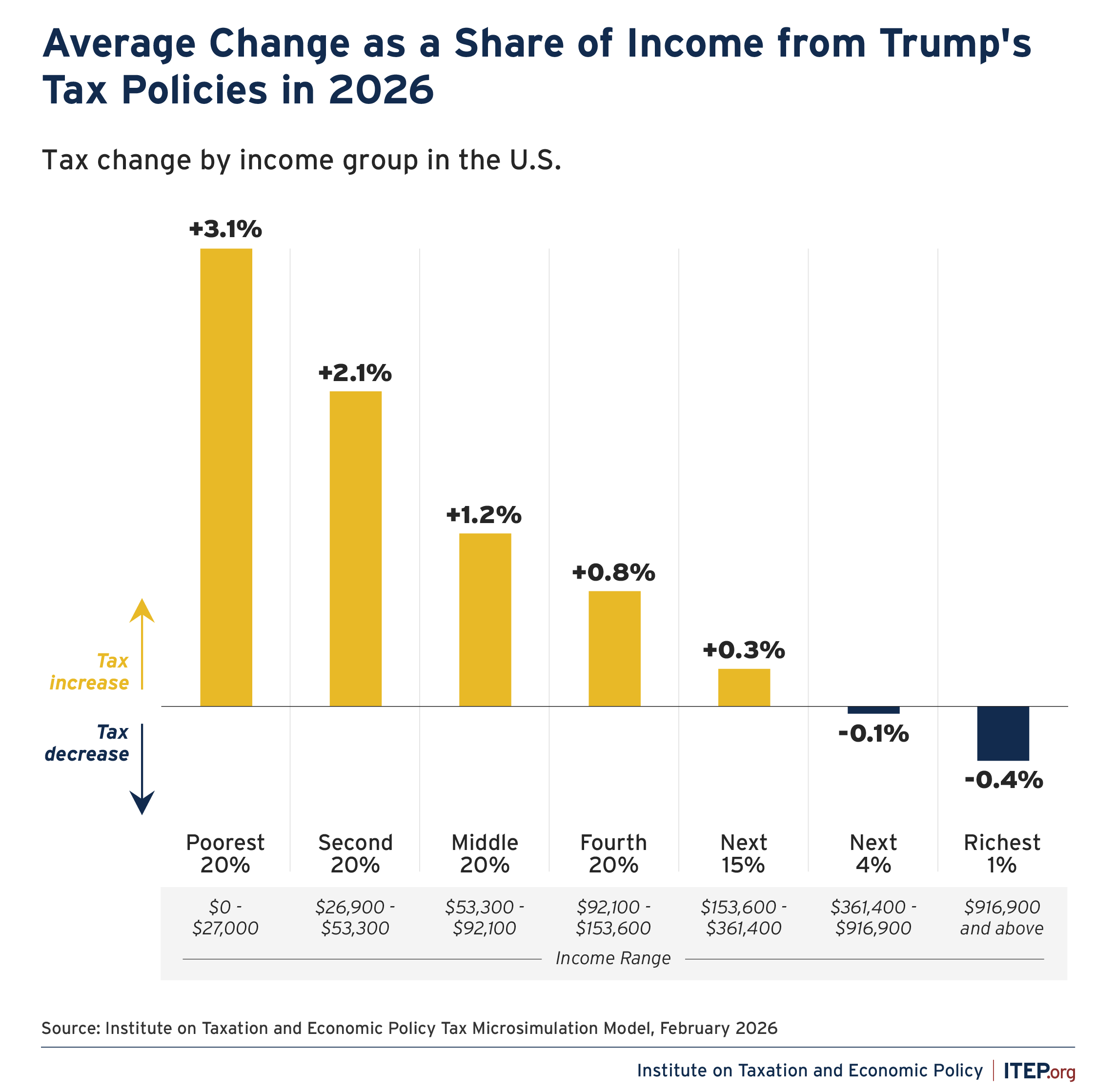
1440
|
'TAXMAN' |
|
PEW RESEARCH|
TOP TAX FRUSTRATIONS FOR AMERICANS: FEELING THAT SOME WEALTHY PEOPLE,
CORPORATIONS DON’T PAY FAIR SHARE
By Andy Cerda and J. Baxter
Oliphant April 6, 2026
With the annual IRS filing
deadline approaching, majorities of Americans continue to be bothered by the
feeling that some wealthy people and corporations do not pay their fair share
in federal taxes.
AMERICANS’ FRUSTRATIONS WITH THE
FEDERAL TAX SYSTEM
% WHO SAY EACH BOTHERS THEM __
ABOUT THE FEDERAL TAX SYSTEM
The feeling that some poor people
don't pay their fairshare The amount you pay in taxes The complexity of the tax
system The feeling that some corporations don't pay their fair share The
feeling that some wealthy people don't paytheir fair share
Source: Survey of U.S. adults
conducted Jan. 20-26, 2026.
Roughly six-in-ten adults now say
the feeling that some wealthy people (61%) and corporations (60%) don’t pay
their fair share bothers them a lot. These percentages are largely
unchanged in recent years.
A Pew Research Center survey,
conducted Jan. 20-26 among 8,512 U.S. adults, also finds that:
·
51% of
Americans say the complexity of the federal tax system bothers them a lot.
That’s roughly on par with past years.
·
41%
are bothered a lot by the amount they personally pay in taxes. That share has
grown steadily over the last several years.
·
Only
12% say a sense that lower-income people don’t pay their fair share bothers
them a lot.
ABOUT THIS RESEARCH
This Pew Research Center analysis
looks at how Americans feel about the federal tax system and paying taxes.
WHY DID WE DO
THIS?
Pew Research Center does research
to help the public, media and decision-makers understand important topics. We
have studied Americans’ views of politics and major policy issues,
including tax policy,
for decades.
Learn more about Pew
Research Center and our politics
research.
HOW DID WE DO
THIS?
We surveyed 8,512 U.S. adults from
Jan. 20 to 26, 2026. Everyone who took this survey is part of the Center’s
American Trends Panel. The survey reflects the views of all U.S. adults. Here
are our survey questions,
detailed responses and methodology.
PARTISANS’
TOP FRUSTRATIONS WITH THE TAX SYSTEM DIFFER
Republicans and Democrats,
including those who lean toward each party, diverge in their frustrations with
the federal tax system.
DEMOCRATS’ TOP TAX FRUSTRATION IS
THE FEELING THAT WEALTHY PEOPLE AND CORPORATIONS DON’T PAY FAIR SHARE
% who say each of the following
bothers them a lot about the federal tax system
The feeling that some wealthy
people don't pay their fair share. The
feeling that some corporations don't pay their fair share. The complexity of the tax system. The amount
you pay in taxes. The feeling that some
poor people don't pay their fair share.
Source: Survey of U.S. adults
conducted Jan. 20-26, 2026.
Democrats are more likely than
Republicans to say certain things about the tax system bother them a lot:
·
The feeling
that some wealthy people don’t pay their fair share (81% of Democrats vs.
41% of Republicans)
·
The
feeling that some corporations don’t pay their share (79% vs. 42%)
By contrast, Republicans are
modestly more likely than Democrats to say other things bother them a lot:
·
The amount
they personally pay in taxes (47% of Republicans say this vs. 36% of
Democrats)
·
The
feeling that some poor people don’t pay their fair share (16% vs. 8%)
About half of both Republicans
(53%) and Democrats (52%) say the complexity of the tax system bothers them a
lot.
GROWING SHARE OF AMERICANS SAY
THEY PAY MORE THAN THEIR FAIR SHARE IN TAXES
% who say that considering what
they get from
the federal government, they pay __ in taxes
'19'21'23'26'19'21'23'26'19'21'23'26
Note: No answer responses are not
shown.
Source: Survey of U.S. adults
conducted Jan. 20-26, 2026. PEW RESEARCH
CENTER
Today, 60% of Americans say that
the amount they pay in taxes is “more than their fair share” given what they
get from the federal government. That’s up from 56% in 2023 and roughly half in
2019 and 2021.
Another 33% now say they pay about
the right amount in taxes, while 5% say they pay less than their fair share.
As in past years, Republicans
(66%) are more likely than Democrats (56%) to say they pay more than their fair
share. But these percentages have increased in both parties over the last
several years.
HOW
DEMOGRAPHIC GROUPS SEE THE AMOUNT THEY PAY IN TAXES
Americans from upper- and
middle-income households, conservative Republicans, and those ages 30 to 64 are
especially likely to say they pay more than their fair share in federal taxes.
A majority of Americans –
especially those with higher incomes and Republicans – say they pay more than
their fair share in taxes
% who say that considering what
they get from the federal government, they pay __ in taxes
Total65+50-6430-49Ages 18-29Lower
incomeMiddle incomeUpper incomeMod/LibConservRep/Lean
RepLiberalCons/ModDem/Lean Dem
Note: No answer responses are not
shown.
Source: Survey of U.S. adults
conducted Jan. 20-26, 2026. PEW RESEARCH
CENTER
RESPONSES BY
AGE
About two-thirds of adults ages 30
to 64 (65%) say their personal tax burden is unfairly high. Smaller shares of
those ages 18 to 29 and those 65 and older say the same.
BY INCOME
Upper-income (68%) and
middle-income (65%) Americans are more likely than those with lower incomes
(49%) to feel their tax burden is unfair, given what they receive from the
federal government. (Refer to the methodology for details on how household
income tiers are determined.)
IDEOLOGY
Conservative Republicans are
particularly likely to say their tax contributions are unfairly high.
About seven-in-ten conservative
Republicans (69%) say they pay an unfair amount, compared with 61% of moderate
and liberal Republicans, 58% of conservative and moderate Democrats, and 53% of
liberal Democrats.
INCOME BY
PARTY
Upper-income Republicans are more
likely than other Americans to say they pay more than their fair share in taxes
% who say that considering what
they get from the federal government, they pay more than their fair
share in taxes
Total Upper income Middle income
Lower income
Note: Family income tiers are
based on adjusted 2024 earnings.
Source: Survey of U.S. adults
conducted Jan. 20-26, 2026.
There are wide differences by
income among Republicans on this question, but smaller differences for
Democrats. About eight-in-ten upper-income Republicans (79%) say they pay more
than their fair share, while 70% of middle-income and 51% of lower-income
Republicans say the same.
By comparison, 57% of upper-income
Democrats and 60% of middle-income Democrats say they pay more than their fair
share. About half of lower-income Democrats say this (49%).
As a result, there is a wide
partisan gap in these views for upper-income Americans but no partisan gap
among lower-income Americans.
Note: This is an update of a post
originally published April 30, 2021. Here are our survey questions, detailed
responses and methodology.
(See conformed result listing at website)
US NEWS
ARE
YOUR TAXES TOO HIGH? MOST SAY YES
By
Olivier Knox April 07, 2026.
It’s
tax season. And you’re not happy about it.
If a
new survey from the nonpartisan Pew Research Center is correct, then about 60%
of you say the feeling that some wealthy people and corporations don’t pay
their fair share bothers you “a lot.” At the other end of the spectrum, 12% say
the same about the feeling some poor people don’t pay their fair share.
The
proportion of Americans who say they pay more than they should, given what they
get from the government, has risen to 60%. That’s up from 56% in 2023, 49% in
2021, and 51% in 2019.
(I’m
not sure what was going on in 2021, but Pew’s numbers show that was a recent
high-water mark – 44% – for Americans saying they were paying the right amount.
It’s currently 33%.)
Dissatisfaction
with taxes has been central to the American identity since before the republic
was born. But whether and how this translates to politics in 2026 is tricky.
Will this benefit politicians who want to cut taxes or those who want to raise
them on the rich and corporations?
This
year, Republicans are banking on Americans being happy with larger income tax
refunds. But it’s not clear whether that will fully counter unhappiness about
the high cost of living, which Democrats say will hand them victory in
November’s elections.
Whichever
way things shake out in seven months, anger at “the system” has certainly been
a powerful force. President Barack Obama rode promises to shake things up into
the Oval Office. Then so did President Donald Trump – partly thanks to Obama
voters.
THE
(INEVITABLE) PARTISAN SPLIT
Republicans
are more likely than Democrats to say they pay more than they should – 66% to
56%. They’re also more likely than Democrats to say the amount they personally
pay bothers them “a lot” (47% to 36%).
Democrats
are also much more likely than Republicans to say the feeling that some rich
folks don’t pay their fair share bothers them “a lot” – 81% to 41%. Same goes
when asked about corporate tax bills – 79% to 42%.
One
interesting area of agreement: Roughly half of Democrats (52%) and Republicans
(53%) say the tax system’s complexity bothers them “a lot.”
More
upper-income Republicans say they pay more than their fair share of taxes – 79%
– than any other group. But there’s GOP variation by income level: 70% of
middle-income Republicans say the same. Ditto for 51% of lower-income GOP
adults.
The
partisan gap virtually vanishes at the bottom end of incomes: 49% of
lower-income Democrats say they pay too much.
The
age cohort most likely to say they pay too much? Americans 50-64 years of age,
67% of whom agree with that notion. Least likely? Folks over 65, just 50% of
whom echo that complaint.
But
anyone can check out the U.S. News guide “9 Last-Minute Tax Moves You Still
Have Time to Make.” Hurry, though!
Opinion:
AI Poses Risk to Health Coverage
When efficiency algorithms govern life-or-death approvals, seniors lose the very access Medicare was
created to provide.
–
Nitya Thummalachetty and Pramod Pinnamaneni
TAX FOUNDATION.ORG
TRACKING THE IMPACT OF THE TRUMP
TARIFFS & TRADE WAR
By: Erica York, Alex
Durante 3/13/26
IMPACT OF TRUMP TARIFFS BY THE
NUMBERS
President Trump's Imposed and
Threatened Tariffs, Topline Preliminary Estimates
|
Table with 5 columns and 1 rows. (column headers with buttons
are sortable) |
||||
|
Average Tax Increase per US Household in 2026 |
10-Year Conventional Revenue, 2026-2035 (Billions) |
Gross Domestic Product (GDP) |
Capital Stock |
Hours Worked Converted to Full-Time Equivalent Jobs |
|
$600 |
$661.8 |
−0.2% |
−0.1% |
-154,000 |
Source: Tax Foundation
General Equilibrium Model, February 2026
Embed Download image Get the data
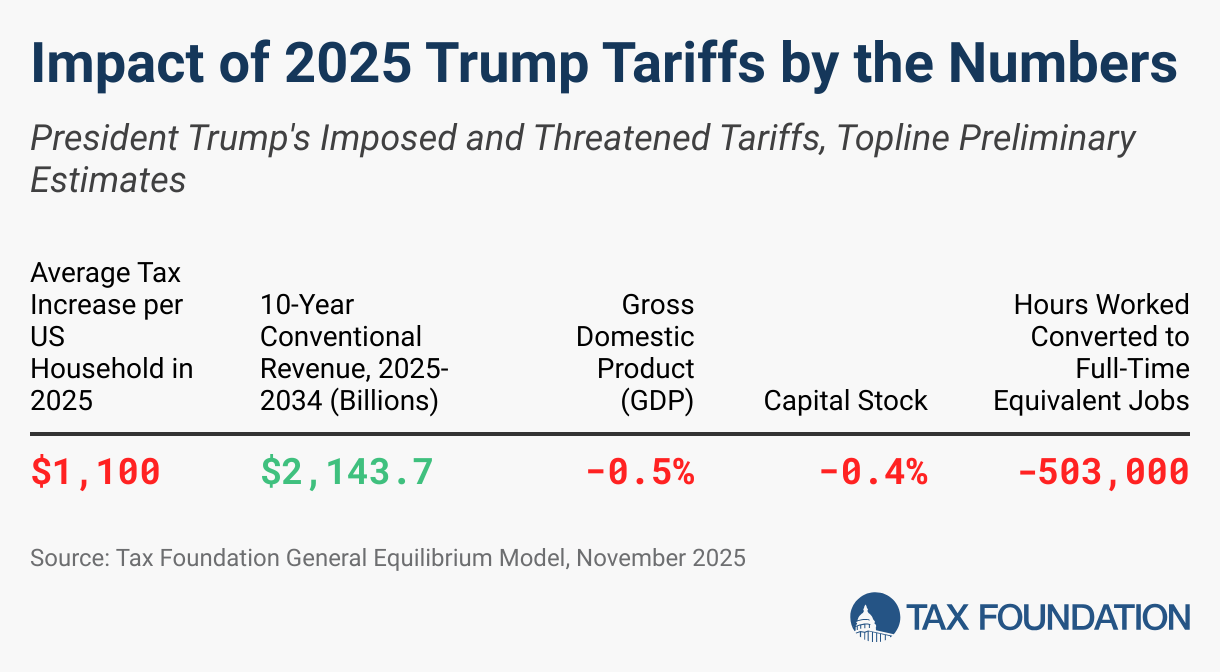
Key Findings
·
In 2025, the
Trump tariffs amounted to an average tax increase of
$1,000 per US household. We estimate the new tariffs currently imposed in 2026
will increase taxes per US household by $600.
·
President Trump imposed
tariffs on nearly all trading partners under the International Emergency
Economic Powers Act (IEEPA) and on several sectors using Section 232. On
February 20, 2026, the Supreme Court ruled 6-3 that IEEPA does not authorize tariffs,
leaving only the new Section 232 tariffs in place. Trump responded by imposing
a 10 percent tariff on
nearly all countries under Section 122, effective February 24, 2026, applying
to an estimated $1.2 trillion (34 percent) of annual imports. The Section 122
tariff is scheduled to expire after 150 days, and several new Section 301
investigations are ongoing.
·
The
IEEPA ruling reduced the weighted average applied tariff rate on
all imports from 13.8 percent to 6.7 percent in 2026 under the remaining
Section 232 tariffs. While the 10 percent Section 122 tariffs are in effect, we
estimate this rises to 10.3 percent.
·
The
average effective tariff rate was 7.7 percent in 2025—the highest since 1947.
If the 10 percent Section 122 tariffs expire on schedule, we estimate the
average effective tariff rate will be 5.6 percent in 2026, the highest since
1972.
·
We
estimate that the remaining Section 232 and Section 122 tariffs will raise $662
billion in revenue from 2026-2035 on a conventional basis. The permanent
Section 232 tariffs will reduce long-run US GDP by 0.2 percent before foreign
retaliation. Accounting for negative economic effects, the revenue raised by
the tariffs falls to $517 billion over the decade. We estimate that the Section
232 tariffs raised $36 billion in net tax revenue in 2025.
·
The
tariffs have not meaningfully altered the trade balance, which fell by only
$2.1 billion in 2025, driven by an increase in the trade surplus of services.
AVERAGE TARIFF RATES
The new tariffs will significantly
raise the tariff rates the US applies to most imports. The weighted average
tariff rate measures the statutory tax rate that applies to US imports. It
differs from the average effective tariff rate that measures actual customs
duties collections as a share of actual goods imports.
According to the World Bank, the
weighted average applied tariff was 1.5 percent in 2022. Prior to the IEEPA
ruling, we estimate US imports faced a weighted-average applied tariff rate of
13.8 percent. While the 10 percent Section 122 tariffs are in effect, we
estimate the applied rate will be 10.2 percent (at 15 percent, it would be 12.1
percent), and that it will fall to 6.7 percent after the Section 122 tariffs
expire.
TRUMP'S TARIFFS DRAMATICALLY RAISE
APPLIED TARIFF RATES
Trade-Weighted Average Applied
Tariff Rate in 2022 and Tax Foundation Estimates of Applied Tariff Rates Under
Trump's Proposals
5.010.0%
1.5%
13.8%
10.3%
12.1%
6.7%
WEIGHTED-AVERAGE APPLIED TARIFF
RATE IN 2022
Total with IEEPA, 2026
Total with Section 122 of 10% for
150 days, 2026
Total with Section 122 of 15% for
150 days, 2026
Total After Section 122 Expires
Note: The weighted average applied
tariff rate measures the statutory tax rate imposed on different products from
different countries, and it differs from average effective rates measured by
actual tariff revenues as a share of total goods imports.
Source: World Development
Indicators and Tax Foundation calculations.
Embed Download imageGet the data
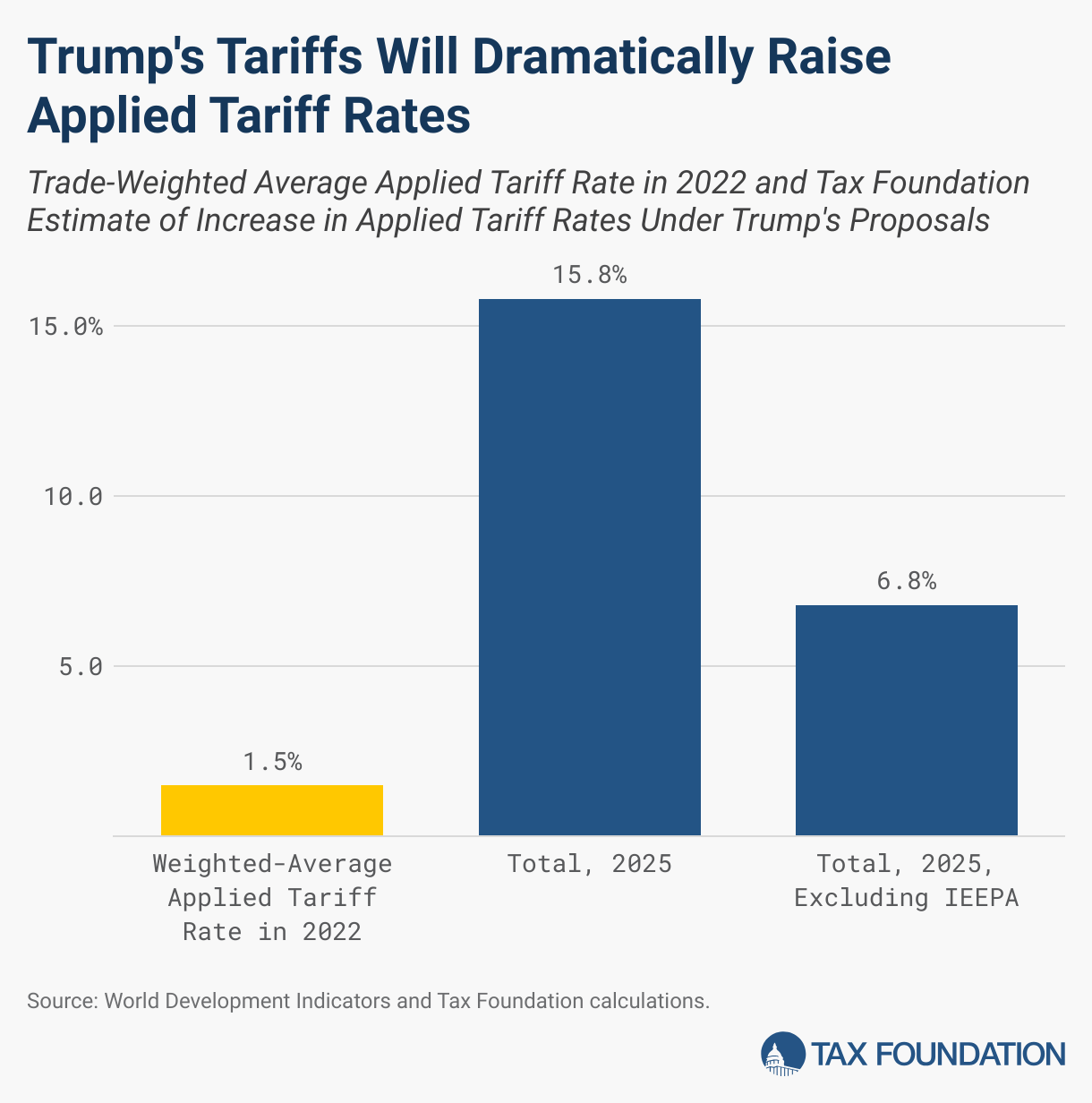
We estimate the average effective tariff
rate by taking tariff revenues as a share of total goods imports. In 2025,
before the Supreme Court ruled the IEEPA tariffs illegal, the actual average
effective tariff rate rose from 2.4 percent in 2024 to 7.7 percent, the highest
since 1947. If the 10 percent Section 122 tariffs end after 150 days, we
estimate the average effective tariff rate for 2026 will be 5.6 percent—the
highest since 1972. (At 15 percent, it would be 6.0 percent and the highest
since 1971.)
TRUMP'S TARIFFS HAVE DRAMATICALLY
RAISED EFFECTIVE TARIFF RATES
Average Effective Tariff Rate on
All Goods Imports in 2024 and 2025, Tax Foundation Estimates of Average
Effective Tariff Rate on All Goods Imports Under Trump's Proposals
2.04.06.0%
2.5%
7.7%
5.6%
6.0%
Average Effective Tariff Rate on
All Goods Imports, 2024
Average Effective Tariff Rate on
All Goods Imports, 2025
Average Effective Tariff Rate on
All Goods Imports, 2026, with 10% Section 122
Average Effective Tariff Rate on
All Goods Imports, 2026, with 15% Section 122
Note: We estimate the average
effective tariff rate by taking tariff revenues as a share of total goods
imports.
Source: Tax Foundation
calculations.
Embed Download image Get the data
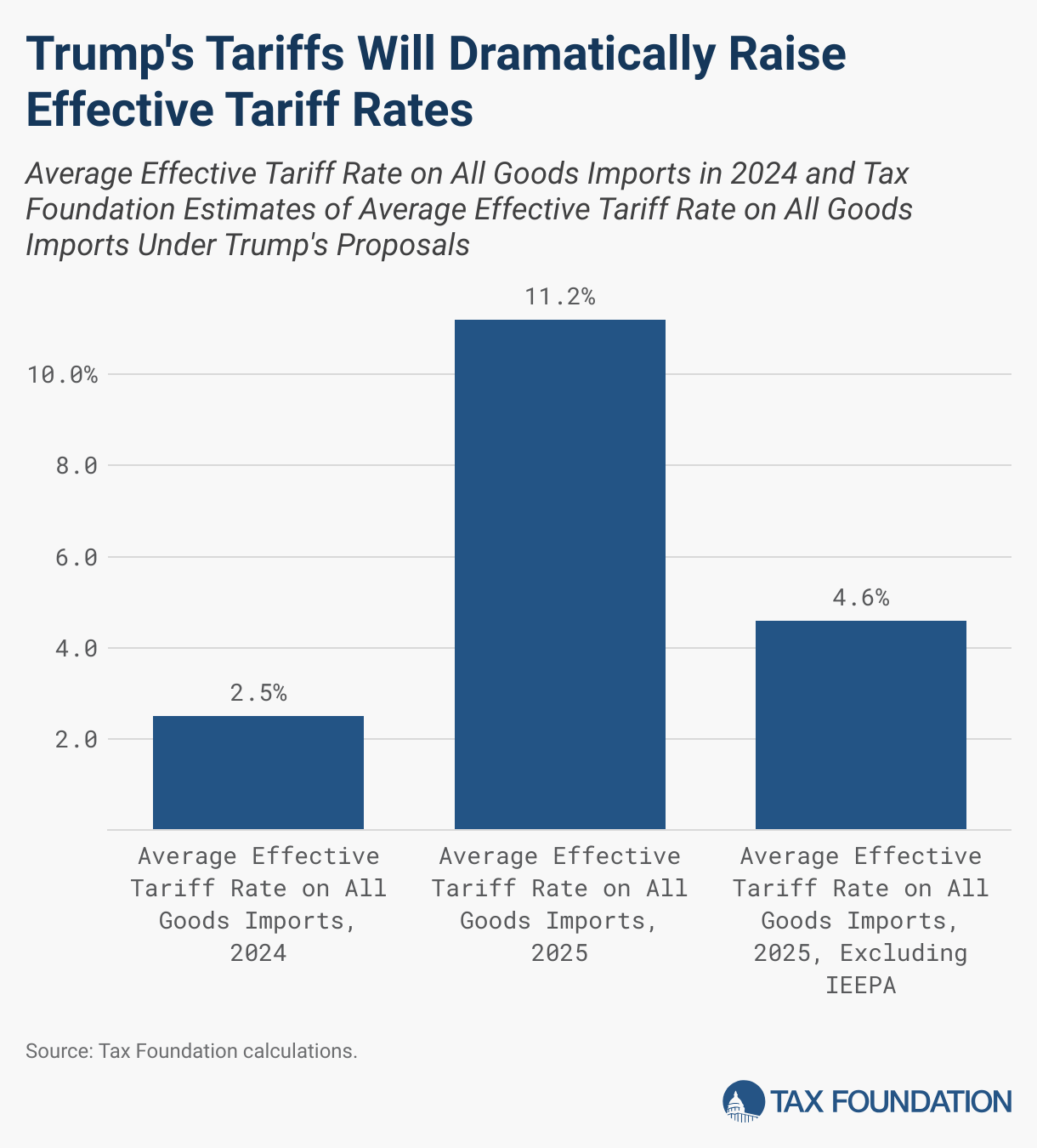
TARIFF REVENUE COLLECTIONS
In calendar year 2025, customs
duties raised $264 billion for the federal government, compared to $79 billion
in calendar year 2024. Total customs duties revenues include pre-existing
tariffs, such as those President Trump imposed in his first term. With the
IEEPA tariffs being ruled illegal, the revenue collected by the government
related to those tariffs will have to be refunded. The total revenue raised by
tariffs will be less than the direct collections, because tariffs mechanically
reduce the bases of income and payroll taxes. We estimate the government netted
$36 billion from the new Section 232 tariffs in 2025.
THE BALANCE OF TRADE
One of President Trump’s stated
goals of imposing tariffs is to shrink the US trade deficit. However, a
country’s balance of trade is not solely driven by trade policy, but instead,
reflects broader macroeconomic balances between saving and investment and net
lending and borrowing with the rest of the world.
In the United States, domestic
investment outpaces domestic saving, requiring a capital inflow from the rest
of the world to close the gap. The capital inflow represents net lending to the
United States from the rest of the world to finance business investment as well
as the government’s budget deficit. Because tariffs do not directly change the
balance between domestic saving and investment, tariffs cannot permanently
change the trade balance.
The last time the United States
ran a trade surplus was in 1975; every year since, the United States has run a
trade deficit. That the United States has consistently run trade deficits for
decades is not an imminent economic problem. Net imports, another term for a
trade deficit, can reflect the strength of the US economy in attracting foreign
investment and in serving as a safe, reliable haven for foreign capital. When
net imports finance the capital stock, it allows the US to enjoy a higher level
of productivity and growth than otherwise would occur.
In 2025, the trade deficit fell by
just $2.1 billion compared to 2024. The reduction in the trade deficit was due
to an increase in the trade surplus of services, as the goods deficit actually
increased by $25.5 billion year over year.
ECONOMIC EFFECTS
Our estimates below separate the
effects of the IEEPA tariffs (ruled unlawful) from other tariffs. See the
Appendix for a detailed explanation of the modeled provisions.
Because the Section 122 tariff
expires after 150 days, it would have no long-run economic impact. We estimate
that before accounting for any foreign retaliation, the Section 232 tariffs
will reduce long-run US GDP by 0.2 percent. The IEEPA tariffs, including the
scheduled “reciprocal” tariffs, would have reduced long-run GDP by an
additional 0.3 percent.
As of September 1, 2025,
threatened and imposed retaliatory tariffs affect $223 billion of US exports
based on 2024 US import values; if fully imposed, we estimate they will reduce
long-run US GDP by 0.2 percent.
Table 1. Estimated Economic Impact
of 2025 Trump Tariffs
|
Long-Run GDP |
Capital Stock |
Pre-Tax Wages |
Hours Worked Converted to Full-Time Equivalent Jobs |
||||
|
Section
232 Tariffs |
-0.2% |
-0.1% |
0.0% |
-154,000 |
|||
|
Section
232 Steel and Aluminum |
Less
than -0.05% |
Less
than -0.05% |
0.0% |
-27,000 |
|||
|
Section
232 Autos and Auto Parts |
-0.1% |
-0.1% |
0.0% |
-98,000 |
|||
|
Section
232 Furniture, Kithcen Cabinets and Vanities, Lumber |
Less
than -0.05% |
Less
than -0.05% |
0.0% |
-3,000 |
|||
|
Section
232 Heavy Trucks and Parts |
Less
than -0.05% |
Less
than -0.05% |
0.0% |
-23,000 |
|||
|
IEEPA
Tariffs, Total |
-0.4% |
-0.3% |
0.0% |
-282,000 |
|||
|
IEEPA
Fentanyl China |
-0.1% |
-0.1% |
0.0% |
-59,000 |
|||
|
IEEPA
Mexico |
Less
than -0.05% |
Less
than -0.05% |
0.0% |
-12,000 |
|||
|
IEEPA
Canada |
Less
than -0.05% |
Less
than -0.05% |
0.0% |
-15,000 |
|||
|
IEEPA
10% Baseline Tariff Excluding Canada and Mexico |
-0.2% |
-0.1% |
0.0% |
-142,000 |
|||
|
IEEPA
"Reciprocal" Tariff Increases
(ROW) |
Less
than -0.05% |
Less
than -0.05% |
0.0% |
-27,000 |
|||
|
Ending
De Minimis |
Less
than -0.05% |
Less
than -0.05% |
0.0% |
-27,000 |
|||
|
Imposed
Retaliation |
-0.2% |
-0.1% |
0.0% |
-141,000 |
|||
Note: Totals may not sum due to
rounding.
Source: Tax Foundation General Equilibrium Model, February 2026
REVENUE IMPACTS
If imposed on a permanent basis,
the tariffs will increase tax revenue for the federal government. We model the
imposed tariffs together, accounting for interactions between the different
rounds of tariffs and timing of implementation. Additionally, we account for
income and payroll
tax offsets, as tariffs mechanically
reduce those tax bases. For this reason, the total tax revenue raised on
net will be less than the tariff revenue reported by Treasury. Revenue is even
lower on a dynamic basis, a reflection of the negative effect tariffs have on
US economic output, reducing incomes and resulting tax revenues. Revenue would
fall more when factoring in foreign retaliation, as retaliation would cause US
output and incomes to shrink further.
On a conventional basis, before
incorporating negative economic effects, we estimate that the Section 232
tariffs will increase US federal tax revenue by $635 billion from 2026 through
2035. The temporary 10 percent Section 122 tariffs will raise $27 billion in
2026 ($35 billion if 15 percent), replacing about 52 percent (or nearly 70
percent, if levied at 15 percent) of the revenue raised by IEEPA over 150 days.
The IEEPA tariffs would have raised an additional $1.4 trillion in revenue over
the next decade. The IEEPA tariffs raised less in 2025 because they were not in
effect for the full year.
On a dynamic basis, incorporating
the negative effects of the US-imposed tariffs on the US economy, we estimate
that the Section 232 and temporary Section 122 tariffs will raise $517 billion
from 2026 through 2035, about $145 billion less than the conventional estimate.
The IEEPA tariffs would have raised an additional $1.1 trillion over the next
decade, about $264 billion less than the conventional estimate. Incorporating
the negative effects of imposed retaliatory tariffs as of September 1, 2025,
further reduces 10-year revenue by $136 billion.
Table 2. Conventional Revenue
Effects of 2025 Trump Tariffs
|
Calendar Year |
2025 |
2026 |
2027 |
2028 |
2029 |
2030 |
2031 |
2032 |
2033 |
2034 |
2035 |
2026-2035 |
|
Section
232 Tariffs |
$36.0 |
$53.8 |
$55.7 |
$57.7 |
$59.5 |
$61.7 |
$64.2 |
$66.7 |
$69.4 |
$71.9 |
$74.4 |
$634.9 |
|
Section
232 Steel and Aluminum |
$8.5 |
$9.7 |
$10.0 |
$10.4 |
$10.7 |
$11.1 |
$11.6 |
$12.0 |
$12.5 |
$13.0 |
$13.4 |
$114.4 |
|
Section
232 Autos and Auto Parts |
$25.8 |
$34.8 |
$35.9 |
$37.2 |
$38.4 |
$39.8 |
$41.4 |
$43.0 |
$44.7 |
$46.4 |
$48.0 |
$409.6 |
|
Section
232 Copper |
$0.3 |
$0.7 |
$0.7 |
$0.8 |
$0.8 |
$0.8 |
$0.9 |
$0.9 |
$0.9 |
$1.0 |
$1.0 |
$8.5 |
|
Section
232 Furniture, Kithcen Cabinets and Vanities, Lumber |
$0.2 |
$1.2 |
$1.3 |
$1.3 |
$1.4 |
$1.4 |
$1.5 |
$1.5 |
$1.6 |
$1.7 |
$1.7 |
$14.5 |
|
Section
232 Heavy Trucks and Parts |
$1.2 |
$7.5 |
$7.7 |
$8.0 |
$8.2 |
$8.5 |
$8.9 |
$9.2 |
$9.6 |
$9.9 |
$10.3 |
$87.8 |
|
Section
122 Tariff (10%) |
$0.0 |
$26.9 |
$0.0 |
$0.0 |
$0.0 |
$0.0 |
$0.0 |
$0.0 |
$0.0 |
$0.0 |
$0.0 |
$26.9 |
|
Section
122 Tariff (15%) |
$0.0 |
$35.4 |
$0.0 |
$0.0 |
$0.0 |
$0.0 |
$0.0 |
$0.0 |
$0.0 |
$0.0 |
$0.0 |
$35.4 |
|
Total |
$36.0 |
$87.0 |
$55.7 |
$57.7 |
$59.5 |
$61.7 |
$64.2 |
$66.7 |
$69.4 |
$71.9 |
$74.4 |
$668.1 |
|
IEEPA
Tariffs |
$95.8 |
$117.3 |
$120.7 |
$125.0 |
$129.1 |
$133.7 |
$139.1 |
$144.6 |
$150.4 |
$155.7 |
$161.0 |
$1,376.7 |
|
IEEPA
Fentanyl China |
$28.0 |
$24.2 |
$25.0 |
$25.9 |
$26.7 |
$27.7 |
$28.8 |
$29.9 |
$31.1 |
$32.3 |
$33.4 |
$285.0 |
|
IEEPA
Mexico |
$2.6 |
$3.6 |
$3.7 |
$3.8 |
$3.9 |
$4.1 |
$4.2 |
$4.4 |
$4.6 |
$4.7 |
$4.9 |
$41.9 |
|
IEEPA
Canada |
$2.8 |
$4.0 |
$4.1 |
$4.3 |
$4.4 |
$4.6 |
$4.8 |
$5.0 |
$5.1 |
$5.3 |
$5.5 |
$47.1 |
|
IEEPA
10% Baseline Tariff Excluding Canada and Mexico |
$47.6 |
$60.9 |
$62.9 |
$65.1 |
$67.3 |
$69.6 |
$72.5 |
$75.3 |
$78.3 |
$81.2 |
$84.1 |
$717.3 |
|
IEEPA
"Reciprocal" Tariff Increases (ROW) |
$9.3 |
$18.4 |
$18.6 |
$19.3 |
$19.9 |
$20.6 |
$21.4 |
$22.3 |
$23.2 |
$24.0 |
$24.9 |
$212.5 |
|
Ending
De Minimis |
$5.6 |
$6.3 |
$6.4 |
$6.7 |
$6.9 |
$7.2 |
$7.4 |
$7.7 |
$8.0 |
$8.1 |
$8.2 |
$72.9 |
|
Total
Conventional Revenue |
$131.8 |
$175.1 |
$180.8 |
$187.3 |
$193.4 |
$200.3 |
$208.4 |
$216.7 |
$225.3 |
$233.3 |
$241.4 |
$2,061.7 |
Source: Tax Foundation General
Equilibrium Model, March 2026
Table 3. Dynamic Revenue Effects
of President Trump’s Tariffs
|
Calendar Year |
2025 |
2026 |
2027 |
2028 |
2029 |
2030 |
2031 |
2032 |
2033 |
2034 |
2035 |
2026-2035 |
|
Section
232 Tariffs |
$23.2 |
$42.8 |
$43.6 |
$45.3 |
$46.0 |
$47.7 |
$49.5 |
$50.9 |
$53.1 |
$54.9 |
$55.9 |
$489.6 |
|
Section
232 Steel and Aluminum |
$6.2 |
$7.3 |
$7.4 |
$7.9 |
$8.1 |
$8.4 |
$8.8 |
$8.9 |
$9.5 |
$9.7 |
$9.8 |
$85.7 |
|
Section
232 Autos and Auto Parts |
$17.1 |
$28.2 |
$28.5 |
$29.2 |
$29.7 |
$30.7 |
$31.8 |
$32.8 |
$34.0 |
$35.1 |
$35.9 |
$315.9 |
|
Section
232 Copper |
$0.3 |
$0.7 |
$0.7 |
$0.8 |
$0.8 |
$0.8 |
$0.9 |
$0.9 |
$0.9 |
$1.0 |
$1.0 |
$8.5 |
|
Section
232 Furniture, Kithcen Cabinets and Vanities, Lumber |
$0.2 |
$1.1 |
$1.3 |
$1.3 |
$1.4 |
$1.4 |
$1.5 |
$1.5 |
$1.6 |
$1.7 |
$1.7 |
$14.4 |
|
Section
232 Heavy Trucks and Parts |
-$0.6 |
$5.5 |
$5.7 |
$6.0 |
$6.1 |
$6.4 |
$6.6 |
$6.8 |
$7.1 |
$7.4 |
$7.5 |
$65.0 |
|
Section
122 Tariff (10%) |
$0.0 |
$26.9 |
$0.0 |
$0.0 |
$0.0 |
$0.0 |
$0.0 |
$0.0 |
$0.0 |
$0.0 |
$0.0 |
$26.9 |
|
Section
122 Tariff (15%) |
$0.0 |
$35.4 |
$0.0 |
$0.0 |
$0.0 |
$0.0 |
$0.0 |
$0.0 |
$0.0 |
$0.0 |
$0.0 |
$35.4 |
|
Total |
$23.2 |
$76.0 |
$43.6 |
$45.3 |
$46.0 |
$47.7 |
$49.5 |
$50.9 |
$53.1 |
$54.9 |
$55.9 |
$522.8 |
|
IEEPA
Tariffs |
$72.0 |
$93.9 |
$95.7 |
$99.7 |
$101.9 |
$106.1 |
$110.3 |
$113.7 |
$118.7 |
$122.4 |
$125.1 |
$1,087.5 |
|
IEEPA
Fentanyl China |
$23.1 |
$19.0 |
$19.6 |
$20.5 |
$20.9 |
$22.0 |
$22.7 |
$23.4 |
$24.5 |
$25.4 |
$25.9 |
$224.0 |
|
IEEPA
Mexico |
$1.9 |
$2.8 |
$2.9 |
$3.0 |
$3.0 |
$3.1 |
$3.2 |
$3.2 |
$3.3 |
$3.5 |
$3.5 |
$31.6 |
|
IEEPA
Canada |
$1.9 |
$3.1 |
$3.1 |
$3.2 |
$3.2 |
$3.3 |
$3.4 |
$3.5 |
$3.6 |
$3.7 |
$3.8 |
$33.8 |
|
IEEPA
10% Baseline Tariff Excluding Canada and Mexico |
$35.4 |
$47.9 |
$49.2 |
$51.1 |
$52.5 |
$54.7 |
$56.9 |
$59.1 |
$61.6 |
$63.7 |
$65.5 |
$562.3 |
|
IEEPA
"Reciprocal" Tariff Increases (ROW) |
$6.4 |
$16.6 |
$16.6 |
$17.2 |
$17.6 |
$18.2 |
$19.0 |
$19.5 |
$20.4 |
$21.0 |
$21.5 |
$187.7 |
|
Ending
De Minimis |
$3.2 |
$4.5 |
$4.4 |
$4.6 |
$4.6 |
$4.8 |
$5.0 |
$5.0 |
$5.3 |
$5.1 |
$4.8 |
$48.2 |
|
Retaliation |
-$8.6 |
-$9.6 |
-$10.8 |
-$11.6 |
-$12.5 |
-$13.2 |
-$14.0 |
-$14.9 |
-$15.6 |
-$16.4 |
-$17.4 |
-$136.0 |
Source: Tax Foundation General
Equilibrium Model, March 2026
In 2026, the Trump tariffs
including IEEPA would have increased federal tax revenues by $171.1 billion, or
0.54 percent of GDP, making the tariffs the largest tax hike since 1993. With
the IEEPA tariff being ruled illegal, we estimate that the Section 232 tariffs
and 10 percent Section 122 tariffs will increase federal tax revenues by $81
billion in 2026, or 0.26 percent of GDP, ranking as the 20th largest
tax increase since 1940. (At 15 percent, the combined new tariffs would
raise $89 billion in 2026, or 0.28 percent of GDP, and rank as the 18th largest
tax increase since 1940.)
Trump's 2025 Tariffs Were the
Largest Tax Hike Since 1993
Average Annual Revenue Change as a
Share of GDP Across Major Tax Laws and Trump's Proposed Tariffs, Yellow Bars
Indicate War-Related Tax Laws
Revenue Act of 1942*^
5.04%
Revenue Act of 1941*^
2.20%
Revenue Act of 1951*^
1.52%
Revenue Act of 1950*^
1.33%
Current Tax Payment Act of 1943*^
1.16%
Revenue and Expenditure Control
Act of 1968*
1.10%
TEFRA of 1982
0.98%
Excess Profits Tax of 1950*^
0.97%
Revenue Act of 1940*^
0.91%
Second Revenue Act of 1940*
0.71%
Omnibus Budget Reconciliation Act
of 1993
0.63%
Tax Adjustment Act of 1966
0.60%
President Trump's 2025 Tariffs
Before SCOTUS Ruling
0.54%
Crude Oil Windfall Profit Tax Act
of 1980
0.51%
Omnibus Budget Reconciliation Act
of 1990
0.50%
Revenue Act of 1943*^
0.40%
Affordable Health Care Act of 2010
0.40%
Deficit Reduction Act of 1984
0.35%
President Trump's 2026 Tariffs
0.26%
Note: * Tax bills were fully or
partially used to fund war efforts in World War II, the Korean War, or the
Vietnam War. ^ The "full-year effect" for the first year of revenue
was used, rather than the effect on the first fiscal year after enactment.
Source: Jerry Tempalski,
“Revenue Effects of Major Tax Bills”; Congressional Budget Office, “Revenue
Projections, by Category”; Tax Foundation General Equilibrium Model; Author
calculations.
Chart: Erica York Embed Download image Get the data
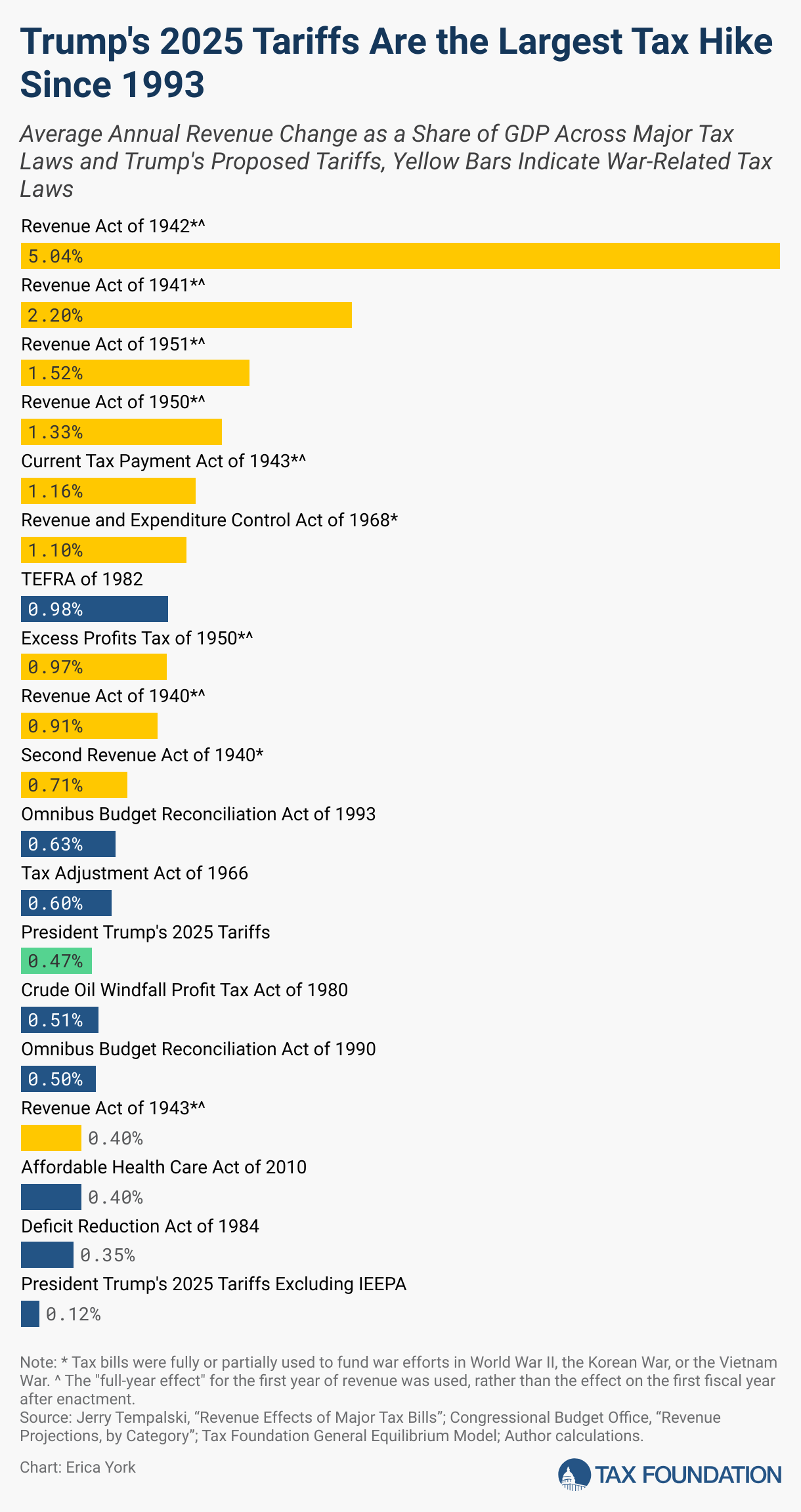
DISTRIBUTIONAL IMPACTS
In 2026, the tariffs will reduce
after-tax incomes for all income groups. The top 1 percent will see a smaller
reduction in after-tax income compared to others. Per US household, the tariffs
altogether will amount to an average tax increase of $1,000 in 2025 and would
have been a $1,300 average tax increase in 2026. However, with the IEEPA
tariffs being ruled illegal, the tax increases will be smaller at $400 in 2026
for the Section 232 tariffs. The 10 percent Section 122 tariffs would increase
the tax burden to $600.
These averages do not capture
additional costs from higher-priced alternatives and reduced consumer choice.
Table 4. Distributional Effects of
2025 Trump Tariffs
|
Percent Change in After-Tax Income under Imposed Tariffs,
2026 |
Nominal Tax Change, 2026 |
|||||
|
Market
Income Percentile |
Section
232 Tariffs |
IEEPA
Tariffs |
Section
122 Tariff |
Section
232 Tariffs |
IEEPA
Tariffs |
Section
122 Tariff |
|
0%
- 20.0% |
-0.3% |
-0.8% |
-0.2% |
$36 |
$79 |
$18 |
|
20.0%
- 40.0% |
-0.3% |
-0.8% |
-0.2% |
$99 |
$215 |
$49 |
|
40.0%
- 60.0% |
-0.4% |
-0.8% |
-0.2% |
$192 |
$418 |
$96 |
|
60.0%
- 80.0% |
-0.3% |
-0.8% |
-0.2% |
$339 |
$740 |
$170 |
|
80.0%
- 100% |
-0.3% |
-0.7% |
-0.2% |
$927 |
$2,019 |
$464 |
|
80.0%
- 90.0% |
-0.4% |
-0.8% |
-0.2% |
$540 |
$1,177 |
$270 |
|
90.0%
- 95.0% |
-0.4% |
-0.8% |
-0.2% |
$756 |
$1,647 |
$378 |
|
95.0%
- 99.0% |
-0.3% |
-0.7% |
-0.2% |
$1,258 |
$2,742 |
$630 |
|
99.0%
- 99.9% |
-0.3% |
-0.7% |
-0.2% |
$3,014 |
$6,566 |
$1,508 |
|
99.9%
- 100% |
-0.2% |
-0.5% |
-0.1% |
$15,987 |
$34,830 |
$7,997 |
|
Total |
-0.3% |
-0.8% |
||||
Note: Market income includes
adjusted gross
income (AGI) plus 1) tax-exempt interest, 2) non-taxable Social
Security income, 3) the employer share of payroll taxes, 4) imputed corporate
tax liability, 5) employer-sponsored health insurance and other fringe
benefits, 6) taxpayers’ imputed contributions to defined-contribution pension
plans. Market income levels are adjusted for the number of exemptions reported
on each return to make tax units more comparable. After-tax income is market
income less: individual
income tax, corporate
income tax, payroll taxes, estate and gift tax, custom
duties, and excise taxes. The 2026 income break points by percentile are:
20%-$17,735; 40%-$38,572; 60%-$73,905; 80%-$130,661; 90%-$188,849;
95%-$266,968; 99%-$611,194. Tax units with negative market income and
non-filers are excluded from the percentile groups but included in the totals.
Source: Tax Foundation General Equilibrium Model, February 2026
TELEGRAPH
UK
ALL THE TAX
CHANGES AND PRICE RISES COMING IN APRIL
|
By Lauren
Davidson Executive Money Editor |
It’s April 1 next week, but this
is no joking
matter. The new month brings with it a cacophony of financial changes that
only a fool would ignore.
First, the good news: the typical household’s energy bills will fall by seven
per cent, or £117 a year, from Wednesday due to the reduction in
the energy price cap. However, this drop is likely to be short-lived. Oil
price shocks from the Iran war are predicted to push the cap from £1,641 to
£1,801 in July. Shop around for a cheaper fixed-term deal and lock in before
the summer.
Elsewhere, most costs are going up from April. Most council tax bills will rise
by 4.9 per cent, which is £111 for an average Band D house. Use our calculator to see how much more you’ll pay. Also
going up next week are water bills, car taxes, mobile phone and broadband
prices and the cost of a TV licence.
Hot on the heels of price rise day comes the start of the new tax year on April
6, which will also leave most people lighter of pocket. Farms, family
businesses and Aim-listed shares will incur more inheritance tax, dividend
taxes will rise by two pence in the pound and the dreaded Making Tax Digital finally arrives for sole traders and
landlords with more than £50,000 of income (find the best software to use here).
Fret not, for you still have time to act to protect your money. Don’t miss out
on the essential tips in these guides.
WORLD POPULATION REVIEW
FIVE COUNTRIES
WITH THE HIGHEST PERSONAL INCOME TAX RATE
57.65%
55.95%
55.9%
55%
52%
TAXATION BY INCOME, SALES
(CONSUMPTION) AND CORPORATE IN 2025 (Highest to Lowest)
|
|
COUNTRY |
PERSONAL
INCOME TAX RATE |
SALES TAX
RATE |
CORPORATE
TAX RATE |
|
|
57.65% |
25.5% |
20% |
|
|
|
55.95% |
10% |
30.62% |
|
|
|
55.9% |
25% |
22% |
|
|
|
55% |
20% |
23% |
|
|
|
52% |
25% |
20.6% |
|
|
|
52% |
4% |
22% |
|
|
|
50% |
21% |
25% |
|
|
|
50% |
17% |
23% |
|
|
|
50% |
22% |
22% |
|
|
|
49.5% |
21% |
25.8% |
|
|
|
48% |
23% |
21% |
|
|
|
47.4% |
25% |
22% |
|
|
|
47% |
21% |
25% |
|
|
|
46.28% |
24% |
21% |
|
|
|
45% |
13% |
25% |
|
|
|
45% |
19% |
30% |
|
|
|
45% |
20% |
25% |
|
|
|
45% |
20% |
25% |
|
|
|
45% |
15% |
27% |
|
|
|
45% |
10% |
24% |
|
|
|
45% |
10% |
30% |
|
|
|
44% |
24% |
22% |
|
|
|
43% |
22% |
24% |
|
|
|
43% |
18% |
30% |
|
|
|
42% |
10% |
30% |
|
|
|
42% |
17% |
23.87% |
|
|
|
41.2% |
15% |
24.72% |
|
|
|
40% |
16% |
30% |
|
|
|
40% |
20% |
25% |
|
|
|
40% |
18% |
30% |
|
|
|
40% |
5% |
20% |
|
|
|
40% |
19% |
27% |
|
|
|
40% |
18% |
30% |
|
|
|
40% |
18.9% |
28% |
|
|
|
40% |
16% |
25% |
|
|
|
40% |
23% |
12.5% |
|
|
|
39% |
18% |
34.94% |
|
|
|
39% |
19% |
35% |
|
|
|
39% |
15% |
28% |
|
|
|
38.5% |
19.25% |
33% |
|
|
|
38% |
20% |
33% |
|
|
|
38% |
10% |
36% |
|
|
|
37% |
21% |
||
|
|
37% |
16% |
30% |
|
|
|
37% |
15% |
25% |
|
|
|
37% |
15% |
31% |
|
|
|
36% |
22% |
25% |
|
|
|
35% |
12% |
22% |
|
|
|
35% |
18% |
29% |
|
|
|
35% |
15% |
30% |
|
|
|
35% |
16% |
30% |
|
|
|
35% |
12% |
25% |
|
|
|
35% |
10% |
20% |
|
|
|
35% |
7% |
20% |
|
|
|
35% |
19% |
26% |
|
|
|
35% |
17% |
35% |
|
|
|
35% |
16.5% |
30% |
|
|
|
35% |
19% |
15% |
|
|
|
35% |
18% |
30% |
|
|
|
35% |
15% |
35% |
|
|
|
35% |
19% |
12.5% |
|
|
|
35% |
18% |
35% |
|
|
|
34% |
16% |
34% |
|
|
|
33% |
5% |
26.5% |
|
|
|
33% |
8.1% |
14.6% |
|
|
|
33% |
37.5% |
||
|
|
33% |
21% |
20% |
|
|
|
33% |
|||
|
|
32% |
23% |
19% |
|
|
|
32% |
16% |
32% |
|
|
|
30% |
18% |
30% |
|
|
|
30% |
16% |
30% |
|
|
|
30% |
10% |
24% |
|
|
|
30% |
15% |
25% |
|
|
|
30% |
18% |
29.5% |
|
|
|
30% |
18% |
35% |
|
|
|
30% |
18% |
28% |
|
|
|
30% |
18% |
20% |
|
|
|
30% |
15% |
30% |
|
|
|
30% |
13% |
30% |
|
|
|
30% |
25% |
18% |
|
|
|
30% |
15% |
25% |
|
|
|
30% |
15% |
25% |
|
|
|
28.5% |
17.5% |
5.5% |
|
|
|
27.5% |
17% |
34% |
|
|
|
27.5% |
14% |
22.5% |
|
|
|
27% |
15% |
27% |
|
|
|
25% |
15% |
27.5% |
|
|
|
25% |
5% |
22% |
|
|
|
25% |
14% |
25% |
|
|
|
25% |
18% |
27% |
|
|
|
25% |
15% |
25% |
|
|
|
25% |
18% |
20% |
|
|
|
25% |
10% |
20% |
|
|
|
25% |
11% |
17% |
|
|
|
25% |
20% |
24% |
|
|
|
25% |
13% |
30% |
|
|
|
25% |
7% |
25% |
|
|
|
25% |
15% |
27% |
|
|
|
25% |
14% |
22% |
|
|
|
25% |
12.5% |
30% |
|
|
|
24% |
7.5% |
30% |
|
|
|
24% |
9% |
17% |
|
|
|
23% |
21% |
21% |
|
|
|
23% |
20% |
15% |
|
|
|
22.4% |
8.1% |
12.5% |
|
|
|
22% |
28% |
||
|
|
20% |
10% |
20% |
|
|
|
20% |
20% |
20% |
|
|
|
20% |
10% |
20% |
|
|
|
20% |
18% |
15% |
|
|
|
20% |
10% |
25% |
|
|
|
20% |
21% |
18% |
|
|
|
20% |
21% |
16% |
|
|
|
20% |
22% |
20% |
|
|
|
20% |
15% |
15% |
|
|
|
20% |
15% |
25% |
|
|
|
20% |
20% |
||
|
|
18% |
20% |
15% |
|
|
|
18% |
18% |
30% |
|
|
|
15% |
17% |
35% |
|
|
|
15% |
15% |
||
|
|
15% |
27% |
9% |
|
|
|
15% |
15% |
25% |
|
|
|
15% |
16.5% |
||
|
|
15% |
21% |
15% |
|
|
|
15% |
15% |
33% |
|
|
|
13% |
20% |
25% |
|
|
|
13% |
13% |
25% |
|
|
|
13% |
20% |
20% |
|
|
|
12% |
12% |
15% |
|
|
|
12% |
14% |
||
|
|
12% |
20% |
12% |
|
|
|
12% |
12% |
||
|
|
10% |
12% |
20% |
|
|
|
10% |
19% |
16% |
|
|
|
10% |
24% |
||
|
|
10% |
20% |
10% |
|
|
|
10% |
20% |
15% |
|
|
|
10% |
17% |
10% |
|
|
|
7% |
15% |
25% |
|
|
|
9% |
|||
|
|
15% |
20% |
||
|
|
18% |
25% |
||
|
|
13% |
|||
|
|
19% |
|||
|
|
18% |
|||
|
|
18% |
27.5% |
||
|
|
5% |
|||
|
|
18% |
30% |
||
|
|
18% |
|||
|
|
10% |
|||
|
|
5% |
9% |
||
|
|
12% |
|||
|
|
5% |
15% |
||
|
|
15% |
|||
|
|
10% |
|||
|
|
10% |
|||
|
|
10% |
30% |
||
|
|
14% |
|||
|
|
50% |
|||
|
|
15% |
|||
|
|
18.5% |
|||
|
|
12.5% |
|||
|
|
12% |
|||
|
|
15% |
|||
|
|
5% |
21% |
AMERICANS for TAX FAIRNESS
THIS TAX DAY
ARIZONA’S BILLIONAIRES ARE GROWING EVEN RICHER IN WAKE OF 2025 TRUMP-GOP TAX
GIVEAWAYS
State Billionaires Are Worth 15%
More Since Trump Was Reelected
April 13, 2026
This Tax Day 2026, after a year of
fiscal policies enacted by President Trump and his Republican Congress that
reward the wealthy, Arizona’s billionaires are flying high while the state’s
workers and families struggle to afford the basics. In just the 16 months since
Trump was reelected, the collective fortune of Arizona’s 15 billionaires has
grown by $9.1 billion, or 14.7%, according to a new
report released today by Opportunity Arizona and Americans for Tax
Fairness (ATF). (See URL for
individuals)
 Source: Americans
for Tax Fairness
Source: Americans
for Tax Fairness
“Trump’s tariffs and tax cuts for
the billionaire class have raised grocery costs and made health insurance
unattainable for hardworking Arizonans,” said Ben Scheel of Opportunity
Arizona. “With nearly half of Arizona’s SNAP recipients losing access, the
effects of OBBBA are devastating. Families everywhere can’t afford food or
healthcare while an Arizona-failed sports team owner and predatory lending
billionaire got $9 billion RICHER in just one year. Trump and Republicans in
Arizona continue to enrich themselves and the billionaire class at the same
time Americans are forced to choose whether to pay rent or get their
medications. Hardworking Arizonans are fed up and will hold leaders accountable
for responding to the affordability crisis.”
“The return of Donald Trump has
been a boom for billionaires but a bust for average workers and families,” said
David Kass, ATF’s executive director. “Republican policies, like the One Big
Beautiful Bill Act (OBBBA), keep giving more to those who already have a lot
while taking from those with too little to spare. America will continue to
struggle with an affordability crisis until we finally pull the plug on GOP
trickle-down economics and start demanding the rich and corporations pay their
fair share of taxes. That’s the only way we can build an economy that helps
workers and families deal with the affordability crisis.”
Last July, Trump and fellow
Republicans enacted,
H.R. 1, the One Big Beautiful Bill Act, a massive tax-and-spending law that,
including added interest on the debt, will
cost more than $4 trillion over the next decade. The bulk of that expense
comes from $4.5 trillion in tax cuts that mostly benefit the wealthy. The
highest-income 20% of American households will receive 70%
of the tax cuts in 2026, and the top 1%–those with incomes of roughly a
million dollars or more–will
receive $1 trillion over the next decade. If temporary components of
the law are eventually made permanent, the total cost would increase to $5.5 trillion.
Those tax cuts were partially paid
for through cuts to vital human services. Around 15
million people will likely lose healthcare over the next eight years
because of cuts to Medicaid and the failure of the law to extend enhanced
premium tax credits to buy coverage under the Affordable Care Act. Some four
million people will lose
nutrition assistance or see their benefits substantially reduced. As
of December 2025, Protect Our Care had counted 600
hospitals, clinics and nursing homes that had closed or were in danger
of closing because of the healthcare cuts in the Republican law.
Meanwhile all through the past
year, Trump has unilaterally imposed a dizzying array of tariffs on imports
from around the world. Carefully crafted tariffs can be one tool for protecting
domestic industries and jobs. But Trump’s scattershot approach, targeting both
friendly and unfriendly trading partners, has the main impact of raising costs
for American families. (Even after the Supreme Court found the basis of many of
Trump’s original
tariffs unconstitutional, Trump reinstated
much of his tariff regime under a different authority.)
The combination of tax and service
cuts plus Trump’s tariffs will saddle the lowest-income 80% of Arizona
residents–four out of five people–with an average of $704
in higher costs this year, according to an ATF analysis of data from
the Institute on Taxation and Economic Policy (ITEP). The same analysis shows
the highest-income 1% will each enjoy on average a cumulative savings of
$8,768.
TRUMP-GOP FISCAL POLICIES: Those
Helped and Those Harmed
This Tax Day, as Americans settle
up with the IRS, there’s another calculation to be made, one that identifies
the winners and losers from Trump-GOP fiscal policies. Republican choices on
taxes, spending and tariffs over the past year have benefited rich households
and big corporations while making life less affordable for everyone else. Only
bold, comprehensive tax reform can reverse this outcome by ensuring the rich
and corporations contribute a fairer share to our national prosperity; while
restoring, expanding and improving public services the rest of us rely on to
get by and get ahead.
HELPED: Rich Members of Congress
Members of Congress are among the
few Americans who can help set their own tax rules. Through their votes,
senators and representatives can help lower or raise rates, open or close
loopholes, initiate or end special breaks. The wealthier a member of Congress
is and the more income he has the greater his personal interest in crafting the
tax code.
NOTE: Congressional financial
disclosure reports list assets and income in ranges rather than specific
amounts. The analysis here is generally based on the upper-range figures. Also,
descriptions of assets and income are not standardized across reports so the
conclusions drawn here are based on the best possible interpretation of the
data. See methodology here.
AZ REP. JUAN CISCOMANI
Last summer, Arizona Republican
Rep. Juan Ciscomani voted
for the Trump-GOP tax-and-spending plan, which heavily favored
the rich.
One part of the law Ciscomani
helped enact offers a special tax break to the owners of non-corporate
businesses. These entities–known as “pass-throughs”–pay no tax on their own
account. Instead, profits and losses are passed through to the owners, who pay
any tax due on their personal returns at individual rates. The provision allows
owners of such businesses to subtract 20% of their share of the profits before
figuring their taxes.
Ciscomani’s most recent
congressional financial
disclosure report lists an S corporation that may qualify for
pass-through status.
Other, rich members of Congress
who may have benefited from the law they voted for include:
|
MEMBER OF |
ESTIMATED NET WORTH (3/20/26) |
POTENTIAL
ESTATE TAX SAVINGS (if
applied in 2026) |
POSSIBLE
PASS-THROUGH TAX SAVINGS |
|
Sen. Jim
Justice (R-WV) |
$6 million |
$3.7
million |
|
|
Rep. Vern
Buchanan (R-FL) |
$6 million |
$962,000 |
|
|
Sen. Ron
Johnson (R-WI) |
$6 million |
$148,000 |
|
|
Sen. Rick
Scott (R-FL) |
$6 million |
$50,000 |
Source: Americans
for Tax Fairness
HELPED: Big Corporations
Even though the main focus of the
2025 Trump-GOP tax-and-spending bill was the permanent extension of individual
tax cuts that were scheduled to expire–cuts that heavily favored the
wealthy–big corporations also received costly tax handouts.
BONUS DEPRECIATION
According to standard accounting
rules, the cost of long-lasting equipment such as machinery and vehicles
purchased by a business is supposed to be deducted in equal pieces over time to
reflect the slow loss of value. But the new law instead lets firms deduct the
full cost of big-ticket purchases in the year acquired. This huge break for
business will
cost $363 billion in lost revenue over the next decade. The revenue
loss from this one tax break is almost double the amount cut from food
assistance in the Republican law, a cut that imperils the nutritional health
of some
four million people.
Huge corporations are among the
biggest beneficiaries of this tax loophole. Amazon cut its tax bill by $6.5
billion last year alone thanks to bonus depreciation, Meta (Facebook)
by $4.9 billion, and Alphabet (Google) by $3.3 billion.
RESEARCH AND EXPERIMENTATION
EXPENSING
For the last several years,
companies have been required to deduct over time (amortize) the cost of
research and experimentation. This reflects the long-term benefits of much
research. The new law allows firms to instead write off the full cost of
research in the year incurred. This loophole will lose
$141 billion in public revenue over the next decade. That’s nearly
enough money to have avoided the cuts to nutritional assistance noted
above.
Meta alone last year avoided $12.6 billion in
taxes because of R&E expensing.
LOOSER INTEREST DEDUCTION RULE
Big companies are allowed to
deduct interest when figuring their taxes, though only to the extent it
does not
exceed 30% of their income. But there are different ways of defining income.
For the past few years, firms had been required to use a stricter version of
income, one that resulted in a smaller number and therefore a tighter
restriction on the interest deduction. The new Republican law changed the
income definition to create a bigger number and therefore larger
deductions.
Among the biggest beneficiaries of
the looser interest-deduction rule are private equity firms. Private
equity uses large pools of money invested by rich individuals and
other entities to buy up companies, often harshly cut costs, then resell them
at a hoped-for profit.
HARMED: Prototypes of Individual
Suffering
Many individual victors of the
Trump-GOP fiscal system are easy to spot because they’re rich, famous and
powerful. In contrast, the suffering of individual victims of those same
Republican policies generally occurs out of the public eye. To address this
discrepancy, the Progressive Caucus Action Fund (PCAF) has developed prototype
profiles of the kind of individuals and families left worse off by the
big GOP
tax-and-spending bill enacted last year.
Among these proxies for real
victims is a 45-year-old waitress named Angela, single mom to two
daughters. It’s explained that she makes too little money to benefit from the
“no tax on tips” feature of the GOP law; but that her elder daughter, Michelle,
will face higher student loan costs because of a repayment option cancelled by
the law. Michelle will also be kicked off of the Supplemental Nutritional
Assistance Program (SNAP) because she can’t piece together enough working
hours.
Another prototype is
a refugee couple who entered the country legally from Sudan. Because
they are not yet Legal Permanent Residents, the GOP law is denying them access
to SNAP, Medicaid and the Children’s Health Insurance Program (CHIP), even
though they have a young daughter who needs complex medical care. Though
both parents work long hours, the new law is also disqualifying them from
receiving the Child Tax Credit.
There’s also a 27-year-old
electrical engineer who lost her solar-power job because the Republican
law rescinded clean-energy funding. With her loss of income, she will be unable
to afford her health insurance without the enhanced premium tax credits the GOP
law failed to extend. She will also owe thousands of dollars more on her
student loans.
A couple in their
40s pictured in the real-life small town of Forks, WA, represents the
hardships the law has created for rural communities. Because of cuts to
Medicaid, the local hospital may close, leaving town residents with a more than
hour long drive to the nearest facility. The husband’s mother may also lose her
Medicaid coverage because of complicated red-tape requirements created by the
GOP law. Their son’s asthma will be worsened by diesel school buses that could
have been replaced by electric vehicles if the law had not gutted environmental
programs.
FOX BUSINESS
RED & BLUE DIVIDE: STATES PUSH COMPETING TAX PLANS AS VOTERS WEIGH
CHANGES IN ELECTION CYCLE
Expert warns
the proposals may be 'counterproductive' as wealthy residents have 'other
places to go'
Lawmakers push aggressive
tax hikes on wealthy as critics warn of economic fallout
FOX Business’
Gerri Willis joins 'Varney & Co.' to report on the growing red vs. blue
state divide over taxes, as new wealth levies target billionaires, property tax
revolts spread nationwide and a wave of income tax cuts reshapes the economy.
By Arabella Bennett Published April 13, 2026 2:21pm EDT
A wave of aggressive tax proposals is hitting voters this
election cycle, as states push sharply different plans that could reshape how
governments raise revenue. From efforts targeting high-net-worth individuals to
proposals aimed at eliminating major taxes altogether, the growing divide is
forcing voters to weigh competing visions of fiscal policy.
 JOSH ALTMAN SOUNDS ALARM ON
CALIFORNIA WEALTH TAX, SAYS WORKERS WOULD PAY THE PRICE
JOSH ALTMAN SOUNDS ALARM ON
CALIFORNIA WEALTH TAX, SAYS WORKERS WOULD PAY THE PRICE
FOX Business’
Gerri Willis joined Stuart Varney on "Varney & Co." to report on the surge in
ballot initiatives and legislative proposals spanning both blue and red states,
highlighting how lawmakers are experimenting with new approaches to taxation
amid mounting budget pressures and political demands.
Those
proposals are already raising concerns about unintended consequences,
particularly when it comes to retaining wealth and investment within state
borders.
BILLIONAIRES AND BUSINESSES
FUEL GROWING EXODUS FROM BLUE STATES
"They do
have other places to go. It's ultimately perhaps counterproductive if you want
to fund certain programs at certain levels," Tax Foundation senior fellow
Jared Walczak said.
The debate
comes as some high-tax states are already grappling with out-migration,
with IRS data showing residents and businesses moving from
states like California, New York and Illinois to states such as Florida and
Texas in recent years — a trend policymakers are increasingly factoring into
tax decisions.
At the same
time, backlash is building in other parts of the country, where voters are
pushing to reduce or eliminate property and income taxes, setting up a broader
national debate over how far states should go in reshaping their tax systems.
PROGRESSIVE LAWMAKERS BERNIE SANDERS, RO KHANNA UNVEIL $4.4T WEALTH TAX
TARGETING BILLIONAIRES
The divide is playing out against
a broader national shift in tax policy. According to the Tax
Foundation, 23 states have cut their top marginal individual income
tax rates since 2021, underscoring a growing push to improve competitiveness
and attract residents. Meanwhile, rising home values have driven property tax
bills higher in many regions, fueling calls for relief and adding pressure on
lawmakers to find alternative revenue sources.
Cutting or
eliminating major taxes presents a challenge for lawmakers, who must determine
how to replace lost revenue while continuing to fund core services.
ITEP
AT LEAST 88 PROFITABLE U.S. CORPORATIONS PAID ZERO FEDERAL INCOME TAX
IN 2025
By Matthew Gardner
and Spandan Marasini April 14,
2026
88
CORPORATIONS, $105 BILLION IN PROFITS, ZERO FEDERAL INCOME TAX
At least 88 of the largest
corporations in America paid no federal corporate income taxes in their most
recent fiscal year despite enjoying substantial pretax profits in the U.S.
While the biggest U.S. corporations have avoided taxes in this way for decades,
it appears that corporate tax avoidance has increased in the most recent year.
This is at least in part due to two separate packages of corporate tax cuts
pushed through by the Trump administration: last year’s “One Big Beautiful Bill
Act” and the 2017 Tax Cuts and Jobs Act (TCJA).
These tax-avoiding corporations
represent a variety of industries and together enjoyed more than $105 billion
in U.S. pretax income in 2025. The statutory federal income tax rate for
corporate profits is 21 percent, which means these 88 corporations would have
paid a collective total of $22.1 billion for the year had they paid that rate
on their 2025 income. Instead, they received $4.7 billion in tax rebates. This
means the total federal corporate income tax breaks enjoyed by these companies
comes to $26.7 billion when measured against the 21 percent statutory rate.
Measured against the 35 percent corporate income tax rate that was in
effect before the two corporate tax cuts pushed through by Republicans and
President Trump since 2017, these companies collectively cut their income taxes
by $41 billion in 2025 alone.
These findings are based on ITEP’s
analysis of the annual financial reports filed by the nation’s largest publicly
traded U.S.-based corporations in their most recent fiscal year. All data
presented here come directly from the income tax notes of these reports.
This is far from a comprehensive
list of the new tax law’s large corporate beneficiaries: many companies with
fiscal years that don’t align with the calendar year have not yet filed such
reports for 2025, making it impossible to know the extent of their tax breaks.
Some companies with substantial tax savings are excluded from this list because
they are not part of the S&P 500 or Fortune 500. Large privately-held
corporations are not required to disclose income tax expense and are excluded
as well. This report also excludes some corporations that reported zero federal
income tax on large profits in 2025 because they relied overwhelmingly on net
operating losses from prior years to zero out their 2025 income tax.
WHICH
COMPANIES PAID ZERO FEDERAL INCOME TAX IN 2025?
The companies avoiding all federal
income tax in 2025 represent a broad cross-section of the U.S. economy, from
manufacturing to services.
·
The
automaker Tesla reported zero federal income tax paid on almost $5.7
billion of U.S. income in 2025.
·
Southwest
Airlines avoided all federal income tax on $561 million of income last
year; its competitor United Airlines achieved the same zero-tax
result on almost $4.3 billion of U.S. income.
·
The
entertainment company Live Nation Entertainment paid zero federal
income tax on $98 million of U.S. income.
·
Yum!
Brands, the parent company of the fast-food chains KFC, Taco Bell, and Pizza
Hut, paid no federal income tax on over $1 billion of U.S. pretax profits last
year.
·
Three
tech companies that specialize in digital
payments—PayPal, Toast, and Block—collectively paid zero federal
income tax on $3.2 billion of U.S. income.
CORPORATE TAX
AVOIDANCE HURTS STATE BUDGETS TOO
Because state corporate income tax
rules generally are based on federal income definitions, tax breaks that are
claimed at the federal level are routinely available against state tax as well.
The nationwide state tax rates paid by these 88 companies bear that out: the
corporations collectively reported an effective state income tax rate of just
1.4 percent. Since the nationwide weighted-average state corporate tax rate is
closer to 6 percent, that implies that these companies may be avoiding state
income taxes on close to three-quarters of their U.S. income.
CORPORATE TAX
AVOIDANCE RELIES ON A VARIETY OF TAX BREAKS
Because the tax returns of these
corporations are not public, it’s impossible to know exactly how the companies
are avoiding all tax liability. But the Securities and Exchange Commission
requires publicly traded companies to disclose, in their annual reports to shareholders,
basic information about their U.S. pretax income, and the federal and state
income tax paid on that income. Annual reports released starting this year,
covering calendar year 2025, are subject to new, more detailed disclosure rules
that also require companies to list categories of tax provisions that have a
significant effect on their income tax expense each year. For this
reason, we can generally describe the tax breaks used by many of these 88
companies to get their tax expense to zero.
The most universally relied-on tax
break in our sample is accelerated
depreciation. A provision in the 2025 tax law allowing companies to
immediately write off capital investments—the most extreme version of tax
depreciation—helped more than half of these companies reduce their federal
income tax last year. 3M, Cheniere Energy, Southwest Airlines, Duke Energy,
Venture Global, and Tesla all used depreciation tax breaks to substantially
reduce current income tax expense, as did several dozen other companies on this
list. (Many other companies on the list likely used depreciation tax breaks but
did not separately disclose them.) The 88 companies collectively reported
reducing their income taxes by $11.4 billion in 2025 through accelerated
depreciation.
At least 40 of these companies
used the federal research and experimentation (R&E) credit to substantially
reduce their federal income taxes in 2025. These include Honeywell, HP, CVS
Health, PayPal, Walt Disney, Block, and Tesla. These companies collectively
disclosed $1.6 billion of R&D credits in 2025.
More than 30 zero-tax companies
achieved this in part by taking advantage of a new tax break created by
Republican leaders in Congress last year. Retroactive to January of 2025, the
new tax law allows companies to immediately write off their research and
development expenses, rather than amortizing them over time as economic
depreciation would require. While the required disclosures don’t give a precise
amount, these companies appear to have reduced their 2025 income taxes by at
least $4.4 billion using the new research expensing provision.
At least 10 of the companies used
the Foreign-Derived Deduction Eligible Income (FDDEI) deduction to reduce their
income taxes. The FDDEI deduction, expanded retroactively by last year’s Trump
tax cuts, is designed to lower the federal corporate tax rate on some profits
generated from exports, meaning sales to customers in foreign countries. The
deduction, which now stands at 33.34 percent of eligible profits, is the
successor to the deduction for Foreign-Derived Intangible Income (FDII), which
was introduced by the Trump tax law enacted in 2017. Among the beneficiaries of
this tax break were HP, Halliburton, Walt Disney, Yum! Brands, and the defense
contractors L3Harris and KBR.
More than a dozen companies used a
tax break for executive stock options to sharply reduce their income taxes last
year. These include Palantir, Tesla, Coinbase, Walt Disney, and Venture Global.
This tax break allows companies
to write off stock-option related expenses for tax purposes
that go far beyond expenses they report to investors.
It’s impossible to know what
fraction of the federal income tax breaks reported by these companies is
attributable to last year’s corporate tax cuts. This is mainly because for
several of the largest tax breaks, especially depreciation and the FDDEI tax
break, the companies’ disclosures don’t separate the tax break that would have
existed absent last year’s tax cuts from the incremental amount the “One Big
Beautiful Bill Act” provided. But it’s unquestionably true that these
companies’ federal income tax bills were far lower in 2025 than they would have
been absent the two rounds of corporate tax cuts pushed through by Republican
leaders and the Trump administration in 2017 and 2025.
COLLECTIVELY THESE 88 CORPORATIONS REPORTED
OVER $105 BILLION IN US INCOME AND $0 IN FEDERAL INCOME TAX
Table with 3 columns and 89 rows.
Company US
Income State HQ
All 88 $105.24
billion
3M $1.84
billion MN
AdaptHealth $66
million PA
Ameren $1.60
billion MO
American Electric Power $3.67 billion OH
Antero Resources $848 million CO
APA $1.25
billion TX
ArcBest $81
million AR
ARKO $19
million VA
ASGN $146
million VA
Atmos Energy $1.46
billion TX
Autodesk $674
million CA
Belden $82
million MO
Biogen $1.17
billion MA
Block $1.52
billion CA
Brighthouse Financial $475 million NC
BrightView Holdings $76 million PA
Brink's $62
million VA
Cheniere Energy $6.97 billion TX
Citigroup $4.45
billion NY
Coinbase Global $1.62 billion DE
Costar Group $127
million VA
CVR Energy $19
million TX
CVS Health $6.57
billion RI
Datadog $90
million NY
Dominion Energy $3.49 billion VA
Dropbox $339
million CA
DTE Energy $1.54
billion MI
Duke Energy $5.54
billion NC
Edison International $6.22 billion CA
EQT $2.67
billion PA
ESAB $35
million MD
Etsy $173
million NY
GoDaddy $981
million AZ
Graphic Packaging $492 million GA
Halliburton $773
million TX
Hasbro $364
million RI
Hillenbrand $24
million IN
Honeywell International $845 million NC
HP $98
million CA
Huntington Ingalls Industries $777 million VA
Illumina $318
million CA
Jefferies Financial $597 million NY
Kaiser Aluminum $136 million TN
KBR $242
million TX
Kohl's $294
million WI
L3Harris Technologies $1.65 billion FL
Liberty Energy $201
million CO
Liberty Media $288
million CO
Live Nation Entertainment $98 million CA
Mastec $450
million FL
MasterBrand $33
million OH
Mosaic $142
million FL
NiSource $1.15
billion IN
NRG Energy $1.03
billion TX
Palantir Technologies $1.58 billion CO
Parsons $372
million VA
Paypal Holdings $1.43 billion CA
PennyMac Financial Services $554 million CA
Petco Health and Wellness $15 million CA
PG&E Corp. $2.46
billion CA
Pitney Bowes $151
million CT
Roku $72
million CA
SAIC $375
million VA
Scotts Miracle-Gro $249 million OH
Seaboard $57
million KS
Sealed Air $147
million NC
Sempra Energy $853
million CA
Solventum $555
million MN
Southwest Airlines $561 million TX
Southwest Gas Holdings $334 million NV
Telephone & Data Systems $58 million IL
Teradata $40
million CA
Tesla $5.68
billion TX
Textron $885
million RI
Toast $316
million MA
UGI $549
million PA
United Airlines Holdings $4.29 billion IL
Upbound Group $153
million TX
V2X $84
million VA
Venture Global $3.32
billion VA
Vistance Networks $21 million SC
Vistra Corp $1.15
billion TX
Walt Disney $8.30
billion CA
WEC Energy Group $1.67 billion WI
Winnebago Industries $22 million MN
Wynn Resorts $293
million NV
Xcel Energy $1.75
billion MN
Yum Brands $1.03
billion KY
POLITICO
TAX DAY ARRIVES WITH REPUBLICANS STRUGGLING TO SELL
THEIR CUTS
The GOP hoped
its "big, beautiful bill" would raise its political fortunes, but is
finding last year's tax cuts overshadowed by Iran and rising costs.
By Bernie Becker
04/15/2026 04:45 AM EDT
Republicans
hoped that last year’s tax cuts would offer giant political benefits, with
taxpayers receiving super-sized refunds and then rewarding them at the ballot
box.
That doesn’t
look like it’s going to happen.
Refunds
haven’t jumped as much as Republicans hoped, which underscores a broader
problem for the party. Many taxpayers remain unaware of last year’s tax cuts
and aren’t feeling much relief, even though their “big, beautiful bill” offered
substantial benefits to a good portion of them.
That’s one
reason why Republicans are still doing everything they can to keep last year’s
tax cuts top of mind this Tax Day, even as they also might be guilty of
overpromising on refunds.
GOP officials
also have another problem: Any benefits they might get from talking up the tax
cuts are running headlong into the war in Iran and the surging gas prices
associated with it, making their goal of holding Congress more daunting.
Even the most
fervent of tax-cut evangelists is concerned.
Grover
Norquist of Americans for Tax Reform said Tuesday that a quick solution to the
conflict with Iran could reduce some of the pressure on prices that might
currently be overshadowing tax cuts.
“But that’s
not guaranteed,” Norquist said at a pre-Tax Day event hosted by his group. “I
run a taxpayer group. War’s kind of out of my control sometimes.”
To help
further get the word out, Republican congressional leaders are writing opinion
pieces with the heads of key business groups, and the party’s House campaign
arm has started running more tax-themed digital ads.
SOME
POSITIVES TO SELL
It’s not just
Republicans on the Hill talking up last year’s tax cuts, either. President
Donald Trump also is headed to Nevada and Arizona this week to plug new tax
incentives. He’s expected to highlight “no tax on tips” in Las Vegas, where he
first rolled out the idea during his 2024 campaign. Conservative groups are
holding events around the country to help sell the tax cuts, too.
GOP officials
have continued to talk up the boost this year in refunds, which for weeks now
have been around $350 higher than in 2025 — an increase of around 11 percent in
all.
But Trump and
other senior Republicans had laid the groundwork for taxpayers to expect a much
bigger check, vowing that refunds would grow by $1,000 — with an average all
the way past $4,000. Instead, average refunds fell below $3,500 by the start of
April, according to the IRS’s most recent filing season statistics.
Republicans
do have positives to sell, after using the megabill to put in more than a
half-dozen new or expanded tax benefits.
More than 25
million filers claimed the new deduction for overtime pay, according to Treasury statistics released Wednesday,
well over projections for the entire filing season. The incentive for tipped
income has outpaced projections as well, while about 30 million taxpayers are
taking advantage of an additional deduction for seniors.
Other new GOP
tax cuts, like the deduction for car loan interest, have been more of a dud, while Democrats
have tarred what’s known as the One Big Beautiful Bill Act as a giveaway to the
rich — much like the 2017 Trump tax cuts before it, and this time with
safety-net cuts added in.
The end
result is that many Americans have found immediate savings from the 2025 tax
cuts swallowed up, with many still unconvinced that the law gave them much
assistance at all.
A
recent Fox News poll found that seven in 10 voters believe their
tax burden is too high, largely because the wealthy aren’t paying enough,
feeding into the Democrats’ message on last year’s megabill and the GOP
approach on taxes in general.
Meanwhile,
the Bipartisan Policy Center found in a poll of its own last week that barely a quarter of
taxpayers who’d filed their return believed the tax law had helped them. Only a
third of those who’d taken advantage of the “no tax on tips” or “no tax on
overtime” provisions thought they’d gotten a boost — a potentially even more
troublesome sign for Republicans.
Sen. James Lankford (R-Okla.) said Tuesday that informing
taxpayers about the new relief would be a “constant issue” for Republicans and
that a good number of people had appreciated the new tax relief.
But he
acknowledged that it could be tough to promote tax cuts, even as Tax Day
arrives. “It’s hard to do the messaging when there are a lot of other things
people are concerned about,” Lankford said.
PLAYING
A TOUGH HAND
At the same
time, plenty of Republicans believe they played their hand as well as they
could in trying to offer immediate tax relief ahead of a midterm election in
which they’d always struggle to maintain power, given their razor-thin House
majority and the potential backlash to their full control of government under
Trump’s second term.
After all,
the focal point of last year’s megabill was to make permanent a range of key
policies from Trump’s first round of tax cuts in 2017, something for which
Republicans might never receive much credit for from voters.
GOP lawmakers
then corrected what Norquist and other 2017 veterans saw as a big mistake from
the original Trump tax cuts — that voters didn’t see or feel enough of the
benefits before heading to the polls in a 2018 election where Republicans lost
the House.
But another
issue is that voters also won’t be getting tax relief solely through refunds,
which can make it more challenging for the GOP to get the word out.
Donald
Schneider of the investment bank Piper Sandler projected that about half of the
roughly $100 billion in retroactive tax relief from the megabill being
delivered will come via people owing the IRS much less this filing season than
they otherwise would have.
The focus on
refunds, Schneider said, “misses half the story.”
“It is
important to not lose sight of both types of tax relief,” Schneider said.
YES, THE RICH MUST START PAYING THEIR FAIR SHARE OF TAXES
We need a 5% wealth tax on
America’s 938 billionaires. Over a 10-year period, this bill would raise
much-needed $4.4tn for public coffers
By Sen. Bernie Sanders Wed 1 Apr 2026 06.00 EDT
Never before in American history
have so few had so much wealth and power. Today, the top one per cent owns more
wealth than the bottom 93%. One man, Elon Musk, worth $805bn, owns more
wealth than the bottom 53% of American households.
And that inequality is getting
worse. Last year alone, after receiving the largest tax break in history from
Donald Trump, 938 billionaires in America became $1.5tn richer. Since he was
elected, President Trump and his family have become $4bn richer.
We have a tax code that is totally
rigged – written by representatives of the wealthy to benefit the wealthy
Never before in American history
have we had such concentration of ownership. While profits soar, a handful of
giant corporations dominate virtually every sector of our economy, charging
higher and higher prices for the products they sell. Four Wall Street firms
combined – BlackRock, Vanguard, Fidelity and State Street – are the major
stockholders of more than 95% of American corporations. Never before in American history have so few
billionaires controlled what we see, hear, and read in the media – both legacy
media and social media. Never before in American history have we seen a ruling
class, within a corrupt campaign finance system, wield the kind of political
power it has today. In the 2026 midterm elections, just 50 billionaires have already
spent over $433m to influence political campaigns and buy candidates who
represent their interests.
Bottom line: the richest people in
America have never ever had it so good.
That is one reality. Here’s the
other reality.
The American working class has
been under savage attack for years. Over the last many decades there has been
an explosion in technology and a huge increase in worker productivity. Despite
that, the average American worker is making almost $20 a week less today than
he or she did 53 years ago, after adjusting for inflation.
According to the Rand Corporation,
over the last 50 years, $79tn in wealth has been redistributed from the bottom
90% to the top 1%. Almost all of the gains in worker productivity have gone to
the top 1%.
Meanwhile, 60% of our people are
living paycheck to paycheck and are struggling to pay the outrageously high
cost of rent, healthcare, prescription drugs, groceries, childcare and the
basic necessities of life. Nearly half of older workers have nothing saved for
retirement, and over 20% of our seniors are trying to make it on less than
$15,000 a year. Tragically, 85 million Americans are uninsured or underinsured
and over half a million go bankrupt each year because of medically related
debt.
WE CAN REVERSE AMERICA’S DECLINE
Why, in a nation of such
extraordinary wealth, exploding technology and greatly increased worker
productivity, are so many people struggling
just to stay alive?
One of the major reasons is that
we have a tax code that is totally rigged – written by representatives of the
wealthy to benefit the wealthy. Instead of raising enough revenue to meet the
needs of working families, corporate lobbyists have riddled the tax code with
loopholes, allowing the wealthiest people and largest corporations in our
country to avoid paying their fair share.
In 2006, Warren Buffett memorably
said: “There’s class warfare, all right, but it’s my class, the rich class,
that’s making war, and we’re winning.”
Mr Buffett went on to say that he,
a multibillionaire, pays a lower tax rate than his secretary. What Buffett said
was true 20 years ago. It is even more accurate today.
In America today, billionaires now
pay a lower effective tax rate than the average worker. Elon Musk paid an
effective tax rate of less than 3.3%, while the average truck driver paid 8.4%.
Jeff Bezos, now worth $223bn, paid an effective tax rate of less than 1%, while
the average firefighter paid 8.7%.
Michael Bloomberg, worth $109bn,
paid an effective tax rate of just 1.3%, while the average registered nurse
paid 13.3%.
And Warren Buffett? His tax rate
was just 0.1%, while the average schoolteacher paid 9.8%.
But it’s not just billionaires who
are not paying their fair share. Last year, after Trump gave corporate America
a tax break of more than $900bn, Tesla, SpaceX, Palantir, Ticketmaster and the
company that owns Taco Bell, Pizza Hut and Kentucky Fried Chicken paid zero in
federal income taxes. These companies combined are worth $3.5tn. Their owners
are worth over $853bn. They made over $17bn in profits last year. And they paid
nothing in federal income taxes.
THE AMERICAN PEOPLE ARE CATCHING
ON
In California, by a 2-to-1 margin,
voters support a tax on billionaires to prevent over 3 million people from
losing healthcare.
In New York City, over 62% of
residents support Mayor Zohran Mamdani’s proposal for a 2% surtax on
millionaires and billionaires.
Nationally, more than six out of
every 10 Americans believe the amount of taxes paid by the wealthy and large
corporations is too low.
That is why I recently introduced
a bill that would establish a 5% wealth tax on the 938 billionaires in America
who collectively are worth more than $8.2tn. These 938 billionaires constitute
0.000003% of the population.
Over a 10-year period, this bill would
raise $4.4tn.
What would this legislation
accomplish?
In the first year, we would
provide every man, woman, and child in a household making $150,000 or less with
a $3,000 direct payment. That is $12,000 for most families of four. We would end homelessness and the housing
crisis in America by building 7m units of low-income and affordable homes and
apartments.
We would expand Medicare to cover
dental, vision and hearing.
We would provide universal
childcare throughout America.
We would strengthen public
education by ensuring that no teacher in America makes less than $60,000 a
year. In the midst of a major crisis in
home healthcare, we would guarantee that seniors and people with disabilities
receive the home healthcare they need through Medicaid.
And let’s not forget: Donald Trump
and his Republican friends in Congress threw 15 million Americans off their
healthcare in order to provide a trillion-dollar tax break for the top 1%.
Through this bill, we would repeal those healthcare cuts and ensure that none
of those 15 million people lose their healthcare.
In other words, we would provide
all of this help and support to working families, the elderly, the children and
the sick through a 5% tax on the wealth of 938 billionaires. Nobody with a net
worth of less than a billion dollars would pay a penny more in taxes.
And let me tell you how insane the
level of wealth inequality is in America today. If this legislation had been
enacted last year, Elon Musk would have owed $42bn more in taxes, leaving him
with just $792bn to survive.
Mark Zuckerberg would have owed
$11bn more, leaving him with a meager $209bn to feed his family. Jeff Bezos
would also have owed about $11bn more, leaving him with just $207bn to put a
roof over his head.
In other words, despite raising an
enormous amount of money that could improve life for hundreds of millions of
Americans, the wealthiest people in this country have so much wealth that they
would barely notice the difference.
As Justice Louis Brandeis
profoundly said back in 1933: “We must make our choice. We may have democracy,
or we may have wealth concentrated in the hands of a few, but we cannot have
both.”
Let’s choose democracy over
oligarchy.
The wealthiest people in America
must start paying their fair share of taxes.
Let’s create an economy that works
for all of us, not just the 1%.
·
Bernie
Sanders is a US senator, and ranking member of the health, education, labor and
pensions committee. He represents the state of Vermont
ATTACHMENT
“A” – FROM THE DON JONES INDEX, April 17, 2025
LESSON for APRIL 17th, 2025
– “OF TARIFFS and TAXES”
|
(THE DON
JONES INDEX: 4/17/25... 14,731.43; 4/10/25... 14,673.02; 6/27/13... 15,000.00 (THE
DOW JONES INDEX: 4/17/25...
39,669.39; 4/10/25... 37,625.31;
6/27/13… 15,000.00) |
Tuesday
(2025) was Tax Day.
Well,
maybe not for some. For reasons potent
or petty to our Internal Revenue Service – acceding to the wishes and the whims
of the weather, the President and, one presumes, God – five states enjoyed
another two weeks’ leisure to pick up the damages from Helene and Milton, tote
up their earnings for 2024, and send the results (and, if applicable, their
money) in to Washington.
Taxation
is almost as ancient as civilization. Today’s tax codes
are extensive and ever-changing, but many of the basic tax types governments
depend on today, including sales taxes, excise taxes, and property taxes, have
been around since early civilization.
A concise history of
the gumment levies dates back about 5,000 years ago, to ancient Egypt, where...
according to a brief history by taxfoundation.org (ATTACHMENT ONE), the Pharaoh
collected a tax equivalent to 20 percent of all grain harvests. Later, the Greeks were responsible for taking
the idea of taxation and spreading it throughout the developed world, as they
expanded their realm and civilization evolved.
Julius Caesar was
first to implement a sales tax: “a 1 percent flat rate that was applied across
the entire Empire. Under Caesar Augustus, the sales tax was 4 percent, closer
to a rate we see today in many U.S. state sales taxes.” Augustus also imposed a direct taxation
system that resembled an income tax. “This began as a direct tax on
an individual’s wealth,” but when proven difficult to execute, the income tax
replaced that collection. Rome was also
the pioneer in imposing inheritance, or death, taxes
Originally, property
taxes were levied in Egypt, Persia, and China based on the production value of
the land, or how much the plot was expected to yield in goods, and so,
therefore, “were typically paid by farmers.”
Property
taxes continued in Medieval Europe under William the Conqueror in
England... “(f)amously, Lady Godiva rode a horse through the streets naked in
protest of the property tax rate her husband was forced to pay.”
Tariffs also date
back to the 3000s BCE “on trade of metal and wool between the ancient
city of Kanesh in Anatolia (modern-day Turkey) and Assyria (in modern-day
Iraq).” The Roman Empire adopted them and
were, thereafter, imposed to control the trade of certain goods like wool,
leather, butter, cheese, and more.
Taxes, our history and
educators... most of them, largely contend... are the price Americans pay for
living in a nation where freedom is charisted, justice is practiced and
opportunity is ever knocking at the door.
American colonies levied “property taxes,
excise taxes, poll taxes, and some early forms of income taxes”, though tax
rates and burdens were far less than their counterparts in Great Britain and
the Crown, consequently struck out against their colonies by taxing sugar,
printed materials and, in 1767, the the tax on tea “that led to the Boston Tea
Party.”
After the war for
independence, tariffs were “the original pipeline of tax revenue for the U.S.
government,” including the “Tariff
of Abominations” in 1828, which increased tensions between the North and
South leading up to the Civil War, after which industrialization emabled the
nativist dream of exports becoming more common than imports. The result was a foreign version of Old World
Only, causing revenues to decline. “In
1913, as a result of declining tariff revenues and as part of a Progressive
political push to shift tax burdens onto the wealthy and limit the excesses of
the Golden Age, the 16th Amendment was ratified, allowing for
federal taxes to be levied on individual and business incomes.
“The World Wars led
to the expansion of the federal income tax to
boost the national budget and further increase progressivity in the federal tax
code. Today, the income tax is the top stream of government revenue.”
The postwar consumption craze
engendered decades of deficit spending - but when the party stops, voters... at
least in the (small “d”) democratic countries... tend to cut off the music or
even shoot the jukebox.
Prior to November, 2024,
bakertilly.com (investment advisors and tax consultants) issued a report
contending that the United State was facing a
pivotal fiscal cliff next year, as numerous Tax Cuts and Jobs Act (TCJA) of
2017 provisions affecting individuals, estates and pass-through entities will
sunset at the end of 2025, resulting in increased tax burdens for the majority
of taxpayers (ATTACHMENT TWO) creating instability and resentment.
Two months before
the election, bakertilley issued another report on the state of the state and
the state of Americans’ money and their findings – atop the other burdens
falling atop the Democratic Party were predicted to determine the outcome of
the contest, and the country.
Dividing and
comparing the tax policy promises and platforms of the competing parties,
bakertilley.org opined that the G.O.P. supported “making the temporary TCJA
provisions permanent” while President and candidate Biden and his replacement,
Kamala Harris, promised to roll them back for taxpayers making over
$400,000. bakertilley.org further broke
down the economic issues into specifics – summarizing the party platforms as
follows...
Business
tax
“The largest
difference in the Republican and Democratic business tax policy platform (was)
the proposed corporate tax rate.” Republicans, then as now, campaigned on
maintaining or even decreasing the current 21% corporate rate, “while Democrats
would like to see an increase to 28%, which is still well below the pre-TCJA
35% rate.”
(See charts and
graphs as ATTACHMENT THREE, 9/4/24)
Individual
tax
Republicans also
promised to make all of the expiring individual provisions permanent. Harris, the replacement nominee by then,
campaigned on the Biden pledge to the under-$400,000 taxpayers plus an array
for further sock-its like “the expansion of the net investment income tax
and/or a wealth tax for ultra-high-net-worth taxpayers.”
Trust,
estate and gift taxes
“The estate tax
exemption (was) the primary focus in this area.” Republicans proposed that $10
million exemption per taxpayer, indexed for inflation; (13.61 million for 2024)
extended or the entire estate tax repealed.
Democrats wanted these made “more restrictive”.
Other policies were
compared, although neither party had much to say about tariffs at the time –
Trump, according to his previously stated views, promising to “implement a 10%
to 20% tariff on all imports and a 60% tariff on Chinese imports.” Harris focused on increasing the corporate
tax rate.
Both expressed
support for the popular proposal to eliminate taxes on tips and gratuities.
After four years of Sad Old Joe,
plague, wars and inflaton, Americans rose up on their hind legs last November;
growled, and voted to bring back Donald Trump, the President they’d elected
eight and then rejected four years earlier.
This time around, a more experienced, wilier coyote could point to the
twenty twenties with a grin and a grimace – the latter reflecting upon Biden
and his legacies: plague and war, higher prices everywhere and foreign fear and
respect for the American eagle plummeting.
Two days after D-Day another
financial corporation, Fidelity.com, issued its own autopsy on the Biden-Harris
campaign and the restoration of Ol’ 45... now New ’47. (November 6th, ATTACHMENT FOUR)
and surmised that President-elect Donald Trump’s Republican victory (including
control... however narrow... of the House and Senate) could “give him the upper
hand in driving his agenda through Congress.”
Trump
expressed support “for lowering corporate taxes to 15% from their current 21%
rate” while the Democrats had wanted this raised.
On the other,
left or populist hand, incoming Veep Vance expressed support for increasing the
Child Tax Credit to $5,000 per little American, Trump proposed tax credits for
“family caregivers taking care of a parent or loved one” (although nothing for
retired or low-income below the poverty line or dependent on Social Security,
Medicare and/or Medicaid... now all rumoured to be on the chopping block).
A week after Trump 2.0 took office
U.S. News and World Report author Jorge Guajardo cited unnamed polls by “our”
pollsters that recommended lowering the corporate tax rates “because it brings businesses and jobs back to the United
States” rather than locating them overseas to avoid the U.S. government taking
such a large cut and a full 61% of those polled said “spending cuts are
necessary and worthwhile to lock in the 2017 tax cuts.” (Jan 28th, ATTACHMENT FIVE)
And now we are nearly one fiscal
quarter into that New American Order wherein another Cato-mite, Kimberly Clausing,
toiling for U.S. News, argued that the
public perception of wasted federal spending “shows a clear openness to making
hard fiscal trade-offs. Even liberal voters acknowledge the need for spending
restraint, with Democratic poll respondents stating they'd willingly cut about
a third of federal expenditures to achieve greater fiscal responsibility,” no
matter Democrats said it would mean hungry children, a lessening of American
influence among our economic and military allies and as the liberals over there
at GUK and IUK contend and the homegrown tax and spenders in Washington
screeched, a neglected, eventually collapsing infrastructure.
“Many know that
preserving our financial future means drastically shrinking the size and scope
of government. Two-thirds of voters correctly conclude that cutting
spending strengthens rather than hurts the economy, rejecting the
Washington tax-and-spend orthodoxy. U.S.
News’ Clausing cited Cato’s polling (Jan. 8th, ATTACHMENT SIX)
Congress, with Speaker Mike in
control and, as Democrats charge, cravenly beholden to Djonald UnContested, is
disposed to do what it always does; meddle with the status quo and legislate
improvements that usually consist of improvements for some, corrosion for
others. In the case of MAGA...
perversely – according to liberals, Democrats and liberal Democrats – it was
the economic pains and aims of the lower middle class that pushed Ol’ 45 back
over the top again, making him our New 47.
The Republican base, in 2024, had
not, for the most part... gone to elite universities like Harvard (also on the
President’s hit list, albeit for other reasons), many had had no education
further than high school, if that. Many
worked with their hands and made things that the businesspeople sold to other
Americans and paid them workman’s wages that they paid out for food, shelter,
some diversions of a limited nature, some savings for retirement or their
children – if they were fortunate – for the American necessities of the time
like a car, a television, maybe an iPhone or computer with Internet access
and... often... a gun.
They had watched and felt their
prospects declining through the Joe years – years when bad bugs from China (as
they were told) killed their families and empowered government regulators as
made them wear masks, like outlaws, and get stuck with needles bearing what
they were told would be cures and preventions, but might also be vaccines that
might contain other diseases to make them sicker or stupider, maybe
nanoparticles to follow them around or turn, perhaps, to perverted practices
that Democratic elits performed or, if not at least condoned.
Their betters told them that they
were no better than the “peasants” that J. D. Vance saw in the Chinese, spat in
the face of their God and took away their taxes to give to the bottom class of
beggars and bums and criminals – the migrants from dark and dirty places
swarming, like the cockroaches in Robert DeNiro and Danny Trejo’s “Machete”
movie, over our borders to despoil and derail the American dream.
Squeezed from above and below,
they united behind the promise of Making America Great Again and threw both the
bums and the betters back into the swamps from whence they had crawled.
To the Marxist madmen of the left,
they responded to allegations of inquality with affirmations of acknowledging
their subservience – so long as movers and shakers of politics, economics and
culture made things – things they
needed or, at least, desired – and if some of them appeared to be making
nothing other than money... well, it was only proof that they were better and
smarter and more favored by God, so they stilled their doubts and chanted along
with their Master: “God bless America!
God keep us safe!”
To the extent that it protected
them and gave them dreams to sleep upon of a night, these Americans... mostly
Republicans, although more than a few had been born to parents or raised by
grandparents who’d lived through depression and war and had pulled the lever
for FDR and maybe JFK until the leftists deserted them on contentious issues
like crime and race and citizenship while MAGA replaced the tired old issue of
the class war with identity politics.
If the President also nurtured
identity and personal grievances, well those were their grievance too and his
solution to the troubles – tariffs, bigger and more beautiful tariffs that
would put the rest of the world back into its place... appreciating the
innovations and generosity of Americans instead of stealing our technology and
undercutting our economy with their mindless army of coolies and peasants
flooding our markets with the cheap substitutes for the goods that Americans of
other times had made and claimed as their own.
After all, prior to the invention
of the Federal Income Tax... a consequence of World War and the actually progressive Progressives of a
century ago before Warren Harding shut the door on poor and working classes to
kick off a decade of debauchery that ended in the Great Depression... the
country was able to thrive on tariffs and so, King Donnie now maintains, should
go back in the Wayback machine and do that (and a few other things) – bringing
us closer and closer to Tax Week, 2025.
A view from across the pond... the
Independent U.K. (not as liberal as the Guardian, but liberal nonetheless)
termed Trump tariff trauma a “queasy” rollercoaster ride: posting on Truth Social
that “THE BEST DEFINITION OF INTELLIGENCE IS THE
ABILITY TO PREDICT THE FUTURE!!!”
But, while a wave of
his magic wand could send the Dow soaring hundreds, even thousands of points up
with the rest of the Wall Street idices profiting too, gravity has occasioned
the nasty habit of bringing the markets back to earth again.
There are signs that
the American people are getting more fed up with the erratic nature of all of
the tariffs, the Brits... as also the Euros, the Asian markets, the angry
Chinese (but not the untaxed Russians) and as many as two thirds of Americans)
now contend. (ATTACHMENT SEVEN) Ray Dalio, the founder of the hedge fund
Bridgewater Associates, “warned that a recession could
be the least of the United States’ worries, and that a reorganization of the
global trade structure could have catastrophic results for the nation.”
Trump has sown chaos in global commerce and financial markets
with a chaotic on-again, off-again approach to imposing duties on products from
… basically the entire world. He has shaken investors’ faith in the U.S.
dollar and in federal bonds, while major stock markets have plummeted. “Experts
are increasingly warning the U.S. may be entering a recession – or worse,”
Olivier Knox of U.S. News concurred.
(Monday, April 14: ATTACHMENT EIGHT)
Describing the ups
and loops, the downs and now... except to China... the temporary outs of the
tariffs, Mr. Knox set his own timeline beginning on April 2nd when
the President
(still playing the Fool in the view of many) announced what he called
“reciprocal tariffs” of up to 50% on American trading partners. “The president
also set a baseline 10% tariff on imports from scores of other countries and
territories. Then, under pressure from the bond market, he suspended the former
for nearly everyone for 90 days.”
Then, on Friday, U.S. Customs and
Border Protection officials announced (at what was certainly the behest of the
best and brightest among Donald’s Cabinet of Curiosities) “a carve-out for
high-tech items such as smartphones, laptops and television displays, many of
which come from China.
ComSec Howard Lutnick told
ABC’s “This
Week,” that all the tech
toys “were going to have a special focus-type of tariff to make sure that those
products get reshored.”
The problem is that it will take
years, in some cases, to bring the industry up to the standards of the Chinese
and other imports. Hasty replacements
will result in more planes falling out of the sky, guns that backfire, failed
scientific experiments... and as for nuclear safety... well...
“One of the biggest X factors,”
Knox concluded, is whether the president “will reach some kind of trade
ceasefire with Chinese President Xi Jinping. Senior Trump aides in recent days
have talked up the importance of the two leaders speaking to each other, while
also insisting that Xi must make the first move.”
He hasn’t. And he’s said that he won’t.
“You think tariffs are bad?” asked Adam Michel director of tax policy
studies for the Libertarian-right gang of pot smokers, wife swappers and tax
haters at Cato – also moonlighting for U.S. News, also on Monday... “Wait till
you see what's next.”
Trump’s tariffs
are raising
prices on imported goods, roiling financial
markets and angering many U.S. consumers who now have to pay what is
an extra tax on those items from abroad.
“But an even larger tax hike is looming on the horizon: the expiration
of the 2017 tax cuts passed during Trump’s first term.” (ATTACHMENT NINE)
Cato commissioned
YouGov to conduct a poll of 2,000 Americans which showed “overwhelming support
for making those tax cuts permanent.
Americans, regardless of their political differences, say they can't afford
higher taxes and prefer to cut spending rather than hike taxes to make up for
the loss of income to the federal government.
There are several
nails within these Nikes of good intent – many opinionators, even some of whom
are Republicans, acknowledge that tariffs are
taxes on Americans because... whether the foreigners retaliate or not upon
goods and services of varying necessity being tariffed with additional tariffs
of their own... the combined price increases upon merchers of everything from
cars to cloths, gas to groceries, will compel them to raise their prices at the pump or the aisles (those, that
is, that are not driven out of business).
Further, since the discretionary/necessity indices favor the more
affluent, funding the government through tariffs will only increase inequality
(as we shall explore in next week’s Lesson),
Attempting to spin a nonpartisan
(or, at least, less partisan) spin on the taxes and tariffs, the Tax Policy Center,
back before Christmas with Trump elected but still waiting in the wings, took
note of the upcoming expiration
of the 2017 Tax Cuts and Jobs Act (TCJA) to contend
that, while all income groups would get a tax cut relative to current law,
higher-income households would receive a larger benefit.
The TCJA was a sweeping piece of
legislation that made major temporary changes to many individual tax provisions,
including reducing marginal tax rates, expanding the standard deduction, expanding the child tax credit, modifying the alternative minimum tax
(AMT), and introducing a new deduction for businesses
organized as pass-through entities (199A).
(12/19/24, ATTACHMENT TEN) It
raised taxes by repealing personal exemptions and limiting itemized deductions.
Using charts, graphs. figures and
mathematics – as noted in the references above and website
here - the TPC deduced that low- and middle-income households “primarily benefit from
the TCJA’s larger standard deduction and expanded child tax credit (Figure 2)
by an average of 0.5% of after-tax income; that middle-income households
receive a 1.2 percent boost in after-tax income (Figure 3) and the “highest-income
taxpayers would benefit the most overall from these extensions, seeing net tax
cuts of 2 percent of after-tax income for those in the top quintile (2.5
percent for those in the top 1 percent).
The liberal Salon
called these differentials a "massive redistribution" of wealth from
workers to the rich and gains would be wiped away by the higher prices tariffs
would bring. (April 12, ATTACHMENT
ELEVEN)
Elizabeth Pancotti, a former
adviser to Sen. Bernie Sanders, I-Vt., and a managing director at the
Groundwork Collective, described the current GOP plan to Salon, thence to
America, as a “triple whammy of massive redistribution in a society that is
already tilted toward the wealthy.”
“The end goal here is to
redistribute trillions of dollars from the middle and working class at the
bottom to the one percent and the wealthy folks,” Pancotti said.
In essence, a tariff is a sales tax
on imported goods, and because lower-income Americans spend a larger proportion
of their income on goods, they will also spend a larger proportion of their
income paying the tariffs on affected goods.
While the top 1% of households
received an average tax cut of $60,000, according to
the Tax Policy Center (above), the bottom 60% of households received an average
tax cut of less than $500 against costs which the Yale Budget Lab estimated
would cost the average American household around
$4,689 per year, “a sum that eclipses the tax cut that most households received
in the GOP’s budget plan while only being about 8% of the average tax cut the
wealthiest households received.”
Pancotti also
pointed out that the Republican budget plan “will almost certainly result in dramatic cuts
to services like Medicaid or Children’s Health Insurance Program (CHIP), which
serves as a safety net for the poorest Americans,” and would facilitate
loopholes that Dean Baker, an economist at the Center for Economic and Policy
Research, says will also make it easier for the wealthy to avoid paying their
taxes.
The
reverse Robin Hoodwink will be global, as well as local, with the UN’s trade and development
arm, UNCTAD, calling on Donald Trump to
exempt the world’s poorest and smallest countries from “reciprocal” tariffs, or
risk “serious economic harm” according to the liberal GUK. (April 14th,
ATTACHMENT TWELVE) GUK identified twenty eight small, poor countries as being
unlikely to become a threat to the world’s largest economy, “given their small
size and modest levels of exports.”
“These include Laos, which is
expected to face a 48% tariff; Mauritius
40%; and Myanmar, to be hit with 45%, despite trying to recover from a
devastating earthquake,” UNCTAD reported, holding out hope that the current
90-day pause would present an opportunity “to reassess how small and vulnerable
economies – including the least developed countries – are treated.
“Malawi,
facing 18% tariffs, bought just $27m of US exports last year; Mozambique, which
faces 16% tariffs, $150m; Cambodia, set for 49% tariffs, $322m.” Most of these exports were “agricultural
commodities, for which the US is unlikely to be able to find substitutes
elsewhere – let alone develop a domestic industry.” (UNCTAD warned Easter candy-lovers that $150m
in vanilla imported from Madagascar, close to $800m in cocoa from Ivory Coast
and $200m in cocoa come from Ghana.)
Even
a few Republicans (whom the New York Times termed caught between their “populist ambitions
and low-tax instincts” as MAGA, its base of support, “increasingly comes from
the working class.” (ATTACHMENT
THIRTEEN)
But Gotham’s
smaller and harsher publican, the New York Post reported Speaker Mike’s pivot
to the President’s right, in an interview with another conservative medium, the
Fox. (April 13th, ATTACHMENT
FOURTEEN)
Despite Trump
previously telling Republicans that he is open to a tax increase for the
wealthy, Johnson (R-La.) argued that he’d prefer to find payfors elsewhere “and
underscored that the GOP needs to hustle on finishing the Trump agenda bill due
to bond market jitters.”
“I’m not a
big fan of doing that,” Johnson told Fox News’ “Sunday Morning Futures” when
asked about ratcheting up taxes on the rich. “We’re the Republican Party and
we’re for tax reduction for everyone. So, I mean, that’s a general principle
that we always try to abide by.”
Postie
Ryan King acknowledged that moderates
are skittish (or as Trump termed them, “yippy”) about “deep cuts to programs
like Medicaid, creating a predicament for Johnson, given the slim GOP control
of the House and Senate” and pachydermical plans to increase defense spending.
Tax hikes on
the rich have been floated as a means of making the math work; even hardliners
such as Freedom Caucus Chairman Andy Harris (R-Md.) at least
expressing “openness” to it.
Privately,
Trump has told Senate Republicans that he is open to “jacking up taxes on
high-income earners,” Semafor reported. Fellow skeptics also include House Majority
Leader Steve Scalise (R-La.).
And Trump
ally Steve Bannon insisted that Republicans will
jack up taxes on the rich, telling “Real Time with Bill Maher” on Friday
that “Trump and the MAGA movement will raise taxes on the wealthy.”
On
Stage Left, the Guardian U.K. reported on a new analysis of company filings by the Groundwork
Collaborative economic thinktank after eleven top US consumer goods
corporations reportedly spent more than three times as much on share buybacks
as they did on taxes.
PepsiCo, Comcast,
personal care giant Kimberly Clark, line-of-fire United Healthcare and the
other companies collectively recorded half a trillion dollars (US) in profits
since the last cuts. “They enacted $463bn in buybacks and paid just $140bn in
federal taxes.” (April 9th,
ATTACHMENT FIFTEEN)
“The
companies are now throwing massive amounts of money at investors who are
largely already wealthy people,” said Pancotti of Groundwork (above). “This is
how you get the staggering wealth inequality in this country.”
In analyzing
prices on food, GUK contended that General Mills and PepsiCo (well, at least
the latter is often sold in food stores)
“have returned $66bn to shareholders and paid just $16bn in taxes since the
cuts.” Diaper merchers Kimberly Clark
and Procer Gamble have seen their profits “soar by at least 70% as they raise
prices across their multitude of brands and consumers pay about one-third more
overall on personal goods” with the average American family paying $1,000 more
per year per child since the days of the plague, “prompting some state
governments to start covering the costs under Medicaid” which is the turkey
neck on Trump’s tax and tariff chopping block.
Similar
instances of gouging are endemic in shelter, in Comcast and AutoZone and other
corporations where executive compensation is tied to stock price, and higher
share prices keep activist shareholders at bay, “so there’s plenty of reason
for company leadership to enact them,” Lenore Palladino,
a University of Massachusetts economist, told the Guardian.
Fox
(April 9th, ATTACHMENT SIXTEEN) was relieved to report that Trump’s
tax cut proposal survived what was termed a "rule vote," a “framework that
serves as one of the first steps in the budget reconciliation process.” The legislation survived by the narrowest of
margins... 216 to 215 votes... with three Republicans — Reps. Thomas Massie,
R-Ky.; Victoria Spartz, R-Ind.; and Mike Turner, R-Ohio — voting with Democrats
to block it.
But several
other Republicans who voted to allow debate on the measure said they “will
still oppose its final passage” unless amendments were made. Republican fiscal hawks raised concerns about
the differences in minimum mandatory spending cuts, which they hope will offset
the cost of new federal investments and start a path to reducing the deficit.
The Senate's
version calls for at least $4 billion in spending cuts, while the House
baseline begins at $1.5 trillion — a significant gap.
“Conservatives
have demanded extra guarantees from the Senate GOP that it is committed to
pursuing deeper spending cuts in line with the House package,” said the Fox.
"They
don't have a plan that I've seen. So until I see that, I'm a no," Rep.
Andy Ogles, R-Tenn., told Fox News Digital.
After
amending the legislation to include the deeper spending cuts that recalcitrant
Republicans demanded, the House... on Thursday last... passed Trump’s “big,
beautiful bill” by a comparative landslide: 216 to 214.
Since the House bill has deeper
spending cuts than the one passed by the Senate, the two versions must be
merged into one bill for Trump to sign into law in a merger process called
"reconciliation" – “and further legislation will be needed to enact
the bigger tax cuts that Trump has asked for.”
(BBC, ATTACHMENT SEVENTEEN)
“The House plan, currently a broad
blueprint with many details still to be worked out, would cut taxes by about $5
trillion (£3.9 trillion). Over the next
decade, it would also (also) add $5.7 trillion to the US government's debt,”
according to another U.K. medium - Reuters. “The Treasury reports that US debt
currently stands at around $36 trillion.”
The revisions won over Turner,
leaving Massie and Spartz the only dissenters in the House.
The budget measure will also slash
the money coming into the US federal government. If it eventually passes, the
bill will extend tax cuts that were passed during Trump's first term in 2017.
President Trump has also asked for
additional tax cuts on tips – to make good on a campaign promise to end income
taxes on tips for service-industry workers – as well as on overtime wages and
Social Security retirement benefits.
Those tax cuts, if passed, would
further increase US government debt.
In a statement after the House
vote, the Treasury Secretary Scott Bessent said: "This vote is more than a
budget win; it's a statement of purpose and strength, which affirms the Trump
administration's commitment to delivering growth and opportunity."
“A rise in federal borrowing
requires another vote by Congress to increase the debt ceiling.” Although such
measures have been contentious, Bessent said during a cabinet meeting on
Thursday that he was confident that Congress would raise the ceiling again
later this year.
However the leader of the House
Democrats, Hakeem Jeffries, called the budget bill a "disgrace" and
criticised potential cuts to Medicaid, the US government program that funds
health care for low-income Americans.
The legislation which
calls for a minimum of $4 billion in
spending cuts is far less than a previous version approved by the House that
mandates $1.5 trillion in cuts. Reuters, again (ATTACHMENT EIGHTEEN)
said “the $4 billion figure is simply a minimum
that does not prevent Congress from passing much larger spending cuts in the
months to come.”
Republican leaders said that if
the billions in tax cuts are not renewed, “Americans will face a tax hike of trillions
of dollars” not to mention the revenues lost to “tax breaks for overtime wages,
tipped income and Social Security benefits, that Trump promised on the campaign
trail.” Nonpartisan analysts (unnamed) said that could drive the bill's cost
north of $11 trillion.
Billions... trillions... what’s a
few million here and there, falling out of Uncle Sam’s wallet. Don Jones would sure like to pick even that up... yessirree!
"I don't care how
philosophically principled you are, I don't care how bold and dramatic the
legislation is, if (the billions, not trillions bill) never makes it to the
president's desk, it's never going to become a law," Republican
Representative Frank Lucas of Oklahoma said in a Thursday interview.
Senate Majority Leader John Thune
tried to sway the concerns of the House hardliners, pledging, "we'll
certainly do everything we can to be as aggressive as possible" with
spending cuts.
Speaker Johnson assured the fiscal
hawks that he’d push for work requirements for able-bodied young men who
"play video games all day" and said the rest of the cuts would come
from a clearing away of waste, fraud, and abuse in the system... Democrats, of
course, declaring otherwise and even wishy washy Republican Susan Collins
dissented: “I don't see how you get to $880 billion."
“What they’re doing in reality is
giving billionaires the national credit card and telling them to go hog wild,”
said Representative Angie Craig, a Minnesota Democrat, during the legislative
debate.
Now?
Riley Beggin of USA
Today (ATTACHMENT NINETEEN) predicted “weeks of debate” on the details of new tax
cuts “and how much to spend on each program, as lawmakers flesh out the
bare-bones resolution.”
Republicans plan to
pass their tax, tariff and budget bill through "reconciliation," which allows them
“to skirt the Senate filibuster and its challenging 60-vote threshold.” But passage of the tax cuts may add between
five and eleven trillion to the National
Debt over the next decade which the ‘Pubs believe can be reconciled by slashing
Medicaid,
snatching school lunches from children and avoiding the looming default by raising
the debt ceiling another $5 trillion.
Trump has targeted Harvard and...
were he more competent... would be able to shut it down. But he isn’t, and he can’t, so
HKS.HARVARD.org (ATTACHMENT TWENTY) solicited trade expert Robert Lawrence (the Albert L. Williams Professor of International Trade
and Investment at HKS – the Harvard Kennedy (John and Bobby, not Bobby Junior)
School, as graduated Peters Hegseth and Navarro, Bill O’Reilly and Turkish
dictator Erdogan – and author of “Behind the
Curve: Can Manufacturing Still Provide Inclusive Growth?”) to discourse upon the debt, the deficit
and other things... and Lawrence answered that just over 8% of Americans work
in manufacturing... that manufacturing (at present) “is simply too small to
have a significant impact on the American labor force,” comprised of gumment
men (and women), middlemen and merchers and way, way too many parasites.
Lawrence believes in a New World
Order in which Americans no longer make stuff... trade, taxes, tariffs and
services or not... so the robots and foreigners will do the work Americans used
to do.
Maybe somebody should consider
legislation to tax the robots?
He says that the bright side is
that higher tariffs will strengthen the dollar, but the dark is that
“foreigners are not going to take these tariffs lying down. They are going to
retaliate.”
As they have.
The old debate was, asked
Lawrence, “do we decouple the West from China?” The new debate is going to be,
“does the rest of the world really need the United States?”
Or Harvard?
In
anticipation of Liberation Day (and April Fools’), the Washpost, prior to his
humiliation pauses, coached advisers that the tariffs represented “a generational opportunity to transform the U.S.
economy.” (March 29th,
ATTACHMENT TWENTY ONE) This kicked off
the first of many stock market declines
and pissed off brokers and broke retirees... but did electrify Steve Bannon,
who gushed: “Instead of Trump’s Birthday, make ‘Liberation Day’ a
national holiday to honor the jobs, skills, and trade that returned to America
and her workers.”
And her
robots.
“At some point they’re going to
have to choose a strategy, because several of these stated goals are in
contradiction with each other,” said Erica York, an economist with the Tax
Foundation, a center-right think tank. “You can’t have a tariff for everything
and everyone — in time, they will have to reveal what the real purpose is.”
And the President...
The WashPost reported that, in an
interview with NBC posted on Saturday, Trump said he “couldn’t
care less” if carmakers raised prices as a result of the tariffs. “I hope they raise their prices, because if
they do, people are going to buy American-made cars. We have plenty,” Trump
said.
“LIBERATION DAY IN AMERICA IS
COMING, SOON,” the president posted on Truth Social. “FOR YEARS WE HAVE BEEN RIPPED OFF BY
VIRTUALLY EVERY COUNTRY IN THE WORLD, BOTH FRIEND AND FOE. BUT THOSE DAYS ARE
OVER.”
USA Today asked and answered such
questions as the curious wandered and wondered about (ATTACHMENT TWENTY TWO)
such as what are reciprocal tariffs
(matching duties on nations that charge fees on U.S. exports), why (because the
U.S. “has allowed other nations to levy tariffs on U.S. exports without any
consequences”), and “who are the Dirty Fifteen?”
The Dirty Fifteen, SecTreas Scott
Bessent said on Fox Business are “nations that contribute most significantly to
the U.S. trade deficit and impose the largest tariffs.” These include China, Mexico, Vietnam, Taiwan,
Japan, South Korea, Canada, India, Thailand, Switzerland, Malaysia, Indonesia,
Cambodia, South Africa and various members of the European Union, according to
the Wall
Street Journal.
See more Q&A at the
Attachment.
“The
Republican president plans to tax imported pharmaceutical drugs, copper and
lumber,” Time opined (ATTACHMENT TWENTY THREE)
“He has put
forth a 25% tariff on any country that imports oil from Venezuela, even though
the United States also does so. Imports from China are being charged an
additional 20% tax because of its role in fentanyl production. Trump has
imposed separate tariffs on goods from Canada and Mexico for the stated reason
of stopping drug smuggling and illegal immigration. Trump also expanded his
2018 steel and aluminum tariffs to 25% on all imports.”
ComSec
Lutnick says they will force other nations to show Trump “respect.”
Curvy
e-con-mystic Arthur Laffer, who says he views “Trump as a smart and savvy
negotiator”, estimates the tariffs on autos, if fully implemented, “could
increase per vehicle costs by $4,711.”
The investment bank Goldman Sachs estimated that the economy would grow
this quarter at an annual rate of just 0.6%, “down from a rate of 2.4% at the
end of last year.”
Happy Harvard
grad and out-of-jail Pete Navarro told the Fox that auto tariffs, alone would
raise $100 billion annually and the other tariffs “would bring in about $600
million per year, or about $6 trillion over 10 years. As a share of the economy,
that would be the largest tax increase since World War II, according to Jessica
Riedl, a senior fellow at the Manhattan Institute, a conservative think tank.”
Foreign
leaders responded as follows...
Canadian
Prime Minister Mark Carney said Trump's tariff threats had ended the
partnership between his country and the United States and that Canada already
has announced retaliatory tariffs.
French
President Emmanuel Macron said the tariffs were “not coherent” and would mean
"breaking value chains, creating inflation in the short term and
destroying jobs.
The Chinese
government said Trump's tariffs would harm the global trading system and would
not fix the economic challenges identified by Trump.
Time
(ATTACHMENT TWENTY FOUR) also took note of the President’s knee-taking (which
he persisted in calling a victory)... telling the press that people “were
jumping a little bit out of line... getting yippy.”
A few more
responses from foreign leaders were solicited...
Bangladesh
Muhammad Yunus, Bangladesh’s interim leader, thanked Trump for “responding positively to our
request” for a pause. The U.S. is the biggest export market for Bangladesh,
which had been hit hard by a 37% tariff.
European
Union
President of
the European Commission Ursula von der Leyen welcomed the tariff pause in
a Thursday statement, calling it an “important step towards
stabilising the global economy.”
Germany
Germany’s
chancellor-in-waiting Friedrich Merz said Trump’s move is a “response to the
determination of the Europeans.”
Greece
“There is a
European message and then there is a Greek message,” Prime Minister Kyriakos Mitsotakis of Greece told American conservative news network Breitbart on
Wednesday. “On the European front there is a possibility of finding a win-win
solution when it comes to trade, a solution which will be mutually
beneficial. As far as Greece is
concerned, we have a strategic partnership with the U.S. I have worked with President Trump before and
I can work very well with him again...”
India
An unnamed
Indian government official told Reuters on Thursday that the country wants to
move swiftly on a trade deal with the U.S., after Trump temporarily reduced a
27% “reciprocal” tariff on the country to 10%.
Ireland
Simon Harris, the Tánaiste or
second-ranking government leader of Ireland said in a Wednesday statement after meeting the same day with ComSec Lutnick in
Washington, D.C. that Trump’s pause “will come as a relief to many businesses
in Ireland,”
Italy
Economy
Minister Giancarlo Giorgetti said Italy, also welcomed Trump’s pause on tariff
– telling reporters in Rome on Wednesday: “Within the G7 all of us outside the
U.S. spoke to try to calm
the situation and find a way to bring the Trump administration to the table
and to a reasonable position.”
Japan
Ryosei
Akazawa, Japan’s Minister for Economic Revitalization, told Bloomberg News that the country’s “position
is unchanged” and that “...(w)e continue to express our strong concerns and
strongly request that they be reviewed.” citing ongoing targeted tariffs on
Japan’s metals and automobiles.
Trump would personally meet with
Italian and Japanese representatives later this week.
Malaysia
Malaysia’s Minister of Investment,
Trade and Industry posted on LinkedIn that the country welcomes
Trump’s pause on higher tariffs.
Malaysia had been hit with a 24% “reciprocal” U.S. tariff, and other
members, including Vietnam and Thailand, of ASEAN, which Malaysia holds the rotating
chairship of this year, also faced significant levies.
Poland
Prime
Minister Donald Tusk of Poland posted “let’s make the best of the next 90
days on X... maintaining close transatlantic relations is a common
responsibility of Europeans and Americans, regardless of temporary
turbulences,” Tusk added.
South
Korea
South Korean
trade envoy Cheong In-kyo met with U.S. Trade Representative Jamieson Greer
and said that the tariff pause “provides room for
negotiations.”
Taiwan
Taiwanese
Foreign Minister Lin Chia-lung also said Trump’s pause gives the country
“breathing room for negotiations.” A
bulk of Taiwan’s trade surplus with the U.S. is in its export of
semiconductors, but Trump waived tariffs after Taiwan Semiconductor
Manufacturing Company (TSMC)—the
world’s largest chipmaker—pledged another $100 billion investment in the U.S.
U.K.
The U.K. will
continue to “coolly and calmly” approach negotiations with the U.S., as Home
Secretary Yvette Cooper told Sky News that “What we want to see is a
reduction in barriers to trade, so countries can trade effectively.”
Vietnam
The U.S. and
Vietnam agreed to begin negotiations for a trade agreement
as Deputy Prime Minister Ho Duc Phoc said the two countries, “should work
towards creating a framework to allow for mutual trade relations.”
Vietnam had
earlier offered to cut its tariff rates on U.S. goods to 0%, Trump said on Truth Social, but White House trade
advisor Peter Navarro... accusing the Vietnamese of being cheaters... said the offer was not good enough.
The German
publication DW further reported that they and, in fact, the entire EU would
suspend its own retaliatory tariffs to allow "time"
for negotiations. (ATTACHMENT TWENTY
FIVE)
Their timeline of tariff
happenings included Trump’s April 9th tariff pause after EU trade
commissioner Maros Sefcovic said that the Euros consider US tariffs
“unjustified and damaging, risking economic harm to both sides, as well as (to)
the global economy”; Chinese leader Xi’s arrival in Hanoi to plot strategy with
the Vietnamese; Japanese PM Shigeru Ishiba’s anti-American speech
to parliament in advance of trade talks between Finance Minister Katsunobu Kato
and SecTreas Scott Bessent - including further warnings by Trump against the
Japanese attempt to buy U.S. Steel, and a rebound on the world financial
markets against the U.S. dollar – sending American financial speculators out to
buy more gold.
In Shanghai,
anti-American sentiment on the streets was rising, according to the Guardian
U.K. (April 11th, ATTACHMENT
TWENTY SIX) with State media and the foreign ministry have been sharing a clip
of the former US president Ronald Reagan decrying tariffs in 1987. On X,
foreign ministry spokesperson Mao Ning has been trolling the US, posting a meme
of a Make America Great Again baseball cap increasing in price from $50 to $77.
The most
telling propaganda has been the resurfacing of a video clip of former Chinese
leader Mao Zedong from 1953. “As to how long this war (the Korean) will last,
we are not the ones who can decide,” Mao says. “No matter how long this war is
going to last, we will never yield,” he’d said to applause.
Historians are comparing the present moment to the Opium
Wars, which were fought over an unsavoury mix of addictive opiates and anger
about trade imbalances – just like in 2025.
GUK included admonitions by Ren Yi, an influential commentator who
writes under the name Chairman Rabbit, who wrote: “The trade war is a war of
public opinion, public sentiment, and information … China should adopt a
‘wartime’ state of tension in terms of public opinion, and all sectors should
move in one direction and one goal. This issue is by no means a joke.”
For proof, Beijing banned
the import of Hollywood
movies last week and Chinese comedians... yes, there are a few... joked that Trump’s new slogan should be
“MCGA” – Making China Great Again.
Some of GUK’s Shanghai
sources also warned that, “without the linchpin of trade keeping the US
and China on co-operative terms, the reasons for avoiding more dangerous
conflicts, such as war in the Taiwan Strait or the South China Sea, are becoming
less compelling.”
Reuters (April 13th,
ATTACHMENT TWENTY SEVEN) went a little bit further in reporting that the
Chinese have put civilian government
officials in Beijing on “wartime footing” and – short of invading Taiwan, have
ordered a diplomatic charm offensive “aimed at encouraging other countries to push back against U.S. President Donald Trump’s
tariffs, according to four people familiar with the matter.”
Their gang of four described how
Beijing's diplomats have been engaging other governments targeted by Trump
tariffs, including sending letters seeking cooperation to several countries.
“Longstanding U.S. allies in Europe, Japan and South Korea have also been
contacted, two people said.”
Most of the people spoke on
condition of anonymity to describe confidential government deliberations.
"China is a responsible major
country. We stand up against hegemony, not only to safeguard our own rightful
interests, but also to uphold the common interests of the international
community," the Chinese foreign ministry said in a faxed statement.
Reuters, looking
back to Trump 1.0 recalled that, between 2017 and 2021, Beijing had several high-level
channels of communication, “most notably between then-ambassador Cui Tiankai
and Trump’s son-in-law, Jared Kushner.”
There isn’t an equivalent channel
this time around, according to a Beijing official familiar with Sino-American
ties, who added that China wasn’t sure who
spoke for Trump on their relationship.
Chinese ambassador to the U.S. Xie
Feng made unsuccessful attempts before the election to reach Trump’s
billionaire ally Elon Musk, according to another anonymous “U.S. scholar”. Musk did not return the Brits’ request for
comment nor Reuters reported, did assorted curiosities from Trump’s cabinet
including NatSec’s Mike Waltz and SecState Marco Rubio, whom they describe as a
“China hawk”.
The most the world, the media and
Don Jones learned regarding the potentiality of trade war or even real war with
China came during an appearance by ComSec Howard Lutnick on ABC Sunday, where
Lutnick merely surmised that “intermediaries” expected that the President of
the United States and President Xi of China would “work this out," Lutnick
said.
Instead, Reuters
opined, the Chinese... “(d)rawing on lessons from Trump’s first term,” have
created “a retaliatory playbook that includes tariffs as well as restrictions
on about 60 U.S. companies and curbs on exports of rare earths,” which embargo
probably impacts American tech jockeys even more than “Minecraft” will
disappoint Chinese chicken jockeys.
DW (above) reported that Asian
stocks rose after Trump's weekend announcement of an exemption of tariffs on
electronics. In Tokyo, the Nikkei 225
Index was up 1.6% while in Hong Kong, the Hang Seng Index rose 2.4%. The
Shanghai Composite Index also rose 0.8% on Monday morning. Stocks in Sydney, Seoul, Singapore, Taipei
and Manila also went up before going down, again, today.
Time’s Philip Elliott fingered the
one person... aside from Trump “who could
definitely put an end to this economic chaos...” and his name
is (Speaker) Mike Johnson. (ATTACHMENT TWENTY EIGHT)
Phil added that
Trump continued to “goad a global
meltdown” (Donnie, perhaps being the “Greatest Of All Dunces”) and that his
antics have triggered a “circus” that “may haunt GOP lawmakers for a generation
and retirees into their graves.”
Here’s looking at
you, Chuck Grassley.
“If Johnson were to
give the green light to a measure reasserting Congress’ authority over
tariffs,” Elliott fantasizes, “things would change really quickly on Capitol
Hill. There would likely be majorities in both chambers for such
legislation—perhaps even large enough to override the veto Trump promised on
Monday to issue if such a bill reached his desk.
“But such a bold
move could very well lead to Johnson getting a pink slip from his caucus, as
his Speakership barely
happened, and only then with Trump’s intervention.
The chances? Nil!
Phil noted a “top hand” among House Republicans who texted him that
“President Trump is still the leader of the party. Speaker Johnson has the
gavel. Leader [John] Thune runs the Senate. And the Supreme Court is our
friend. As the kids say: STFU.”
So the decision to
postpone Trump’s tariffs on mostly everyone except China could not help but
inspire relief.
“Republicans were otherwise
pleased with the apparent retreat a week after Trump’s Rose Garden announcement
threw the financial and political worlds into a frenzy,” reported a trio of
politicos from Politico (April 9th, ATTACHMENT TWENTY NINE)
“I think jubilation is too strong a word, but
... it was positive,” said Sen. John Cornyn of Texas, who described
fellow senators “checking in on the balances of their retirement account as
stocks surged.”
U.S. Trade Representative Jamieson
Greer Greer, “who spent Tuesday and Wednesday morning defending the tariff
rollout and insisting the president shouldn’t let the stock market drive his
economic decisions,” told the House Ways and Means Committee that he knew a
pause on the tariffs was under discussion when he entered the hearing in the
morning “but that he only learned of the pause in real time.”
Other lawmakers “also appeared to have little
insight into what, exactly, changed Trump’s mind. Several lawmakers pointed to
Trump, himself, saying he was ultimately responsible for setting the policy.”
“As he promised, he’s going to use
these tariffs to leverage good,
strong trade agreements, just like he got finished before in Trump 45,”
said Sen. Roger Marshall (R-Kan.). “So I’m excited.”
The Polititrio next channeled
Sen. Rand Paul (R-Ky.), one of the most vocal opponents of tariffs in
the Senate, (who) was more blunt: “Ten percent tariffs are bad, but they’re
better than 60 percent.”
“Behold the ‘Art of the Deal,’”
Speaker Mike Johnson posted on X.
Privately, though, others in the
GOP saw little method to the madness. “What a shitshow,” said a conservative
House Republican granted anonymity to react candidly to the pause, “and after
[Greer] just testified how we need the tariffs?”
Elliott, again,
contended that “President
Donald Trump blinked. Sort of.” (Time,
April 9th, ATTACHMENT THIRTY)
“While markets acted
with giddiness and the White House took a victory lap, it was an obvious
climb-down but not a full-on retreat. And, like so much else in Trump’s
hour-by-hour zigzag, both global leaders and millions of businesses have no
confidence that the latest rules will still be in place by the time I finish
typing this sentence,” Elliott opined, further declaring that the President has
been made “the new king of the sandbox after throwing a tantrum that
traumatized his bullied rivals.”
Trade Rep Greer, as
described in Elliott’s previous treatise, noted the 10% tariff is on the low end. “We should be running up
the score,” he told the Senate Finance Committee – saying the proceeds could
help reduce the national pile of red ink.
Cato-mite Scott
Lincicome, having included the President’s voluntary pause among three options
(perhaps excluding the reality of permanent reciprocity as too grisly to
contemplate) told Elliott that Trump’s “sudden lurch” against the “coin-toss”
SCOTUS and
feckless Congress was the least worst of all possible worlds.
“It sucks, but it’s
not Armageddon,” Lincicome said.
A CBS poll on the
long-term impacts found Americans split according to partisanship, but both
factions made the assumption that the tariffs wouldn’t be permanent... that
Trump was just using them in his long-term strategy of expressing dominance and
then cutting deals. (April 13th,
ATTACHMENT THIRTY ONE)
“But in the short term, a big
majority of Americans think new tariffs are going to raise prices, and many
think that's the case in the long term, too. So, an inflation-weary public is
bracing for that to hit their bottom line: a growing number think Trump's
policies are making them financially worse off, not better,” most think that
tariffs will make the economy worse more immediately, too and a majority
finally agrees that Donald Trump now owns the issue, the economy and the
future.
Old Joe’s ghost has finally been
exorcised... for better or for worse. “A
majority say his policies, not Joe Biden's, are responsible”
Bouncing from issue
to issue to issue, short and/or long term, the CBS/YouGov numbers found more people saying they liked
Trump's goals with tariff and trade policy than liked his approach; that
Republicans and most independents believed “judging Trump's trade policies will
take at least a few months (or even years) to evaluate”, while Democrats were
more ready to evaluate them sooner; that, while all factions believed that “the
wealthy and corporations” would benefit, effects on the middle and working
class were divided by their biases (and Trump’s trending, like the markets, was
pointing down).
For the large majority who think
the economy was worsening, prices and general lack of confidence were cited as
top reasons, along with Donald Trump specifically. Those who think the economy
is good — a group that includes a lot of Republicans — listed Mr. Trump, along
with general confidence, and the job market.
“(C)urrent views of the U.S.
economy have been majority negative for years and still are. More Republicans are
calling it good now, a partisan effect we often see over the years when the
White House changes hands. And Republicans say that's in part due to their
confidence in general and because of Donald Trump in particular. Those
Republicans pushed the overall economy rating up a bit, even as Democrats and
independents rated it worse.”
Along with economics and jobs,
“Republicans also see tariffs and trade as a matter of fairness and
patriotism.” And most Republicans
don't want Congress involved, even though it's a Republican-controlled
Congress.
(See all the charts, graphs and
more numbers than even a gopher can eat here!)
While businesspeople
have tended to trend Republican, key industrial, service and financial sectors
largely approved of the tariff can-kick – which approval, openly expressed or
not, extended to Congress (Politico,
April 9th, ATTACHMENT THIRTY TWO) even if many lawmakers “also appeared to have little
insight into what, exactly, changed Trump’s mind.” Several pointed to Trump, himself, saying he
was ultimately responsible for setting the policy; Sen. Thom
Tillis (R-N.C.) said he’s been “seeking information from the administration
on who, ultimately, is helping to shape Trump’s plan.” A growing number of
media-ites, especially among the financial presses, believe it was the
weakening Treasury Bond status that prompted the pivot.
“Behold the ‘Art of the Deal,’”
Speaker Mike Johnson posted on X.
Billionaires and businesspeople,
especially retailers who long have marched cheap Chinese warez to middle and
lower-income customers remained angry and fearful when interviewed by the
liberal GUK.
These ranged from a baby-supply
mercher in Minnesota now experiencing “suicidal thoughts” (April 10th,
ATTACHMENT THIRTY THREE), to a quartet of Richie Richmen (April 7, ATTACHMENT
THIRTY FOUR) and one outlier who has profited from the chaos and confusion.
The losers...
Elon Musk: whose estimated wealth
has fallen by $130bn, although he still comfortably remains the world’s richest
person, with a net worth of $302bn despite some Americans torching his
Teslas...
Mark Zuckerberg: the world’s third
richest (after Musk and Jeff Bezos’ $193bn) and now worth $179bn lost many of
his component suppliers and customers in Asia
to the tune of $28bn.
Bezos: lost $23.5bn
in two days, $45bn so far this year.
Bernard
Arnault: Europe’s richest (at $158bn) has lost $18.6bn this year – including
“$6bn on Thursday and more than $5bn on Friday as Trump’s tariffs hit the Asian
factory hubs that underpin (his) global garment industry.”
Not all
billionaires have seen their net worth decrease, despite the two-day rout.
Warren
Buffett, the world’s sixth richest person, (whom GUK calls the “sage
of Omaha”) has seen his wealth increase by $12.7b to $155bn this year. On Friday, Trump shared a video on his social
media site, Truth Social, that erroneously claimed Buffett had praised his
recent economic policies. Berkshire
Hathaway subsequently denied the contention and saying that comments attributed
to Buffett were false.
The
MAGAminions at New York’s Post reported that Trump’s base was “sticking with him” (April 13th,
ATTACHMENT THIRTY FIVE) even as the liberals “were beginning to blame
him for economic strife that has bubbled up during his tariff push,” according
to the CBS poll (above).
Fox
(ATTACHMENT THIRTY SIX) interpreted the CBS numbers as proving that Trump’s
tariffs were ‘aggressive,
but probably needed’ (according to “Nancy from North Carolina”) while two
men from Michigan disagreed...
"They're great," ‘Steve’
said. "I think they're great for our country and going to be great for our
country in the long run. Little hiccup right now, but in the long run, we'll be
way better off."
"He's
bullying our friends and all the country, the whole world, and he's trying to
get things to change by bullying people," ‘Ford’ replied.
Biting
the hand that slaps them, more liberal losers whined about the duties, ‘Shane’
complained that Trump was “...trying to take advantage of our influence in the world,”
while ‘Mary’ doubted that they were “appropriate” and ‘David’ called them too
“broad.”
But hope
springs eternal, once spring has sprung.
"In the long run, they're going to be good," contended ‘Glen’.
"I think that right now we're going to feel the effects of it from the
economy, but it will probably for a few months. But I think, in the longer run,
it's going to work out."
The
news was not very good, said the professionals.
JPMorgan CEO
Jamie Dimon opined that the broad tariff program “would lead to a recession.” (1440, ATTACHMENT THIRTY SEVEN)
The good
news, Richmond Fed President Tom Barkin said, is that price hikes from
tariffs may not arrive until
the summer “as companies work through existing inventory.” Which, of course, augurs more weeks (or
months or years) of belt-tightening and higher prices thereafter until American
manufacturers can catch up with the Chinese (unless they can lower labor costs
via wage cuts, or robots or skimping a bit, here and there, on quality, transparency
or safety).
NPR’s take on
Trump’s pauses focused on his remarks at the White House – widely transmitted –
that the “bond market” had factored into his decision.
"Well, I
thought that people were jumping a little bit out of line. They were getting
yippy, you know. They're getting a little bit … afraid," Trump told
reporters.
Earlier, in a
hastily arranged gaggle with reporters outside the White House, Treasury
Secretary Scott Bessent insisted that the market chaos caused by Trump's hefty
tariffs was not the reason for the policy shift.
"This
was driven by the president's strategy. He and I had a long talk on Sunday, and
this was his strategy all along," Bessent told reporters.
(April 9th, ATTACHMENT THIRTY EIGHT)
Bessent said
China was the "biggest source" of trade issues for the United States
and the rest of the world.
"I'm not
calling it a trade war, but I'm saying that China has escalated, and President
Trump responded very courageously to that, and we are going to work on a
solution with our trading partners," he said.
Yahoo’s
‘yippy’ yokels quoted POTUS as having said: "We
decided to pull the trigger and we did it today and we are happy about
it," he said. "If you keep going, you are going to be back to where
it was four weeks ago," he added. (ATTACHMENT
THIRTY NINE)
The
sharp move upward in markets came after Trump paused many tariffs but kept 10%
baseline duties in place that came into effect last weekend for all countries.
That baseline does not apply to Mexico or Canada, which still face
a separate set of duties related to fentanyl.
The President said
this was not a negotiation by saying "sometimes it's not a negotiation
until it is."
A new Yale
Budget Lab study released Tuesday estimating that the tariffs could push prices
up by 2.3% and translate to an average of $3,800 more in costs this year for
families.
Senate
Minority Leader Chuck Schumer, D-N.Y., called it evidence the administration is
"feeling the heat" from Democrats, and claimed "irretrievable
damage" had already been done to the U.S. economy – but pivoted just as
the news broke.
"It's
still an issue, but not today," he told the Fox (ATTACHMENT FORTY).
"Volatility
in our economy is so destructive,” New York’s other Senator Kirsten Gillibrand
toldPresident Trump may have paused these reciprocal tariffs, but he's
maintained a 10% tariff on all of them. Businesses will now not invest in new
projects or expand their workforce because they have no idea of what is coming
next," Gillibrand warned.
"A
90-day pause means they don't know what's gonna happen at the end of the 90
days.”
Sen. Andy Kim
(D-NJ) claimed that "America First" had translated to "America
alone."
"I've
never seen this level of isolation of the United States as I do right now, and
that is so damaging on so many different fronts," Kim claimed.
Polling from
Quinnipiac University shows that 72% of voters thought the tariffs would hurt
the U.S. economy in the short term. (USA
Today ATTACHMENT FORTY ONE) A smaller
majority (expected a long-term impact.)
Trump may have “blinked” but,
reported US News (ATTACHMENT FORTY TWO), the real headache remains China, “the
world’s top exporter (ahead of No. 2, the United States) and a global rival in
economic, military and diplomatic terms.”
ComSec Lutnick says Donnie “expects
to have conversations” with Chinese President Xi Jinping,
Chinese officials have watched
Trump suddenly change his mind, and they “don’t want to own responsibility for
setting Xi up to be humiliated by Trump on [the] world stage,” said Ryan Hass,
a Brookings Institution scholar.
The Trump administration's 145%
tariff on Chinese goods "could hardly have come at a worse
time" for China, where – as Lily Kuo reported for The
Washington Post – exports have been "a rare bright spot" in a struggling
economy, As the U.S. accounts for about 15% of China's total exports, some
financial analysts are predicting the trade war could halve the country's
projected GDP growth.
“So we may be in this mess for a
while,” U.S. News ventured.
A quartet of New York Timepieces
blamed (or credited) the government bond yields for Trump’s reverse course on
everyone but China despite his
resistance to rethink the levies.
(ATTACHMENT FORTY THREE)
“I know what
the hell I’m doing,” he told Republicans on Tuesday as the massive tariffs he
had imposed sent global markets into a tailspin. “BE COOL!” he said in a social
media post Wednesday morning. “Everything is going to work out well.”
At 9:37 a.m.
Wednesday, the president was still bullish on his policy, posting on Truth
Social: “THIS IS A GREAT TIME TO BUY!!!”
But, by that afternoon, the
markets were “yippy” and, soon, the lawyers were jumping like fleas over his
“yeepy” decree... the afternoon before Tax Day, Libertarians became first in
line to file suit against “Liberation Day” – challenging the President’s
invocation of the International Emergency Economic Powers Act (IEEPA), a 1977
statute which provides a president with the authority to impose “necessary
economic sanctions” to combat an “unusual and extraordinary threat,” never
before used to impose tariffs. (The
Hill, ATTACHMENT FORTY FOUR)
“Our system is not set up so that
one person in the system can have the power to impose taxes across the world
economy. That’s not how our constitutional republic works,” Jeffrey Schwab,
senior counsel at Liberty Justice Center, told The Hill.
The Libs, conjoined with the
Antonin Scalia Law School, now join Canada’s Blackfeet
Nation, the New
Civil Liberties Alliance to create an omnipartisan opposition to
“Liberation Day.” More plaintiffs will
inevitably arise.
Finally, the WashPost, yesterday,
compliled a roster of American imports from China, along with an estimated
value of how much each could cost Don Jones.
(Attachment Forty Five).
Stephen Moore, a longtime ally of
Trump’s who is co-founder of the Committee to Unleash Prosperity, which
supports the tax cuts to benefit billionaires, worries that the tariff overload
might rouse the sheeple from the sleeple.
“We’re trying to steer Trump away
from some of these protectionist tariffs — the steel and aluminum tariffs, for
example, are not very effective. If you want to save manufacturing jobs, this
is not the way to do it,” he’d told the Post a few days earlier. “There’s danger all the tariff stuff is
drowning out the tax stuff.”
We’ll take a look at the math next
week and determine who’ll benefit from Trump’s Tariffs, and who will not.
See
the weekly rundowns and stats here.
ATTACHMENT
“B” – FROM SLATE
Joe Biden Is Waging Class Warfare Without the War
The
president’s passive-aggressive leftism.
BY BEN MATHIS-LILLEY APRIL
07, 2021 3:16 PM
On March 12, President Joe Biden
held a press conference with Vice President Kamala Harris, Speaker of the House
Nancy Pelosi, and Senate Majority Leader Chuck Schumer to celebrate the passage
of the American Rescue Plan Act—ARP, for short. With his party’s other leading
figures around him in the Rose Garden, discussing the first major product of
their “unified” control over the executive branch and Congress, it was as close
to an official mission statement as the new president has taken the opportunity
to make.
After emphasizing the parts of the
huge, deficit-financed spending bill that provide direct payments to low-income
and middle-class Americans, Biden took a metaphorical step back to describe
what he believes it accomplishes philosophically. “The bill does one more
thing, which I think is really important,” he said. “It changes the paradigm.”
Specifically, he said, “for the first time in a long time, this bill puts
working people in this nation first.” About three weeks later, Biden went to
Pittsburgh to introduce an even larger spending proposal—ostensibly related to
infrastructure, but really just a plan
for trying to fix everything—and said he wants it financed by tax increases
on wealthy individuals and corporations.
Changing the paradigm by redistributing money from the
rich to the poor and the middle class is a plan Bernie Sanders could (and does)
support, described in a way that’s only a thesaurus away from Elizabeth
Warren’s call for big, structural change. It’s an embrace of the
kind of populism that was described for years—by people like Joe Biden—as being
too divisive and disruptive to appeal to the American public as a whole. And
according to the polls, the American public as a whole loves
it! They’re eating
it up, like a bunch of hogs!
How is he getting away with it?
The answer probably involves some structural factors—the ever-widening maw of
inequality and segregation that threatens to pull the American dream once and
for all into its vast darkness, and such—and some good
timing, courtesy of accelerating vaccine distribution and the comparative
effect of having taken over from one of the worst presidents ever. But another
thing that differentiates Biden from the Democrats who were considered
unelectable radicals for proposing the things he’s doing is the way he talks.
Consider this thesis statement
from the speech Sanders
gave when he announced his 2020 campaign.
Today, I want to welcome you to a
campaign which tells the powerful special interests who control so much of our
economic and political life that we will no longer tolerate the greed of
corporate America and the billionaire class—greed which has resulted in this
country having more income and wealth inequality than any other major country
on earth.
Sanders went on to name the enemy,
or, rather, list the many enemies: “the private health insurance companies,”
“the pharmaceutical industry,” “Walmart, the fast food industry, and other
low-wage employers,” “corporate America,” “the fossil fuel industry,” “the
prison-industrial complex,” “the top 1 percent and the large profitable
corporations,” “large, multinational corporations,” and “Wall Street, the
insurance companies, the drug companies, the military-industrial complex, the
prison-industrial complex, the fossil fuel industry and a corrupt campaign
finance system that enables billionaires to buy elections.” He used the
words destroyed, attacked, slashed,
and starvation, and described “greed, recklessness, and illegal
behavior” in addition to “greed, hatred, and lies.” He referred three times to
a “struggle,” and twice each to a “fight” and a “revolution,” using the
phrase justice on its own six times and moral
responsibility once.
Elizabeth Warren’s campaign
announcement speech was
similar, although Warren spent less time rallying moral outrage against
particular depraved outcomes and more time outlining the history and mechanisms
of a system she described six times as being “rigged” against the middle and
working classes. Her remarks opened with a description of a strike by tens of
thousands of textile workers in 1912 during which some strikers were killed,
and went on to sketch out the means by which lobbyists and donors, in her
telling, manipulate a corrupt government for the benefit of wealthy special
interests in the present day. What united both Sanders and Warren’s visions was
confrontation. The forces against them were strong, active, and irredeemable,
and while they could be surmounted, it would take a fight, or a revolution.
Biden has adopted the descriptive
language of the left in many ways, making frequent reference to the portion of
the Trump tax cuts that benefited the top 1 percent of earners (83 percent, he
says), citing the idea of “rewarding work, not wealth” as a mantra, and
projecting concern for the people and groups who have been “left behind” by
those “at the top.” But he hasn’t co-opted its sense of confrontation. Words he
hasn’t used (in the context of American politics) since becoming president include cheat, corrupt, donor, greed, lobbyist, rigged,
or structural. Twelve of the 14 times he’s said Wall Street,
it’s been to suggest that its analysts support his economic vision. He has
mentioned fighting for U.S. companies (“to ensure that
American businesses are positioned to compete and win on the global stage”) but
not against them. At his most hostile, Biden will lament the disproportionate
benefits accrued by “corporations” or the misguided ideas of “my Republican
friends.” (The exception to this rule is Donald Trump, whose tenure and policy
objectives he mentions with a casual contempt.)
This was how Biden elaborated, at
the Rose Garden event, on the trickle-down era that, in his telling, the ARP
has supplanted:
For too long, it’s been the folks
at the top—they’re not bad folks. A significant number of them know they
shouldn’t be getting the tax breaks they had. But it put the richest Americans
first, who benefited the most. The theory was—we’ve all heard it, especially
the last 15 years—the theory was cut taxes on those at the top and the benefits
they get will trickle down to everyone. Well, you saw what trickle-down does.
The enemy in the passage above is
not a person or even an institution, but a theory. Continued the president:
“This is the first time we’ve been able to—since the Johnson administration,
and maybe even before that—to begin to change the paradigm.” (One wonders what
the version of Joe Biden who played a role in the harsh 2005 bankruptcy bill
and the top-down, too-big-to-fail bailouts of the Obama era thinks about that
statement.) Then he explained how he thinks the new paradigm works.
We don’t have anything against
wealthy people. You got a great idea, you’re going to go out and make millions
of dollars, that’s fine. I have no problem with that. But guess what? You got
to pay your fair share. You got to pay something, because guess what, folks who
are living on the edge—they’re paying. And so again, all it’s done
is make those at the top richer in the past and everyone else fallen behind.
This time, it’s time that we build an economy that grows from the bottom up and
the middle out. The middle out.
And this bill shows that when you
do that, everybody does better. The wealthy do better. Everybody does better
across the board. If that’s our foundation, then everything we build upon will
be strong. A strong foundation. Our competitiveness around the world, the jobs
here at home, the health and quality of our lives. That’s what the American
Rescue Plan represents. It’s all about rebuilding. What I’ve been saying, and
Bernie, and a lot of others are saying, the backbone of this country, the
backbone of this country are hardworking folks, hardworking folks, middle-class
folks, people who built the country. And I might add, I think unions built the
middle class. It’s about creating opportunity and giving people a fair shot.
That’s really all and everything it’s about.
Biden describes the rollback of
the trickle-down era as a conventional-wisdom no-brainer, selling it, in his
March 31 speech, as a necessary step toward new achievements in national
greatness that will be on par with the intercontinental railroad, the
interstate highway system, and NASA. He’s turning the page, but the previous
chapter is mentioned only in vague terms, as one during which few people did
anything wrong, or, if they did, made anything more than a good-faith mistake.
If possible, he would prefer to rebuild the middle class without talking about
who destroyed it.
Biden had a front-row seat to a
presidency whose agenda was held back by accusations of divisive class-warring.
Those charges were largely unfair: Barack Obama was as loyal a friend as
(regulated) American capitalism will ever have, and there was barely a socially
liberal banker or corporate lawyer from New York City, Chicago, or D.C. whom he
didn’t try to hire to work in his administration. The notion that he was
unusually hostile to business depended in large part on the fact that he was
Black, which made him susceptible to accusations of being radical, socialist,
Muslim, secretly African, or whatever—it didn’t have to be accurate to
convince some people that he wasn’t part of the American tradition as they
understood it.
POPULAR IN NEWS & POLITICS
2.
The
Problem With Boycotting Georgia
3.
The
Fight Against Trans Rights Was Never Going to Stop With Bathrooms or Sports
4.
The
Conservative Movement’s Favorite Legal Theory Is Rooted in Racism
As an Irish-presenting white guy,
Biden began the game with an unfair advantage, but he has not squandered it.
A Morning
Consult poll found that voters, by a 54–33 margin, support the idea of
paying for an infrastructure bill with tax increases over the idea of paying
for one without tax increases or not passing one at all; a
Data for Progress poll taken before Biden’s announcement framed the choice
slightly differently, as one between raising taxes and cutting spending, but
got similar
results. While CEOs are reportedly annoyed
behind the scenes about the potential for higher taxes, their public
response has been polite, even helpful: JPMorgan’s analysis described Biden’s
proposals as “manageable,”
while Amazon’s Jeff Bezos said in a statement that his company is “supportive
of a rise in the corporate tax rate.” Democrats in Congress are indicating
there will be some negotiating over the
form tax increases will take, but there is a consensus that they will, at
some point this summer, pass an enormously redistributive spending bill and
don’t expect or even fear that they will pay a political price for it.
Perhaps it was because donors,
lobbyists, and special interests didn’t see what was sneaking up on them, or
maybe they never cared as much about points on the margin, as they wanted to be
given credit for having, at least in some sense, earned their money. But the
long and short of it is that corporate America is not reacting to a Democratic
president’s transformative tax-and-spend proposals as an existential threat.
The battle foreseen by Sanders and Warren seems to have ended, for the most
part, before it ever began, and Joe Biden won.